
A first trip to Portugal works especially well when you combine Lisbon, a day trip to Sintra and several nights in Porto. This 7 day Portugal itinerary gives you a practical first look at the country without changing hotels every night.
- Days 1–3: Lisbon, including a Sintra day trip
- Day 4: Lisbon to Porto
- Days 5–6: Porto and Vila Nova de Gaia
- Day 7: Departure
The route is simple, moves north without backtracking, and uses Portugal’s rail network for the longest transfer.
Day 1: Arrive in Lisbon and Explore the Historic Center
Keep your arrival day relatively relaxed.
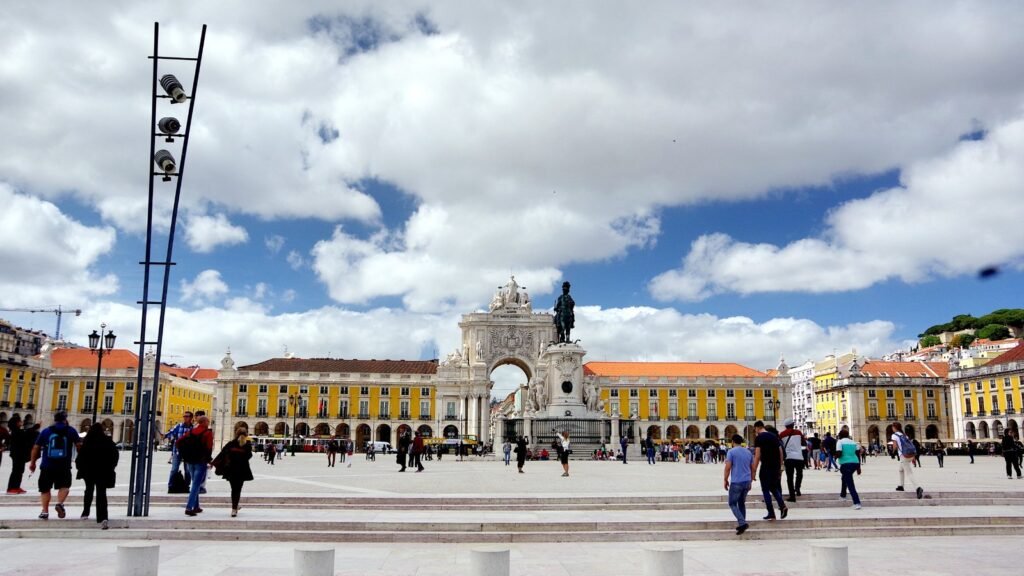
After checking into your hotel, start with central Lisbon around Baixa and Praça do Comércio. This area gives you an easy introduction to the city and puts you close to many of Lisbon’s historic streets and viewpoints.
Walk through Rua Augusta, explore the streets around Rossio and Chiado, and continue toward the Tagus River.
If you still have energy, make your way toward Alfama in the late afternoon or evening.
Lisbon’s historic neighborhoods are hilly, so avoid trying to cover too much immediately after a long flight.
Day 2: Belém, Alfama and Classic Lisbon
Use your second day for several of Lisbon’s best-known areas.
Start in Belém, where major sights include Jerónimos Monastery, Belém Tower and the riverfront.
Later, return toward central Lisbon and spend more time in Alfama, one of the city’s oldest neighborhoods.
A practical sightseeing day might combine Belém in the morning with Alfama and central Lisbon later in the day.
Portugal’s official tourism site highlights Baixa, Praça do Comércio, Alfama and Belém among Lisbon’s major areas to explore.
Getting Around Lisbon
For most first-time visitors, walking and public transportation work well together.
Lisbon Metro accepts the navegante occasional card, and contactless bank cards can also be used directly at Metro gates for individual journeys. The occasional card currently costs €0.50 and can be loaded with tickets or pay-as-you-go credit.
Do not underestimate Lisbon’s hills. A route that looks short on a map can involve a steep climb.
Use trams, Metro, buses or funiculars strategically rather than trying to walk every section of the city.
Day 3: Sintra Day Trip
Use your third day for Sintra.
Sintra is part of Lisbon’s urban rail network and is one of the most popular excursions from the capital. CP’s Lisbon network includes the Sintra line, making it practical to visit without renting a car.
The main challenge is not getting to Sintra—it is deciding how much to see once you arrive.
For a first visit, prioritize Pena Palace and then add either the historic center, Quinta da Regaleira, the Moorish Castle or another site depending on your interests and available time.
Trying to visit every major palace in one day usually creates a rushed experience.
Visiting Pena Palace Without Missing Your Time Slot
Pena Palace requires advance planning.
When purchasing a Palace ticket, you choose a specific date and time for entry to the interior of the palace. Parques de Sintra currently states that there is no late-arrival tolerance. If you miss your scheduled palace time, you may not be admitted and the ticket is not refunded.
Another important detail: the time printed on your ticket is for entry to the Palace interior, not the entrance to Pena Park.
Parques de Sintra advises allowing roughly 30 minutes to travel from the park entrance to the palace entrance.
Build the rest of your Sintra day around that reservation rather than treating the palace as a flexible stop.
How Much Can You See in Sintra in One Day?
Sintra has enough attractions to justify more than one day, but a day trip works well if you are selective.
Portugal’s official tourism site itself notes that one day is not enough to see everything in Sintra.
A comfortable first visit might include Pena Palace, time in Sintra’s historic center, lunch or pastries, and one additional major attraction.
That is usually more enjoyable than racing through four or five monuments.
Day 4: Lisbon to Porto by Train
Check out of your Lisbon hotel and travel north to Porto.
Portugal’s national rail operator, CP – Comboios de Portugal, runs both Alfa Pendular and Intercidades services between Lisbon and Porto. Alfa Pendular is CP’s premium high-speed service and connects the two cities as part of its national network.
For most travelers, the journey takes roughly three hours depending on the train and station combination.
Book directly through CP when practical. CP specifically warns that some third-party sites are not official partners and may charge higher prices.
After arriving in Porto, check into your hotel and keep the rest of the afternoon relaxed.
First Afternoon in Porto
Spend your first Porto afternoon walking through the historic center.
A good introductory route includes Avenida dos Aliados, São Bento Station, Porto Cathedral and the streets descending toward the Douro River.
End the day around Ribeira, where colorful buildings line the riverfront opposite Vila Nova de Gaia.
Porto’s historic center is compact enough to explore largely on foot, but like Lisbon, it includes steep streets and elevation changes.
Day 5: Historic Porto and Ribeira
Use your first full Porto day for the historic center.
Start around São Bento Station and continue toward Porto Cathedral.
Walk down through the older streets toward the Ribeira district and the Douro River.
Portugal’s official tourism site places Avenida dos Aliados, Porto Cathedral and the historic center among the city’s major sights.
Later, cross the Dom Luís I Bridge toward Vila Nova de Gaia.
The bridge itself is one of the best places to appreciate the relationship between Porto, Gaia and the Douro.
Afternoon in Vila Nova de Gaia
Vila Nova de Gaia sits across the Douro from Porto and is historically associated with the cellars where Port wine was stored and aged.
Even if you are not particularly interested in wine, Gaia is worth visiting for the riverfront views back toward Porto.
Walk along the waterfront, explore the area around the Port lodges, and take your time rather than treating Gaia as a quick photo stop.
In the evening, return across the river for dinner in Porto or stay on the Gaia side.
Day 6: Porto at a Slower Pace
Use your final full day in Porto more flexibly.
You might explore more of the historic center, spend time around Bolhão Market and Rua de Santa Catarina, visit a museum, or head toward the Atlantic coast around Foz do Douro.
This is also a good day for a slower lunch and unscheduled wandering.
One of the advantages of a seven-day itinerary is that you do not need to turn every hour into a timed attraction.
Leave room for places you discover after arriving.
Day 7: Depart Porto
Your final day depends on your departure time.
If you are flying home from Porto, finishing the itinerary here avoids unnecessary backtracking to Lisbon.
Whenever possible, consider an open-jaw flight: arrive in Lisbon and depart from Porto.
If your return flight leaves from Lisbon instead, allow enough time for the train journey south and the transfer to the airport.
I would avoid scheduling a major attraction on departure morning unless your flight is late in the day.
Where to Stay in Lisbon
For a first visit, choose a location that makes sightseeing and transportation easy.
Baixa and Chiado are convenient for central sightseeing and restaurants.
Alfama offers historic atmosphere but can involve steep streets and more difficult luggage transfers.
Avenida da Liberdade provides a more spacious, central location with convenient transportation.
The best neighborhood is not necessarily the most picturesque one. Consider how often you will be moving luggage and how close you want to be to Metro or rail connections.
Where to Stay in Porto
For first-time visitors, the historic center is usually the most convenient area.
Ribeira puts you close to the river and many major sights, although it can be busy.
Areas around Aliados and Bolhão offer good access to restaurants, shops and transportation.
Staying slightly uphill from Ribeira can make hotel access easier while keeping most major attractions within walking distance.
Do You Need a Rental Car for This Portugal Itinerary?
No.
For Lisbon, Sintra and Porto, a rental car is generally unnecessary.
Lisbon and Porto are best explored largely on foot and by public transportation, Sintra is connected to Lisbon by urban rail, and Lisbon-to-Porto travel is straightforward by train.
A car becomes more useful if you extend the trip into rural areas, smaller towns, the Douro Valley or regions where public transportation is less convenient.
For this seven-day route, avoiding a rental car also eliminates parking and city-driving concerns.
Should You Visit Lisbon or Porto First?
If you’re deciding how to divide your time between the two cities, see our Lisbon vs Porto comparison.
For most first-time visitors flying into Lisbon, the natural order is:
Lisbon → Sintra → Porto
This keeps the itinerary geographically simple and avoids backtracking.
If your international flight arrives in Porto instead, reversing the route works just as well.
There is no major sightseeing advantage to starting in one city over the other.
Your flight schedule should usually determine the direction.
Is 7 Days Enough for Portugal?
Seven days is enough for an excellent first introduction to Lisbon, Sintra and Porto.
It is not enough to see all of Portugal.
The mistake would be trying to add the Algarve, Évora, Coimbra, the Douro Valley and several smaller towns to the same week.
A better first trip focuses on fewer places and gives you enough time to actually experience them.
If you have additional days, consider adding time to Lisbon or Porto or adding one carefully chosen destination rather than repeatedly changing hotels.
Best Time for This 7 Day Portugal Itinerary
Portugal can be visited throughout the year.
Spring and autumn are particularly attractive for city sightseeing because temperatures are often comfortable.
Summer brings longer days but also more visitors and potentially higher accommodation prices.
Winter can be quieter and less expensive, although you should expect shorter days and a greater chance of rain.
Sintra can feel noticeably cooler and more changeable than central Lisbon, so bring an extra layer even when Lisbon itself feels warm.
Portugal Train Travel Tips
For Lisbon to Porto, reserve your long-distance train once your travel date is firm.
CP’s Alfa Pendular and Intercidades services require reserved seating on long-distance journeys, and the CP app allows users to search schedules and purchase eligible tickets in advance.
Check the exact departure and arrival station before paying.
In Lisbon, major long-distance trains may use Oriente or Santa Apolónia depending on the service. In Porto, long-distance trains commonly serve Campanhã, with local connections available toward São Bento and other parts of the city.
Always verify the specific train you booked rather than relying on a generic city name.
Final Thoughts
A first trip to Portugal does not need to involve crossing the entire country.
This 7 day Portugal itinerary gives you three distinct experiences: Lisbon’s historic neighborhoods and riverfront, Sintra’s palaces and mountain landscape, and Porto’s compact historic center along the Douro.
The route is easy to follow, does not require a rental car and minimizes unnecessary hotel changes.
Reserve Pena Palace carefully, book your Lisbon-to-Porto train once your plans are firm, and leave some unscheduled time in both cities.
That balance usually creates a better first trip than trying to see every famous destination in Portugal in one week.