
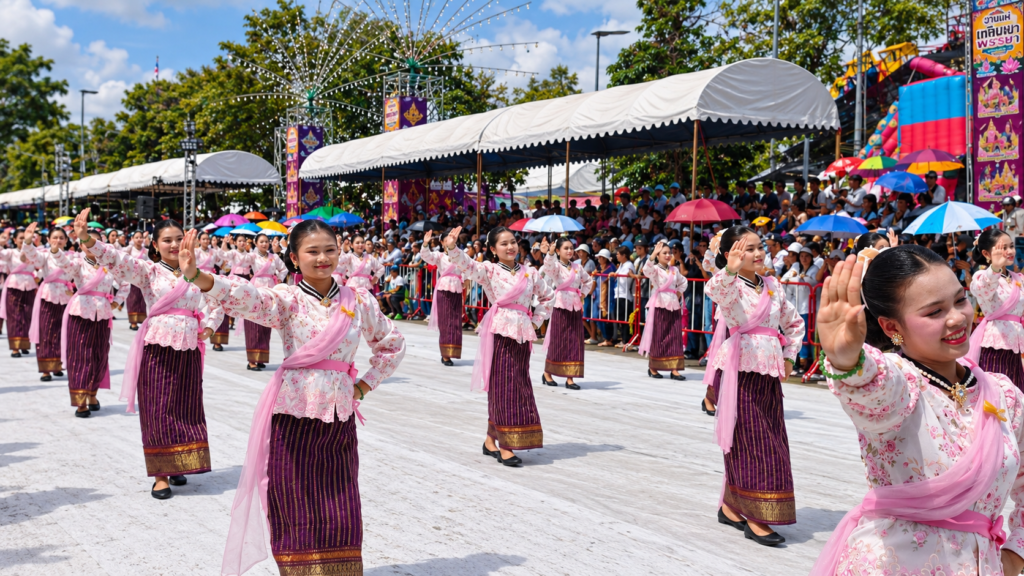
Thailand culture and local customs become much easier to understand once you look beyond temples, beaches and familiar images of Bangkok. Everyday life is shaped by Buddhism, family relationships, regional identities, social courtesy, food, festivals and traditions that continue to evolve alongside modern Thai life.
Travelers often notice that interactions can feel polite and relatively restrained, particularly in situations where confrontation would serve little purpose. At the same time, Thailand is culturally diverse. Life in Bangkok can feel very different from a northern village, an Isan town or a Muslim community in the south.
You do not need to master a complicated set of rules before arriving. Most visitors will do well by observing the people around them, behaving respectfully in religious settings and remembering that customs may change according to place, age, occasion and community.
This guide explains the traditions and everyday etiquette travelers are most likely to encounter, while avoiding the idea that every Thai person behaves or thinks in exactly the same way.
Thailand Culture and Local Customs: Understanding the Basics
Courtesy, respect and awareness of social context are useful principles when traveling in Thailand.
Age and social relationships can influence how people greet one another and communicate, but visitors are not expected to understand every level of Thai social etiquette.
A calm manner, friendly greeting and willingness to observe local behavior are usually more valuable than trying to perform traditions perfectly.
It is also important not to reduce Thai culture to a collection of rules. Bangkok is a huge international city, while rural and regional communities maintain their own traditions. Younger and older generations may approach customs differently, and everyday behavior varies considerably between individuals.
The Wai and Everyday Greetings
The wai is one of Thailand’s best-known gestures of greeting and respect. It is made by bringing the palms together and slightly bowing the head.
Thai government guidance describes the wai as a greeting that may also communicate thanks, apology or respect depending on the situation.
Travelers do not need to initiate a wai every time they meet someone. If someone offers you one, returning it politely is appropriate in many situations.
The common greeting sawasdee can accompany the gesture. Thai speech also commonly uses polite particles at the end of sentences, although visitors should not worry about mastering these immediately.
A Few Useful Thai Expressions
- Sawasdee — Hello
- Khob khun — Thank you
- Chai — Yes
- Mai — No / not, depending on context
Perfect pronunciation is less important than approaching the interaction politely.
Temples and Buddhist Traditions
Buddhism has had a profound influence on Thai art, architecture, festivals and everyday cultural life.
Temples, known as wat, are both cultural landmarks and active religious spaces. Visitors should remember that people may be praying, making merit, meditating or participating in religious ceremonies while tourists are sightseeing nearby.
Dress Respectfully
Thai government guidance recommends modest clothing at temples. Exact requirements vary by site, but covering shoulders and wearing trousers or skirts around knee length or longer is a sensible approach.
Major temples may enforce dress standards more strictly than smaller local sites.
Remove Shoes When Required
Shoes are generally removed before entering certain temple buildings. Look for shoe racks, signs or what local visitors are doing.
The same custom may apply in private homes and some small businesses or traditional accommodations.
Feet and Sacred Images
When sitting inside a temple, avoid pointing the soles of your feet toward Buddha images or monks.
Thai government temple guidance also advises visitors to behave quietly, silence phones and follow posted photography restrictions.
You can review the government’s Thai temple etiquette guidance before visiting major religious sites.
The Head, Feet and Personal Space
Some Thai etiquette is connected with traditional ideas about the symbolic position of the head and feet.
Avoid casually touching another person’s head, including children’s heads, unless you know the person well and understand that it is acceptable in that particular relationship.
Similarly, avoid using your feet to point at people or objects, moving things with your feet or resting your feet on tables and chairs.
These customs are especially important around sacred objects and religious spaces.
Travelers sometimes become overly anxious about accidentally breaking etiquette. A small unintentional mistake is very different from deliberately disrespectful behavior. Pay attention, correct yourself if necessary and continue politely.
Shoes, Homes and Everyday Courtesy
Removing shoes is common before entering Thai homes.
You may also encounter the custom at temples, guesthouses, massage establishments and certain small businesses.
If you are unsure, look near the entrance. A row of shoes is usually the clearest indication that yours should come off as well.
When invited into someone’s home, follow the host’s example rather than assuming the customs will be identical everywhere.
Giving and Receiving
When handing someone money, a document or another object, doing so neatly and respectfully is preferable to tossing or sliding it casually.
Small gestures of courtesy matter more than attempting to memorize an elaborate ritual for every interaction.
Songkran and Major Festivals
Thailand’s festivals provide some of the clearest examples of how religious traditions, family relationships and community life overlap.
Songkran
Songkran is the traditional Thai New Year festival and takes place in mid-April.
International visitors often know Songkran primarily for large public water fights, but the tradition is considerably broader.
UNESCO describes Songkran as a time for family reunions, respect for older adults and ancestors, Buddhist merit-making and symbolic cleansing with water.
Traditional activities can include visiting temples, giving alms, bathing Buddha images, pouring water respectfully and sharing food with family and community members.
UNESCO inscribed Songkran in Thailand on the Representative List of the Intangible Cultural Heritage of Humanity in 2023.
Regional Festivals
Festival traditions vary widely between provinces and communities.
When attending a local celebration, remember that some activities may have religious or community significance beyond what is immediately obvious to visitors.
Observe first, ask before entering restricted areas and avoid blocking ceremonies simply to get a photograph.
Traditional Arts and Performance
Thailand’s performing arts demonstrate how cultural traditions continue to be taught and adapted rather than existing only as museum pieces.
Khon Masked Dance Drama
Khon is a masked dance-drama tradition that combines dance, music, literature, costumes, ritual and craftsmanship.
Performances draw on stories connected with the Thai version of the Ramayana tradition and require highly trained dancers, musicians and craftspeople.
UNESCO inscribed Khon masked dance drama on its Representative List in 2018.
Nora in Southern Thailand
Southern Thailand has its own distinctive performing traditions.
Nora combines dance theatre, improvisational singing, regional music and elaborate costumes. UNESCO describes it as a community-based tradition with deep cultural and social significance in southern Thailand.
The tradition was added to UNESCO’s Representative List in 2021.
Regional Identity Matters
Thailand should not be treated as culturally uniform.
Northern Thailand
Chiang Mai, Chiang Rai and surrounding northern provinces have traditions connected with the historical Lanna region.
Temple architecture, food, festivals, handicrafts and regional languages all contribute to a cultural atmosphere that can feel noticeably different from Bangkok.
Isan
Northeastern Thailand, commonly known as Isan, has strong regional traditions influenced by its own history, languages, music and close cultural connections with neighbouring Laos.
Food, festivals and music are particularly important expressions of regional identity.
Southern Thailand
Southern Thailand contains Buddhist and Muslim communities as well as distinctive regional cuisines, dialects and cultural traditions.
Travelers moving between the Andaman coast, Gulf provinces and deep southern areas should expect meaningful cultural differences rather than assuming the entire peninsula shares one identity.
Markets, Food and Social Life
Markets are among the best places to observe everyday Thai life.
Morning markets serve residents buying produce and prepared meals, while night markets may combine dining, shopping and social activity.
Some famous markets are heavily oriented toward tourism, but even these can reveal ingredients, regional foods and ways of eating that travelers may not encounter in hotel restaurants.
Be considerate when photographing vendors. A market stall is someone’s workplace, not simply a colourful backdrop.
If you are interested in regional dishes, street food and market culture, see our What to Eat in Thailand: A Regional Food Guide for Travelers.
Traditional Thai Massage and Wellness Culture
Traditional Thai massage, known as Nuad Thai, is more than a service developed for modern tourism.
UNESCO recognizes Nuad Thai as part of the art, science and culture of traditional Thai healthcare and inscribed it on the Representative List of the Intangible Cultural Heritage of Humanity in 2019.
Travelers will encounter massage businesses everywhere from neighbourhood shops to hotels and spas, but quality, training and style vary.
A traditional Thai massage can involve assisted stretches and substantial pressure. Communicate clearly if you are uncomfortable and choose establishments appropriate to the type of treatment you want.
You can learn more through UNESCO’s Nuad Thai heritage profile.
Photography and Respectful Travel
Thailand is highly photogenic, but cultural sensitivity still matters.
At temples, follow posted photography rules and do not photograph people who are praying, meditating or taking part in religious activities without permission.
Thai government temple guidance specifically advises visitors to avoid photographing worshippers engaged in religious activities and to respect areas where photography is prohibited.
The same principle applies in markets, villages and everyday street life. A person does not become public property simply because they happen to be standing somewhere interesting.
Drones may also be subject to legal, safety and local-site restrictions, so do not assume that an attractive temple or beach is automatically an acceptable flying location.
Practical Cultural Etiquette for Travelers
- Return a wai politely when it is appropriate rather than worrying about performing it perfectly.
- Dress modestly when visiting active temples and religious sites.
- Remove shoes when signs, shoe racks or local custom indicate that you should.
- Avoid touching people’s heads casually.
- Do not point your feet toward people, Buddha images or sacred objects.
- Keep your voice and phone volume low inside temples.
- Ask before taking close photographs of individuals.
- Remember that customs vary between regions, generations and communities.
- Approach festivals as living community traditions, not simply tourist entertainment.
- When uncertain, observe what local people are doing before acting.
Experience Thai Culture Beyond the Major Attractions
Thailand’s best-known attractions provide only one part of its cultural story.
Visit a morning market before sightseeing begins. Spend time in a neighbourhood temple rather than only the most famous Bangkok complexes. Listen to regional music, try local food and notice how public life changes between Bangkok, Chiang Mai, Isan and the south.
If you attend Songkran or another major festival, look beyond the spectacle and learn why the tradition matters to the community celebrating it.
Understanding Thailand culture and local customs is ultimately less about memorizing a checklist and more about traveling attentively. Respect sacred spaces, observe local behavior, ask when you are unsure and remember that modern Thailand contains many different cultural experiences within one country.
For broader trip planning, see our Thailand Travel Guide: What to Know Before You Go.
You can also explore more destinations through our Culture travel guides.