
For first-time visitors planning eastern Canada, Toronto vs Montreal is one of the most useful comparisons to make.
Both cities deserve a place on a Canada itinerary, but they offer noticeably different experiences.
Toronto feels larger, newer and more spread out, with a dramatic skyline, diverse neighbourhoods and easy access to Niagara Falls. Montreal feels more compact and atmospheric, with historic streets, strong neighbourhood culture, Mount Royal and a distinctly French-Canadian character.
If you have enough time, the best answer is usually to visit both.
The more important question is which city you should visit first and how many days you should spend in each.
Toronto vs Montreal at a Glance
Here is the simplest comparison for first-time visitors.
Toronto
- Larger and more spread out
- Modern skyline and waterfront
- Strong multicultural food scene
- Excellent museums and major attractions
- Easy base for Niagara Falls
- Toronto Islands provide a quick escape from downtown
- Usually needs three or four sightseeing days
Montreal
- More compact central sightseeing area
- Historic architecture in Old Montreal
- Strong French-Canadian identity
- Excellent neighbourhood exploration
- Mount Royal provides nature within the city
- Particularly strong café and restaurant culture
- Usually works well with three full days
Neither city is a replacement for the other.
They complement each other extremely well.
Should You Visit Toronto or Montreal First?
For most first-time travelers arriving from outside Canada, I recommend:
Toronto → Montreal
This creates a straightforward eastbound route.
You can begin in Toronto, take a Niagara Falls day trip from Toronto, return to the city, and then travel east to Montreal by VIA Rail.
If possible, fly home directly from Montreal.
That eliminates the need to backtrack to Toronto at the end of the trip.
However, there is nothing wrong with reversing the route if flights are cheaper or more convenient.
The best order depends primarily on airfare and your broader itinerary.
How Many Days Do You Need in Toronto?
For a first visit, three full days in Toronto is a good minimum.
Four days is even better if you want time for museums, neighbourhoods and the Toronto Islands without rushing.
Toronto covers a large geographic area, and its attractions are not concentrated in a single historic district.
A typical first visit might include:
- CN Tower
- waterfront
- St. Lawrence Market
- Distillery District
- Toronto Islands
- Kensington Market
- Chinatown
- Royal Ontario Museum
- Art Gallery of Ontario
- Queen Street West
Trying to cover all of these in two days would involve considerable movement around the city.
What Can You See With 2 Days in Toronto?
Two days can provide a solid introduction if your schedule is tight.
Day 1
Focus on central Toronto:
- CN Tower
- Harbourfront
- Union Station area
- St. Lawrence Market
- downtown
Day 2
Choose between:
- Toronto Islands
- museums
- Kensington Market and Chinatown
- Distillery District
- additional neighbourhood exploration
Two days works, but you will need to prioritize.
If Niagara Falls is also part of your trip, treat that as a separate day rather than trying to combine it with Toronto sightseeing.
What Can You See With 3 Days in Toronto?
Three days allows the itinerary to breathe.
A practical structure is:
Day 1: Downtown, CN Tower and waterfront
Day 2: Toronto Islands and neighbourhoods
Day 3: Museums, markets and additional neighbourhoods
Toronto’s official tourism site describes the Toronto Islands as a chain of 15 islands just offshore from downtown, connected by trails and reached by ferry.
They are particularly useful because they provide a completely different experience from downtown Toronto while still being extremely close to the city center.
How Many Days Do You Need in Montreal?
For most first-time visitors, three full days in Montreal works very well.
The city is more compact than Toronto for the type of sightseeing most visitors want to do.
Three days gives you time for:
- Old Montreal
- Old Port
- Mount Royal
- downtown
- Plateau-Mont-Royal
- Mile End
- markets
- museums
- restaurants and cafés
Unlike Toronto, Montreal’s classic visitor experience is easier to connect on foot and by Metro.
What Can You See With 2 Days in Montreal?
Two days can cover the major highlights.
Day 1
Explore:
- Old Montreal
- Rue Saint-Paul
- Place d’Armes
- Notre-Dame Basilica area
- Old Port
Tourisme Montréal continues to identify Old Montreal and the Old Port as two of the city’s essential visitor areas.
Day 2
Visit:
- Mount Royal
- downtown
- Plateau-Mont-Royal or Mile End
This gives you a strong introduction, although a third day makes it much easier to explore neighbourhoods properly.
Is 3 Days in Montreal Enough?
Yes.
Three days gives most first-time visitors a good balance between major sights and neighbourhood exploration.
You can spend one day in Old Montreal, one around Mount Royal and downtown, and one exploring neighbourhoods or museums.
Mount Royal Park itself covers approximately 200 hectares and sits directly within the city, making it one of Montreal’s defining features.
This combination of urban neighbourhoods and easily accessible green space is one of Montreal’s strongest advantages.
Which City Is Easier to Walk?
Montreal generally wins this comparison.
Toronto is certainly walkable within individual neighbourhoods, but the city is large and many major areas are separated by meaningful distances.
You will probably use the TTC regularly.
Montreal’s central visitor areas feel more compact.
Old Montreal, downtown and several nearby districts can be connected more easily, although the Metro remains extremely useful.
Both cities reward walking.
Montreal simply requires less transportation between many of the areas first-time visitors are most likely to explore.
Toronto vs Montreal for Public Transportation
Both cities have extensive public transportation.
Toronto uses:
- subway
- streetcars
- buses
Montreal uses:
- Metro
- buses
Toronto’s streetcars are particularly useful through downtown neighbourhoods.
Montreal’s Metro is straightforward and covers many areas visitors are likely to use.
For a tourist staying centrally, I would give Montreal a slight advantage for simplicity.
Toronto’s larger geographic footprint means transportation planning becomes more important.
Which City Has Better Architecture?
If historic architecture is important to you, Montreal has the advantage.
Old Montreal contains cobblestone streets, historic commercial buildings, churches and public squares that create a distinctly older atmosphere.
Toronto has historic areas such as Old Town and the Distillery District, but much of the downtown skyline is modern.
The contrast is part of the reason the cities work so well together on the same trip.
Toronto gives you the modern metropolis.
Montreal gives you considerably more old-world atmosphere.
Toronto vs Montreal for Skyline Views
Toronto wins this category.
The CN Tower dominates the skyline, and the dense cluster of downtown buildings beside Lake Ontario gives Toronto one of Canada’s most recognizable city views.
One of the best perspectives is actually from the Toronto Islands.
The ferry and island waterfront provide wide views back toward the CN Tower and downtown skyline.
Montreal’s skyline is attractive but less dramatic.
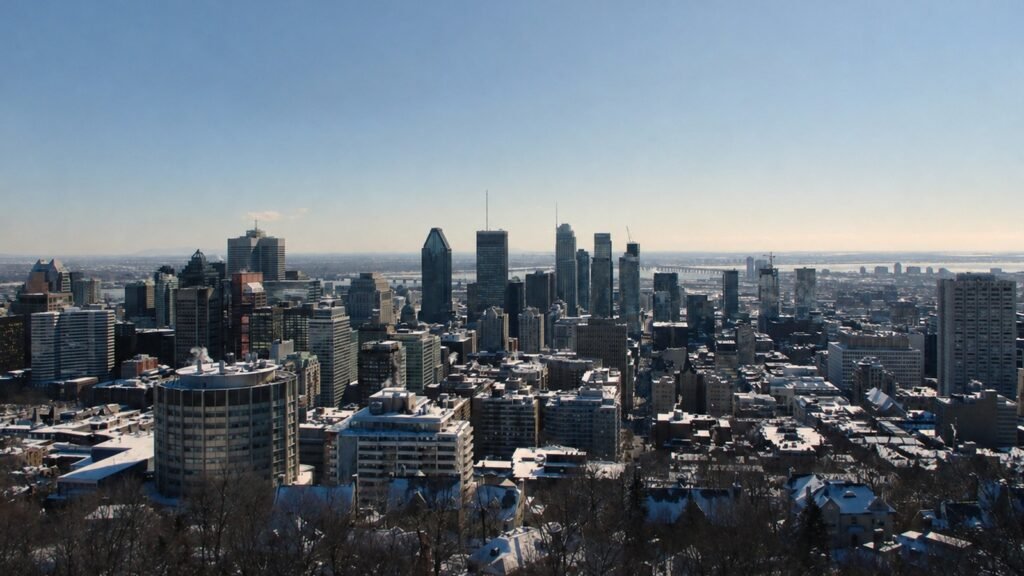
Its strongest city views come from Mount Royal, particularly around the Kondiaronk lookout.
Toronto vs Montreal for Neighbourhoods
This comparison is much closer.
Toronto has an enormous variety of neighbourhoods.
Destination Toronto organizes the city into areas ranging from the City Centre and Waterfront to Westside, Midtown, Scarborough, Eastside and others.
For first-time visitors, areas such as Kensington Market, Chinatown, Yorkville, Queen West and the Distillery District offer very different experiences.
Montreal’s neighbourhood culture is equally strong.
Tourisme Montréal highlights areas including:
- Plateau-Mont-Royal
- Mile End
- Little Italy
- Old Montreal
- Downtown
- Mount Royal
- Outremont
- The Village
The central difference is scale.
Toronto has more geographic spread.
Montreal makes it easier to move between several distinctive neighbourhoods during one day.
Toronto vs Montreal for Food
Both cities are excellent food destinations, but for different reasons.
Toronto’s strength is extraordinary multicultural variety.
You can find excellent food representing communities from across Asia, Europe, the Middle East, the Caribbean, Africa and Latin America.
Montreal combines international restaurants with a particularly strong local culinary identity.
Visitors often associate the city with:
- Montreal-style bagels
- smoked meat
- poutine
- bakeries
- cafés
- Quebec cuisine
I would not choose one city over the other solely for food.
Instead, treat them as complementary experiences.
Toronto vs Montreal for Museums
Toronto has an exceptionally strong museum lineup.
Major options include:
- Royal Ontario Museum
- Art Gallery of Ontario
- Aga Khan Museum
- Hockey Hall of Fame
Montreal also has excellent museums, including:
- Montreal Museum of Fine Arts
- Pointe-à-Callière
- Montreal Science Centre
- contemporary-art institutions
If museums are a major priority, both cities can easily fill additional days.
Toronto probably has the edge in sheer variety for a first visit.
Toronto vs Montreal for Nightlife
Both cities have active nightlife.
Toronto offers enormous variety across neighbourhoods, entertainment districts, restaurants, bars and live music venues.
Montreal has a reputation for a lively evening culture concentrated in areas that are relatively easy to navigate.
For travelers who want restaurants, bars and nightlife within a compact central area, Montreal may feel more convenient.
For sheer variety, Toronto has the advantage.
Which City Feels More European?
Montreal.
Old Montreal’s architecture, French language, cafés, narrow streets and public squares create an atmosphere noticeably different from most large North American cities.
That does not mean Montreal feels like a European city in every respect.
It is distinctly Canadian and North American.
But the French influence and older built environment give it a character that Toronto does not try to replicate.
Do You Need to Speak French in Montreal?
No.
English-speaking visitors can travel comfortably through the major tourism areas of Montreal.
French is the official language of Quebec and is what you will see prominently on signs, menus and public information.
Using a few basic French phrases is courteous, but you do not need to be fluent to visit.
For many travelers, hearing and seeing French throughout the city is part of what makes Montreal feel so different from Toronto.
Which City Is Better for Families?
Both work well.
Toronto may have the edge for families interested in:
- CN Tower
- Toronto Islands
- major museums
- aquarium
- major sports attractions
Montreal provides:
- Old Port activities
- museums
- parks
- Mount Royal
- walkable central neighbourhoods
The better choice depends on the ages and interests of the children.
Which City Is Better Without a Car?
Both.
I would not rent a car simply to visit Toronto and Montreal.
Public transportation is extensive in both cities, and parking can be inconvenient and expensive in central areas.
The trip between them is also straightforward by train.
VIA Rail currently lists Toronto to Montreal at an average travel time of approximately 5 hours 13 minutes over 538 kilometres.
That makes a Toronto → Montreal itinerary particularly easy to organize without driving.
Is the Train Better Than Flying Between Toronto and Montreal?
For many travelers, yes.
A flight is faster in the air, but flying also requires:
- traveling to the airport
- arriving early
- security
- waiting
- collecting luggage
- traveling from the destination airport
VIA Rail connects central Toronto with central Montreal.
That city-center-to-city-center convenience is why the train works so well for this itinerary.
Always compare the actual schedules and fares for your dates, but the train is often the more comfortable choice for tourists already staying downtown.
Toronto vs Montreal for Day Trips
Toronto has one enormous advantage:
Niagara Falls.
A Niagara Falls day trip from Toronto adds one of Canada’s most famous natural landmarks without requiring another hotel.
Toronto can also serve as a base for other southern Ontario destinations.
Montreal has excellent possibilities as well.
Depending on the length of your trip, you could consider destinations such as:
- Quebec City
- Eastern Townships
- smaller communities around Quebec
However, Quebec City is significant enough that I would generally prefer giving it more than a rushed excursion if your schedule permits.
Which City Is More Expensive?
Both are major Canadian cities, and hotel prices can fluctuate substantially by season, events and location.
Toronto frequently has expensive central accommodation.
Montreal can also become costly during major festivals and peak summer periods.
Rather than assuming one city will always be cheaper, compare hotels for your exact travel dates.
Location matters as much as the city.
A slightly more expensive hotel near useful transit may save considerable time.
Toronto vs Montreal in Summer
Both cities are excellent summer destinations.
Toronto benefits from:
- waterfront activities
- Toronto Islands
- patios
- festivals
- long sightseeing days
Montreal is particularly lively during festival season, with outdoor dining, neighbourhood activity and major cultural events.
Summer is also peak travel season, so accommodation should be booked earlier.
Toronto vs Montreal in Winter
Winter produces a very different experience.
Toronto offers museums, restaurants, indoor attractions and winter city activities.
Montreal embraces winter particularly well, but temperatures can be very cold.
Mount Royal and other outdoor spaces remain active throughout the season.
If you travel in winter, the decision should be based less on which city is “better” and more on whether you are prepared for Canadian winter conditions.
Should You Spend More Time in Toronto or Montreal?
For most first-time visitors, I would give Toronto one extra day if Niagara Falls is included.
A good split is:
Toronto: 3 days
Niagara Falls: 1 day
Montreal: 3 days
That gives you a balanced introduction without rushing either city.
If Niagara Falls is not part of the itinerary, three days in each city works very well.
A Good Toronto and Montreal Itinerary
For travelers following our 10 day Canada itinerary, a practical structure is:
Days 1–3: Toronto
Explore downtown, the waterfront, Toronto Islands and neighbourhoods.
Day 4: Niagara Falls
Take a full-day trip from Toronto.
Day 5: Toronto
Use the day for museums, neighbourhoods or anything weather disrupted earlier.
Day 6: Toronto to Montreal
Travel by VIA Rail.
Keep the first Montreal evening relatively flexible.
Days 7–9: Montreal
Explore Old Montreal, Mount Royal, downtown and neighbourhoods.
Day 10: Departure
Fly home from Montreal if possible.
This creates a simple eastbound route without unnecessary backtracking.
What If You Only Have 5 Days?
With five days, I would not try to do Toronto, Niagara Falls and Montreal equally.
One option is:
Toronto: 2 days
Niagara Falls: 1 day
Montreal: 2 days
It works, but it is busy.
If you prefer slower travel, choose one city plus a day trip instead.
What If You Have 7 Days?
Seven days works much better.
A good split is:
Toronto: 3 days
Niagara Falls: 1 day
Montreal: 3 days
You would still need to account for the Toronto-to-Montreal travel time, but this gives each city meaningful sightseeing time.
What If You Have 10 Days?
Ten days is ideal for the route we are building.
You can spend several days in Toronto, dedicate a full day to Niagara Falls, travel to Montreal without rushing and still have three substantial Montreal sightseeing days.
The biggest advantage is flexibility.
Bad weather does not have to ruin your Toronto Islands day, and you do not need to compress every Montreal neighbourhood into one afternoon.
Toronto vs Montreal: Which City Should You Visit First?
For most first-time visitors, my recommendation is:
Start in Toronto and finish in Montreal.
Toronto makes a strong introduction to modern urban Canada and provides easy access to Niagara Falls.
Then Montreal changes the atmosphere completely with Old Montreal, French culture, Mount Royal and its neighbourhoods.
The sequence feels naturally varied rather than repetitive.
And if you can fly home directly from Montreal, it is also geographically efficient.
Is Toronto or Montreal Better?
There is no meaningful overall winner.
Choose Toronto if you particularly value:
- modern skyline
- major museums
- multicultural neighbourhoods
- Toronto Islands
- Niagara Falls access
- big-city variety
Choose Montreal if you particularly value:
- historic architecture
- walkability
- cafés and neighbourhood life
- French-Canadian culture
- Mount Royal
- compact sightseeing
For a first eastern Canada trip, however, I would not choose between them.
Visit both.
Final Thoughts
The Toronto vs Montreal comparison works best when you stop asking which city is better and instead recognize how different they are.
Toronto is larger, more modern and more geographically spread out. Montreal is more compact, historic and culturally distinct.
Together they create a much stronger introduction to eastern Canada than either city would provide alone.
For most first-time visitors, start in Toronto, include Niagara Falls if time permits, take the train east and finish in Montreal.
That route gives you city skylines, neighbourhoods, waterfront scenery, one of the world’s best-known waterfalls and a distinctly different French-Canadian experience—all without needing a rental car.