
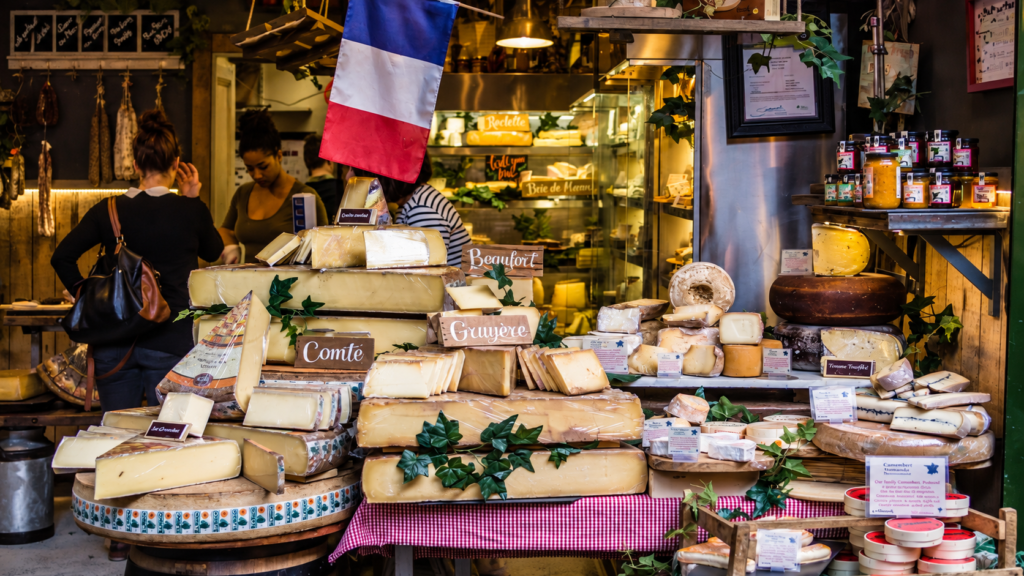
Knowing what to eat in France is less about working through a checklist of famous dishes and more about understanding how strongly French food changes from one region to another. Butter and cream dominate parts of Normandy, buckwheat galettes define Brittany, hearty pork dishes appear in Alsace and Lyon, olive oil and herbs shape Mediterranean cooking, and the southwest has its own traditions built around duck, beans, peppers and local produce.
France is internationally associated with fine dining, but some of the most memorable meals are much simpler: a warm baguette from a neighbourhood bakery, cheese from a market, a plate of charcuterie, a crêpe eaten outdoors or the daily special in a small bistro.
The best approach is to eat according to where you are. Regional specialties are not simply tourist attractions; they reflect local agriculture, climate, history and long-established cooking traditions.
This guide will help you recognize those regional differences and know what to look for as you travel through France.
Think Regionally
There is no single menu that represents all of France.
A dish that feels completely at home in Strasbourg may rarely appear in Nice. Brittany’s crêperies are different from Lyon’s bouchons, and the food culture of Provence bears little resemblance to the butter-rich cooking of Normandy.
French cooking is closely connected with the idea of terroir — the relationship between a food or drink and the place where it is produced. Geography, soil, climate, farming traditions and local knowledge all contribute to regional identity.
France’s official tourism site also emphasizes the importance of regional products, seasonal ingredients, convivial meals and the relationship between food, wine and place. Travelers who want additional background can read about the gastronomic meal of the French.
Learning what to eat in France therefore begins with asking a simple question: What is this particular region known for?
Regional Food Highlights
Paris and Île-de-France
Paris brings together food from every region of France, making it possible to eat Breton crêpes at lunch, Alsatian choucroute at dinner and pastries from one of the country’s best-known pâtisseries in between.
That variety can make it tempting to treat Paris as a summary of all French cuisine, but the capital and surrounding Île-de-France region also have traditions of their own.
Brie de Meaux and Brie de Melun come from the surrounding region, while Paris itself is an excellent place to explore classic bistro dishes, pâtisserie, chocolate, bread and contemporary French cooking.
Look for neighbourhood boulangeries in the morning, markets during the day and small restaurants serving seasonal menus rather than concentrating only on famous dining rooms.
Normandy
Normandy’s cuisine reflects its dairy farms, apple orchards and long coastline.
Butter and cream play major roles in traditional cooking, and the region produces famous cheeses including Camembert, Pont-l’Évêque, Livarot and Neufchâtel.
Apples appear in desserts, cider and Calvados, while coastal areas provide oysters, mussels, scallops and other seafood.
You may encounter dishes prepared with cream, butter, cider or apples in combinations that immediately distinguish Norman cooking from Mediterranean France.
If you enjoy cheese, this is a particularly rewarding region to visit local markets and fromageries rather than relying only on cheese served at restaurants.
Brittany
Brittany is one of the easiest French regions to recognize through food.
Its savoury buckwheat galettes are filled with combinations such as ham, cheese, egg, mushrooms or vegetables. Sweet wheat-flour crêpes may follow with butter, sugar, caramel, chocolate or fruit.
Salted butter is central to many Breton specialties, including kouign-amann, the intensely buttery layered pastry associated with the region.
Other sweets include far breton, often made with prunes, and Breton butter biscuits.
The coastline contributes oysters, mussels, lobster and fish. Cancale is particularly associated with oysters, while cider is commonly paired with galettes and crêpes.
A traditional crêperie is one of the simplest ways to experience Breton food without needing a formal restaurant meal.
Loire Valley
The Loire Valley is known not only for castles and vineyards but also for goat cheeses, charcuterie, freshwater fish and regional sweets.
Cheeses to look for include Sainte-Maure de Touraine, Valençay, Selles-sur-Cher and Crottin de Chavignol.
Rillettes de Tours provide a savoury contrast, while the region around the Loire and its tributaries has long incorporated river fish into local cooking.
Tarte Tatin, the upside-down caramelized apple tart, is associated with the Sologne area of the Loire Valley and remains one of France’s best-known desserts.
Pairing local cheese with Loire wines is an easy way to understand how regional food and wine traditions developed together.
Burgundy and Franche-Comté
Burgundy is one of France’s great food-and-wine destinations, with a cuisine that often incorporates the region’s wines directly into cooking.
Boeuf bourguignon is the famous example: beef slowly cooked with red wine, vegetables and aromatics.
You may also encounter oeufs en meurette, eggs served with a red-wine sauce, as well as escargots prepared with garlic and parsley butter.
Gougères — small savoury cheese pastries made from choux dough — are a particularly good snack with a glass of local wine.
Dijon is closely associated with mustard, while neighbouring Franche-Comté contributes cheeses such as Comté and a strong tradition of smoked meats and mountain cooking.
This is a region where ordering locally rather than simply choosing the most familiar French dish usually pays off.
Lyon and Auvergne-Rhône-Alpes
Lyon has one of France’s strongest culinary identities.
Traditional bouchons lyonnais serve hearty regional dishes in an informal setting. Typical foods include quenelles, Lyon sausage, charcuterie, salade lyonnaise and cervelle de canut, a seasoned fresh-cheese preparation despite its unusual name.
Lyon is also known for sweets made with bright pink pralines, particularly praline tart and praline brioche.
Travel farther into the Alpine areas of the region and the cuisine changes again.
Savoie and neighbouring mountain districts are associated with cheese-rich dishes such as raclette, fondue and tartiflette, made with potatoes, onions, bacon and Reblochon cheese.
These substantial dishes make more sense in their mountain setting, particularly during cooler weather, than they do as generic examples of French cuisine.
Alsace
Alsace sits close to Germany, and its food reflects centuries of cultural exchange along the border.
Choucroute garnie combines fermented cabbage with sausages and other meats, while flammekueche — also called tarte flambée — is a thin baked flatbread traditionally topped with cream, onions and bacon.
Other regional dishes include baeckeoffe, a slow-cooked casserole of meat and potatoes, and spaetzle-style noodles.
For something sweet, look for kougelhopf, the distinctive ring-shaped yeast cake.
Alsatian wines are another major part of the experience. Riesling, Gewürztraminer, Pinot Gris and other local wines accompany a cuisine that is noticeably different from southern France.
Provence and the Côte d’Azur
In Provence and along the Mediterranean coast, olive oil, tomatoes, garlic, herbs, vegetables and seafood become more prominent.
Ratatouille combines Mediterranean vegetables, while tapenade turns olives and capers into a savoury spread.
Marseille is associated with bouillabaisse, the famous fish preparation whose traditional versions are considerably more elaborate than an ordinary seafood soup.
In Nice, look beyond the internationally familiar salade niçoise. Local specialties include socca, a thin chickpea-flour pancake, and pissaladière, an onion tart traditionally associated with the region.
Provençal markets are particularly useful for discovering olives, cheeses, herbs, fruit, vegetables and prepared foods without committing every meal to a restaurant.
The flavours here often feel lighter and more Mediterranean than the butter, cream and pork traditions found farther north.
Southwest France and the Basque Country
Southwestern France has a rich collection of culinary traditions rather than one unified cuisine.
Dordogne and surrounding areas are strongly associated with duck, goose, foie gras, confit and walnuts. The Bordeaux area brings wine to the foreground but also offers seafood from the nearby Atlantic coast and Arcachon Bay.
Bordeaux’s best-known sweet is the canelé, a small pastry with a caramelized exterior and soft interior.
Travel south toward the French Basque Country and peppers, cured meats and distinctly Basque preparations become more visible.
Piperade combines peppers, tomatoes and onions, while gâteau basque is a traditional pastry generally filled with pastry cream or cherry preserve.
As elsewhere in France, menus become much easier to understand once you stop expecting the same dishes from one town to the next.
Occitanie
Occitanie stretches from the Mediterranean toward the southwest and mountains, so its food varies considerably within the region.
Cassoulet is one of its best-known dishes. This slow-cooked combination of white beans and meat is particularly associated with towns including Castelnaudary, Carcassonne and Toulouse, although recipes and local loyalties differ.
The Aubrac area is known for aligot, a remarkably elastic mixture of potatoes and cheese.
Roquefort cheese comes from the southern part of the region, while the Mediterranean side contributes oysters, mussels and dishes influenced by olive oil, garlic and herbs.
Around Nîmes you may also encounter brandade, traditionally made with salt cod and olive oil.
Northern France
In Hauts-de-France near the Belgian border, beer, potatoes, cheese and slow-cooked meat play an important role in regional cuisine.
Carbonnade flamande is beef slowly cooked with beer, while moules-frites — mussels with fries — reflect the region’s proximity to Belgium and the North Sea.
Maroilles is the area’s famously aromatic cheese and appears both on its own and in cooked dishes.
In and around Lille you may also see the local version of welsh, a rich dish of melted cheese served over bread and often accompanied by ham and an egg.
This hearty northern cooking is another reminder that French food extends far beyond the dishes most commonly exported internationally.
Corsica
Corsican cuisine reflects the island’s mountains, forests, Mediterranean coast and distinct cultural identity.
Charcuterie is particularly important, with traditional cured pork products appearing frequently on menus and market stalls.
Brocciu, a fresh Corsican cheese made from sheep’s or goat’s milk whey, is used in both savoury and sweet preparations.
Chestnuts have also played an important historical role, and chestnut flour appears in breads, cakes and other regional foods.
For dessert, look for fiadone, a Corsican cheesecake-style preparation traditionally made with brocciu and citrus.
What to Eat in France: Foods You’ll See Across the Country
Regional cooking is essential, but some foods and dining traditions appear throughout France in many different forms.
Bread
Bread remains part of everyday food culture, and visiting a good boulangerie should be considered part of the travel experience rather than merely a way to buy breakfast.
The baguette is the obvious starting point, but bakeries may also offer country loaves, sourdough-style breads, seeded breads and regional specialties.
Freshness matters. Bread bought from a busy bakery in the morning can be a completely different experience from packaged bread purchased simply for convenience.
Cheese
French cheese varies enormously by region, milk type, production method and degree of aging.
Alongside internationally familiar Brie and Camembert, you may encounter Comté, Roquefort, Reblochon, Munster, chèvre, Saint-Nectaire, Cantal and dozens of local cheeses that rarely appear on restaurant menus outside France.
A fromagerie can be less intimidating than it looks. Explain that you would like to try something local and indicate whether you prefer mild, strong, creamy or firm cheese.
Charcuterie
Terrines, pâtés, cured sausages, ham and other preserved meats appear throughout France, although styles vary by region.
A small charcuterie plate can be an easy way to sample several local products, particularly when paired with bread, pickles and a regional wine.
Bistro and Brasserie Classics
Depending on the restaurant, you may encounter dishes such as steak-frites, croque-monsieur, onion soup, roast chicken, omelettes, salads and seasonal daily specials.
These foods are useful when you want something familiar, but they should complement rather than replace regional specialties during a longer trip.
Boulangeries, Pâtisseries and French Sweets
One of the pleasures of travelling in France is learning that a bakery, pastry shop and chocolate shop are not necessarily the same thing.
A boulangerie focuses primarily on bread and often viennoiseries. A pâtisserie specializes in pastries and desserts. A chocolaterie focuses on chocolate, while a confiserie specializes in confectionery.
Croissants and Pain au Chocolat
A properly made croissant should be crisp and flaky outside with a layered, buttery interior.
Try one from a well-regarded neighbourhood bakery rather than assuming every croissant in France is automatically exceptional.
For chocolate, choose a pain au chocolat, a laminated pastry wrapped around chocolate batons.
Classic Pastries
Pâtisserie counters may include éclairs, mille-feuille, fruit tarts, Paris-Brest, Saint-Honoré, macarons and elaborate individual cakes.
Do not feel compelled to search only for the most famous shops. A strong local pâtisserie can provide an excellent experience without the lines associated with internationally known names.
Regional Desserts
Regional sweets are often more interesting than ordering the same pastry everywhere.
- Brittany: kouign-amann and far breton
- Bordeaux: canelé
- Loire Valley: tarte Tatin
- Lyon: pink-praline tart and brioche
- Alsace: kougelhopf and pain d’épices
- Basque Country: gâteau basque
- Corsica: fiadone
Wine, Cheese and the French Table
Wine is deeply connected with many French food regions, but there is no need to become a wine expert before travelling.
An easy approach is to drink locally. Burgundy with Burgundian food, Loire wine with Loire goat cheese, Alsatian wine with Alsatian dishes and Rhône wines around Lyon or Provence can provide useful introductions to regional pairings.
France also produces cider, beer, sparkling wines, spirits and excellent non-alcoholic options. Brittany and Normandy are particularly associated with cider, while beer plays a larger role in Alsace and northern France.
You do not need alcohol to enjoy French dining culture. Coffee, mineral water and simply spending time over a meal are equally part of the café and restaurant experience.
Practical Dining Tips for France
Understand the Different Types of Food Shops and Restaurants
A boulangerie is useful for bread, pastries and often sandwiches. A pâtisserie specializes in desserts. A fromagerie sells cheese, while a charcuterie focuses on prepared and cured meats.
A bistro generally suggests relatively informal dining, while a brasserie traditionally offers a broader menu and longer service hours, although the distinction is not rigid.
A traiteur sells prepared foods to take away and can be extremely useful when you want a good meal without sitting in a restaurant.
Look for the Menu du Jour or Formule
Many restaurants offer a fixed-price lunch or daily menu that may combine a starter and main course, main course and dessert, or all three.
In French, entrée means the starter. The main course is usually listed as the plat or plat principal.
A daily menu can be one of the better ways to eat well without automatically choosing the most expensive items on the à la carte menu.
Meal Times Can Be More Structured
Do not assume every restaurant serves continuously throughout the afternoon.
Outside heavily touristed districts, lunch and dinner service may occur during defined periods, with kitchens closing between them.
Check opening hours if you are planning a late lunch or unusually early dinner, particularly in smaller towns.
Service Is Included
Restaurant prices in France include service. Tipping is therefore optional rather than a required percentage added to the bill.
If service has been particularly good, leaving a small additional amount is perfectly acceptable, but travelers do not need to apply North American tipping percentages automatically.
You Can Ask for Tap Water
You are not required to order bottled water with a restaurant meal.
Ask for une carafe d’eau, s’il vous plaît if you would like tap water. A carafe of ordinary drinking water with a meal is provided without an additional charge.
Markets Are Worth Your Time
Food markets can reveal more about a region than another formal restaurant meal.
Look for local cheeses, breads, vegetables, fruit, charcuterie, prepared foods, olives, seafood and pastries.
Markets are also particularly useful when staying in an apartment or planning a picnic.
Do Not Assume Famous Means Better
France has exceptional Michelin-starred restaurants, but fine dining is only one part of the country’s food culture.
A bakery with a steady local clientele, a family-run crêperie, a crowded Lyon bouchon or a market stall selling regional cheese may be just as memorable.
Pay attention to what local customers are ordering and which specialties appear repeatedly in the region.
Food Is Part of Understanding France
The strongest French food experiences rarely come from trying to eat every internationally famous dish during one trip.
They come from recognizing that Brittany is not Provence, Alsace is not Normandy, and Lyon is not Paris. Each destination has its own ingredients, specialties and dining traditions.
Understanding what to eat in France is therefore less about memorizing a list and more about letting each region tell you what belongs on the table.
Visit markets. Try unfamiliar cheeses. Order the regional dish. Stop at neighbourhood bakeries. Pay attention to seasonal menus, and leave room for the pastry you did not know existed before you arrived.
For more trip-planning information, see our France Travel Guide: What to Know Before You Go.
You can also explore more regional cuisine in our Food travel guides.