
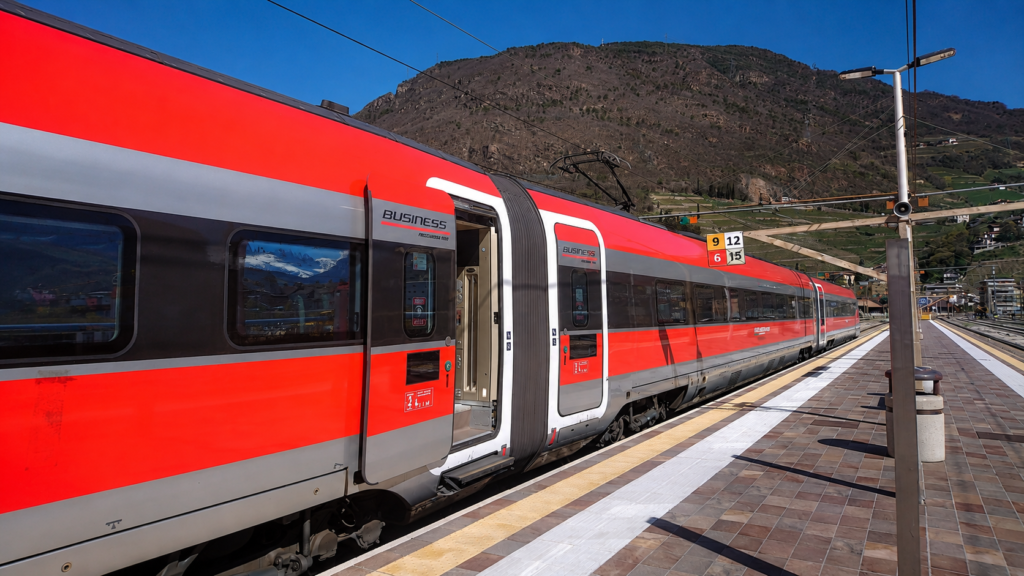
Italy’s rail system is one of the easiest ways to travel between major destinations, but first-time visitors can make simple mistakes that cost time, money or unnecessary stress.
High-speed trains make routes such as Rome to Florence and Florence to Venice remarkably straightforward, while regional trains connect smaller towns and cities throughout the country.
The system becomes much easier once you understand that not every Italian train works the same way. Avoiding these common Italy train mistakes can make your first rail journey much easier.
These are 12 common Italy train mistakes to avoid on your first trip.
1. Assuming Every Italian Train Works the Same Way
One of the biggest mistakes is treating all Italian trains as if they follow the same rules.
Italy has several types of rail service, including:
- Frecciarossa high-speed trains
- Italo high-speed trains
- Intercity trains
- Regional trains
- Local and metropolitan services
High-speed trains generally require a reservation for a specific train and seat.
Regional trains operate differently and are designed primarily for shorter local journeys.
Before buying any ticket, check what type of train you are booking. The rules for changes, seat reservations and ticket validation may depend on the service.
2. Not Comparing Trenitalia and Italo
For many major-city routes, travelers have more than one high-speed operator to choose from.
For a detailed comparison, see our Trenitalia vs Italo guide.
Trenitalia operates Frecciarossa services, while Italo operates a competing private high-speed network.
On routes such as:
- Rome to Florence
- Rome to Naples
- Florence to Venice
- Rome to Milan
both companies may offer useful departures.
Do not automatically book whichever company you recognize first.
Compare:
- departure time
- ticket price
- fare flexibility
- travel class
- arrival station
There is no requirement to use the same company for your entire trip.
You might take Italo from Rome to Florence and Trenitalia from Florence to Venice if those departures work better.
3. Waiting Until the Last Minute to Book High-Speed Trains
High-speed rail tickets use variable pricing.
Cheaper fares can disappear as departure approaches, particularly during weekends, holidays and busy travel periods.
Waiting until the day of travel can leave you with:
- higher prices
- fewer departure choices
- less desirable seating
- limited availability in your preferred class
If your itinerary is already fixed, there is usually an advantage to booking major high-speed journeys in advance.
Regional trains are generally less important to book far ahead because they operate under a different fare structure.
4. Buying the Cheapest Fare Without Reading the Rules
A low ticket price can look attractive until your plans change.
High-speed operators sell different fare types with different rules for:
- changing the departure time
- changing the travel date
- obtaining a refund
- boarding another train
For Trenitalia, a Base fare is generally more flexible than Economy or Super Economy.
For Italo, Flex generally provides more flexibility than Economy or Low Cost.
A €10 saving may not be worthwhile if the ticket becomes difficult or impossible to change.
Before paying, ask yourself whether your travel plans are completely fixed.
If not, compare the fare conditions rather than looking only at the price.
5. Thinking Every Train Ticket Needs to Be Validated
This is one of the most confusing pieces of Italy train advice because the rules have changed over time.
Not every ticket requires manual validation.
For Trenitalia’s current Digital Regional Ticket, the ticket automatically validates at the scheduled departure time of the train you selected.
Other electronic regional ticket types may also already be validated.
High-speed tickets for a specific reserved train do not normally need to be stamped at a station machine.
The important lesson is:
Do not blindly follow old advice telling you to validate every ticket.
Check what type of ticket you actually purchased and follow the instructions attached to that ticket.
6. Forgetting to Validate a Paper Regional Ticket
Although not every ticket requires validation, paper regional tickets still do.
If you purchase a single paper regional ticket from a station ticket office, machine or authorized seller, Trenitalia currently requires it to be validated before departure using a station validation machine.
This is where many tourists get confused.
The rule is not simply:
“Validate your Italian train ticket.”
The better rule is:
Know whether your specific ticket requires validation.
If you have a paper regional ticket, look for the validation machines before boarding.
If you have a digital ticket, read the instructions in the app or confirmation email.
7. Looking Only at the Destination Name Instead of the Train Number
Large Italian stations can have several trains heading in the same general direction.
Your departure board may show a city that is farther along the route than your actual destination.
For example, you might be traveling to Florence on a train whose final destination is Milan.
If you search only for “Florence” on the board, you may become confused.
Instead, compare:
- train number
- scheduled departure time
- operator
- destination
- platform
The train number is often the most reliable way to confirm that you are waiting for the correct service.
8. Going to the Platform Too Early and Assuming It Will Not Change
Italian departure boards use the word binario for platform or track.
The platform may not be posted until relatively close to departure, and operational changes can occur.
Do not panic if you arrive at the station and do not immediately see a platform number.
Watch the electronic departure board and the operator’s app.
Once your platform appears, head toward it promptly rather than assuming the information will remain unchanged.
At large stations such as Roma Termini or Milano Centrale, reaching the platform can take several minutes.
9. Treating an Italian Train Station Like an Airport
There is usually no reason to arrive at a high-speed train station two hours before departure.
Train travel is much more streamlined than flying.
There is normally no airline-style check-in procedure, and you generally go directly toward the platform once it is announced.
At the same time, arriving only a few minutes before departure can be risky in an unfamiliar station.
For a first visit to a major station, allowing roughly 20–30 minutes gives you time to:
- locate the departure board
- find the correct platform
- buy food or water
- deal with an unexpected platform change
- move luggage through the station
The goal is not to arrive extremely early—it is to avoid arriving stressed.
10. Packing More Luggage Than You Can Handle Yourself
Train travel is easy until you are trying to move two enormous suitcases through a crowded station.
Italian rail travel may involve:
- stairs
- escalators
- narrow train aisles
- overhead luggage racks
- luggage areas at the end of a carriage
- quick boarding periods
You generally remain responsible for handling your own luggage.
Pack with the assumption that at some point you may need to lift your suitcase yourself.
This is especially important in smaller stations where elevators may not be conveniently located.
11. Booking the Right City but the Wrong Station
Some Italian cities have multiple railway stations.
This matters particularly in Venice.
Venezia Santa Lucia is located on the Venetian islands at the edge of the Grand Canal.
Venezia Mestre is on the mainland.
If your hotel is in historic Venice, getting off at Mestre because you saw the word “Venezia” can leave you with an additional transfer.
Other cities also have multiple stations, including Rome and Milan.
Before booking, check the exact station closest to your accommodation.
Do not assume every station carrying the city’s name is equally convenient.
12. Scheduling Connections Too Tightly
A journey may look perfect on a booking screen while giving you only a few minutes to change trains.
That can become stressful if:
- your first train is delayed
- the second train leaves from another platform
- you are carrying luggage
- you are unfamiliar with the station
When possible, give yourself a reasonable connection buffer.
This becomes especially important when combining:
- high-speed and regional trains
- different train operators
- train and ferry connections
- train and airport transfers
Saving 15 minutes on paper is rarely worth spending the entire first journey worrying about whether you will make the connection.
Bonus Tip: Use the Official Train Apps
Before your trip, consider installing:
Trenitalia
and
Italo
The apps can make it easier to:
- retrieve tickets
- check departure times
- see delays
- manage eligible ticket changes
- confirm train numbers
- monitor your journey
Save your tickets to your phone before heading to the station.
A screenshot can also be useful as a backup if mobile reception is poor.
Should You Use a Third-Party Train Booking Site?
Third-party booking services can be useful for comparing journeys, particularly when several operators are involved.
However, booking directly with Trenitalia or Italo often makes it easier to manage:
- schedule changes
- refunds
- delays
- ticket modifications
If the direct operator’s website offers the same itinerary and fare, booking directly is usually the simpler choice.
Always confirm which rail company is actually operating the train.
Is Train Travel in Italy Difficult?
No.
Once you understand the basic differences between high-speed and regional trains, Italy’s rail system is relatively straightforward.
For a classic first-time itinerary such as:
high-speed trains allow you to travel city center to city center without airport transfers, baggage check-in or lengthy security procedures.
The biggest challenge is usually not the train system itself.
It is understanding a few rules before your first journey.
Final Thoughts
Traveling through Italy by train can be one of the easiest parts of your trip. Most Italy train mistakes are easy to avoid once you understand the basic ticket, station and booking rules.
Most common problems are preventable:
- know what type of train you booked
- compare Trenitalia and Italo
- understand your fare rules
- check whether your ticket requires validation
- confirm your train number and station
- monitor the departure board
- allow reasonable connection time
- travel with luggage you can manage
A little preparation before your first journey can make the rest of your rail travel feel routine.
Once you understand the system, taking the train between Italian cities becomes far less intimidating—and often one of the most convenient ways to explore the country.