
A 10 day Canada itinerary combining Toronto, Niagara Falls and Montréal gives first-time visitors three very different experiences without trying to cover an enormous country in a single trip.
Toronto provides the big-city introduction, Niagara Falls adds one of Canada’s best-known natural landmarks, and Montréal brings historic streets, French-Canadian culture and a distinctly different atmosphere.
The route is also practical. You can arrive in Toronto, visit Niagara Falls as a day trip, travel from Toronto to Montréal by train and fly home from Montréal without renting a car.
10 Day Canada Itinerary at a Glance
A practical first-time route looks like this:
- Days 1–3: Toronto
- Day 4: Niagara Falls day trip
- Day 5: Toronto
- Day 6: Toronto to Montréal by train
- Days 7–9: Montréal
- Day 10: Departure
This itinerary deliberately avoids trying to add Ottawa, Québec City, Vancouver, Banff or other major Canadian destinations into the same ten days.
Canada is simply too large for that approach to work well.
Day 1: Arrive in Toronto
Keep your first day relatively easy.
If you arrive at Toronto Pearson International Airport and are staying downtown, the UP Express provides a direct rail connection to Union Station.
The current journey takes approximately 28 minutes, making it one of the simplest ways to reach downtown without dealing with road traffic.
After checking into your hotel, spend the afternoon or evening exploring the downtown waterfront.
A relaxed first walk could include:
- Union Station
- Harbourfront
- Nathan Phillips Square
- Yonge Street
- the Entertainment District
Avoid trying to complete a full sightseeing itinerary immediately after a long flight.
Day 2: CN Tower, Waterfront and St. Lawrence Market
Use your first full Toronto day for the central city.
Start around the CN Tower and Toronto waterfront.
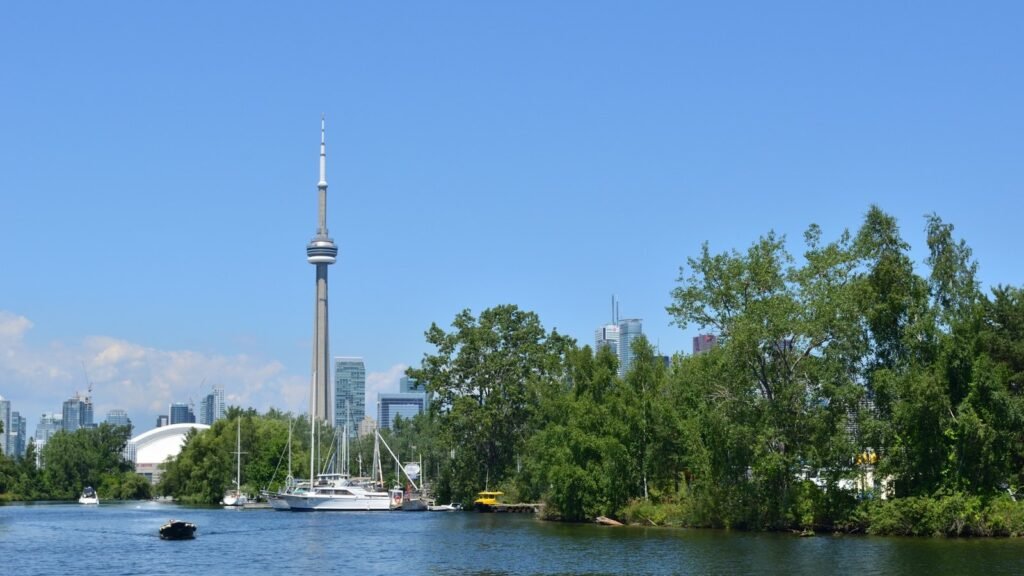
The CN Tower remains Toronto’s most recognizable landmark and rises more than 553 metres above the city. Its main observation areas provide wide views across downtown and Lake Ontario.
Afterward, walk through the surrounding waterfront and downtown area.
Later in the day, continue east toward St. Lawrence Market.
The market sits in Toronto’s historic Old Town and contains more than 120 merchants and food vendors, making it useful both as a sightseeing stop and a place for lunch.
Leave some time simply to walk through the surrounding streets rather than moving immediately to another major attraction.
Day 3: Toronto Islands and Toronto Neighbourhoods
Use your second full sightseeing day to see a different side of Toronto.
Weather permitting, start with the Toronto Islands.
The islands sit just offshore in Lake Ontario and are reached by a short ferry ride from downtown. The archipelago consists of 15 connected islands with trails, waterfront areas and some of the best views back toward Toronto’s skyline.
Do not necessarily spend the entire day there.
After returning downtown, choose one or two Toronto neighbourhoods depending on your interests.
Possible options include:
- Kensington Market
- Chinatown
- Yorkville
- Distillery District
- Queen Street West
Toronto is spread out, so trying to visit several distant neighbourhoods in a single afternoon can create unnecessary transit time.
Day 4: Niagara Falls Day Trip from Toronto
Use Day 4 for Niagara Falls.
You do not need to move hotels for a first visit.
Niagara Falls works well as a day trip from Toronto, especially if your main goal is to see the falls and one or two Niagara Parks attractions.
The Canadian side gives you direct views of Horseshoe Falls and easy access to the Niagara Parks area around Table Rock.
Getting from Toronto to Niagara Falls
GO Transit currently operates Toronto–Niagara service seven days a week.
Depending on the schedule, travelers may have a direct GO Train option. When a direct train is not available, GO also describes a route using the Lakeshore West train to Burlington followed by GO Bus Route 12 to Niagara Falls.
Schedules can change because of construction and track work, so check the current GO trip planner shortly before your travel date rather than relying on an old timetable.
What to See at Niagara Falls
Start around Table Rock Centre, beside Horseshoe Falls.
Spend time simply viewing the falls before immediately heading into an attraction.
A good first visit could include:
- Horseshoe Falls viewpoints
- Niagara Parkway
- Journey Behind the Falls
- Niagara Parks Power Station
- time along the riverfront
Journey Behind the Falls is one of Niagara Parks’ signature experiences, taking visitors through tunnels to viewing areas beside Horseshoe Falls.
Niagara Parks currently allows timed tickets to be reserved online, so booking ahead can make your day easier during busy periods.
Do not overload the day with every attraction in the Niagara region.
For a first visit, the falls themselves should remain the focus.
Day 5: A Slower Final Day in Toronto
Use your final Toronto day more flexibly.
This is useful because weather can affect activities such as the Toronto Islands, and your interests may change after spending several days in the city.
Possible choices include:
- Royal Ontario Museum
- Distillery District
- Kensington Market
- Art Gallery of Ontario
- additional waterfront time
- shopping or neighbourhood exploration
This day also prevents the itinerary from becoming a sequence of tightly scheduled attractions.
If you missed something earlier because of weather or fatigue, move it here.
Day 6: Toronto to Montréal by Train
Check out of your Toronto hotel and travel to Montréal.
For this itinerary, the VIA Rail train is usually the most convenient option because it connects central Toronto with central Montréal without requiring another airport transfer.
VIA Rail currently lists the Toronto–Montréal route at an average travel time of approximately 5 hours 13 minutes, with multiple weekly departures.
Travel times vary by departure, so check the specific train before booking.
The trip is long enough to use most of the middle of the day but short enough that you can still enjoy Montréal after arriving.
If you’re deciding how to divide your time between the two cities, see our Toronto vs Montreal comparison.
First Evening in Montréal
Once you check into your Montréal hotel, keep the evening simple.
Walk through part of downtown or head toward Old Montréal for your first look at the city.
Do not schedule a major timed attraction immediately after the train journey in case of delays.
Day 7: Old Montréal and the Old Port
Spend your first full Montréal day in Old Montréal.
This is one of the best areas for understanding how different Montréal feels from Toronto.
Walk through:
- Rue Saint-Paul
- Place d’Armes
- Place Jacques-Cartier
- the Old Port
- the streets surrounding Notre-Dame Basilica
Tourisme Montréal describes Old Montréal and the Old Port as two of the city’s essential areas, with historic architecture, cobblestone streets, museums and waterfront attractions.
Avoid treating the neighbourhood simply as a route between individual attractions.
Much of the experience comes from walking through the streets.
Day 8: Mount Royal and Central Montréal
Start Day 8 around Mount Royal.
Mount Royal Park sits in the heart of the city and includes walking routes and viewpoints over downtown Montréal.
The Kondiaronk lookout near Mount Royal Chalet provides one of the classic views over the city.
Afterward, continue toward central Montréal.
Depending on your interests, the rest of the day could include:
- McGill University area
- Golden Square Mile
- Montréal Museum of Fine Arts
- downtown Montréal
- Plateau-Mont-Royal
Do not underestimate the walking involved in reaching and exploring Mount Royal.
Comfortable shoes are useful throughout this trip, but particularly here.
Day 9: Montréal Neighbourhoods and Food
Use your final full day to move beyond the most obvious landmarks.
Montréal is particularly rewarding when you spend time in its neighbourhoods rather than concentrating entirely on downtown.
Consider areas such as:
- Plateau-Mont-Royal
- Mile End
- Little Italy
- Jean-Talon Market
- Atwater Market
This is also a good day to leave more time for food.
Montréal has a strong local food identity, and trying a few neighbourhood restaurants, bakeries or markets gives you a different experience from sightseeing around Old Montréal.
If you prefer museums or major attractions, use this day for anything you skipped earlier.
Day 10: Depart Montréal
Your final day depends on your flight time.
If possible, fly home directly from Montréal rather than returning to Toronto.
This is known as an open-jaw itinerary:
Fly into Toronto → travel east → fly home from Montréal
It eliminates unnecessary backtracking and saves you from spending another five hours returning to Toronto solely for your flight.
If a round-trip Toronto airfare is substantially cheaper, compare the total cost before deciding.
How Many Days Do You Need in Toronto?
For a first visit, three to four full sightseeing days works well.
Toronto is geographically large and has many distinct neighbourhoods.
Three days gives you time for the downtown core, waterfront and several neighbourhoods.
A fourth day gives you more flexibility for museums, the Toronto Islands or slower sightseeing.
In this itinerary, Day 5 acts as that buffer.
How Much Time Do You Need at Niagara Falls?
A full day is enough for most first-time visitors who are staying in Toronto.
You can see the main Horseshoe Falls viewpoints, walk through the Niagara Parks area and visit one or two attractions without changing hotels.
Staying overnight becomes more useful if you want to explore:
- Niagara-on-the-Lake
- wineries
- multiple Niagara Parks attractions
- evening illumination and fireworks
- the surrounding Niagara region
For this 10-day route, a day trip keeps the itinerary simple.
How Many Days Do You Need in Montréal?
Three full days is an excellent starting point.
That gives you time for:
- Old Montréal
- Mount Royal
- downtown
- several neighbourhoods
- food markets or museums
Montréal is compact enough that three days feels substantial without exhausting the city.
If you have an additional day, Montréal can easily justify it.
Do You Need a Rental Car for This Canada Itinerary?
No.
For this particular route, renting a car is unnecessary.
Toronto has extensive public transportation, Niagara Falls can be reached using GO Transit, and Toronto to Montréal is straightforward by VIA Rail.
Montréal also has a strong public transit network and many central areas are easy to explore on foot.
A rental car becomes more useful if you add smaller towns, rural areas or destinations that are poorly served by rail and transit.
For Toronto, Niagara Falls and Montréal, avoiding a rental car also removes parking and city-driving concerns.
Where to Stay in Toronto
For a first trip, staying somewhere reasonably central makes sightseeing considerably easier.
Useful areas include:
Downtown / Entertainment District
Convenient for the CN Tower, waterfront, Union Station and many major attractions.
Old Town / St. Lawrence Market area
Good for food and historic streets while remaining close to downtown.
Yorkville
More upscale and convenient for shopping, museums and the subway.
If you plan to take both the Niagara trip and VIA Rail to Montréal, staying within easy reach of Union Station can simplify transportation.
Where to Stay in Montréal
For first-time visitors, several central areas work well.
Old Montréal
Best for historic atmosphere and easy walking access to the Old Port.
Downtown Montréal
Convenient for transportation, shopping and museums.
Plateau-Mont-Royal
A good option if you prefer neighbourhood restaurants and a more residential atmosphere.
There is no single best neighbourhood.
Choose based on whether you prioritize historic atmosphere, nightlife, transportation or easy luggage access.
Best Time for This 10 Day Canada Itinerary
Late spring through early autumn is the easiest period for this exact route.
Warmer weather makes Toronto’s waterfront, the Toronto Islands, Niagara Falls and Montréal’s outdoor neighbourhoods easier to enjoy.
Summer also brings larger crowds and potentially higher hotel prices.
Spring and autumn can provide comfortable sightseeing temperatures with fewer peak-season visitors.
Winter travel is entirely possible, but it creates a very different itinerary.
Cold weather, snow and shorter daylight hours make outdoor sightseeing less predictable.
Canada Train Travel Tips
Book the Toronto–Montréal VIA Rail journey once your itinerary is firm.
The route is popular, and fares can vary depending on departure time and ticket conditions.
Check:
- departure station
- departure time
- baggage rules
- fare flexibility
- seat selection
- current service notices
For the Niagara Falls day trip, use the current GO Transit trip planner close to your travel date because service patterns and construction schedules can change.
Do not assume a train schedule found months earlier will still be identical on the day you travel.
Is 10 Days Enough for Canada?
Ten days is enough for an excellent first introduction to part of eastern Canada.
This 10 day Canada itinerary deliberately focuses on Ontario and Québec rather than trying to cover the country from coast to coast.
It is not enough to see Canada as a whole.
The country is enormous.
Trying to combine Toronto, Montréal, Vancouver, Banff and several other destinations in ten days would involve substantial flying and very little actual sightseeing.
A better approach is to treat this as an Ontario and Québec introduction.
Then build a separate western Canada trip later.
Should You Add Ottawa or Québec City?
Both are worthwhile destinations, but I would not automatically add them to this ten-day itinerary.
Adding another city means another hotel change and another travel day.
If you particularly want to see Ottawa or Québec City, consider extending the trip rather than squeezing one of them between Toronto and Montréal.
Ten days already gives you a good balance of major-city sightseeing, neighbourhood exploration and Niagara Falls.
Final Thoughts
A well-paced 10 day Canada itinerary does not need to cross the entire country.
Toronto, Niagara Falls and Montréal give first-time visitors a useful introduction to three very different sides of Canada.
Toronto provides the large multicultural city experience, Niagara Falls delivers the major natural landmark, and Montréal adds historic streets, neighbourhood culture and a distinctly French-Canadian atmosphere.
Traveling from Toronto to Montréal by train keeps the route simple, while visiting Niagara Falls as a day trip avoids another hotel change.
If possible, fly into Toronto and home from Montréal.
That creates a straightforward eastbound itinerary with minimal backtracking and enough time to actually experience each destination.