
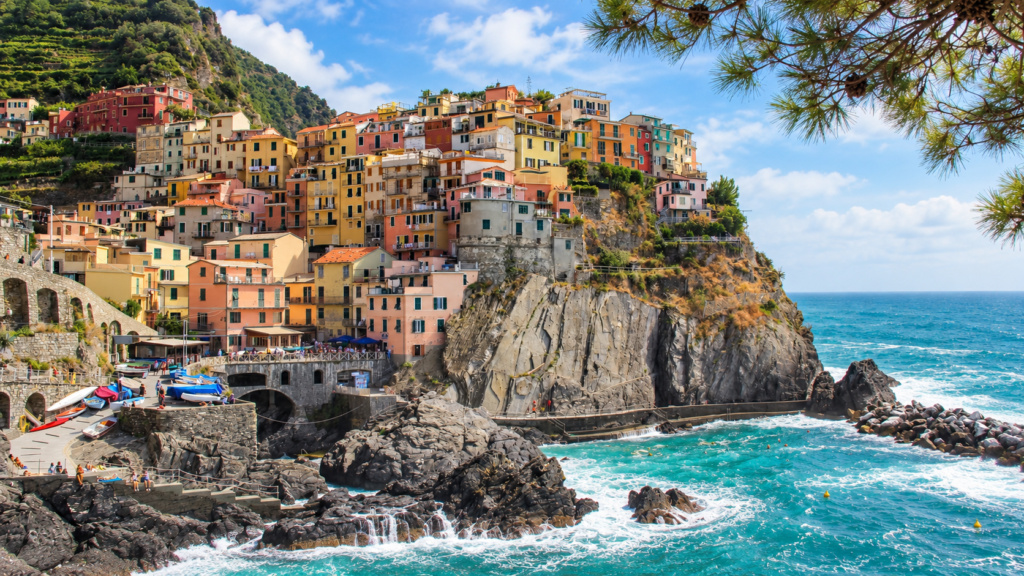
Italy has thousands of kilometres of coastline, but a coastal trip here can mean very different things depending on where you go.
You might spend your time walking between colourful Ligurian villages, swimming below the cliffs of the Amalfi Coast, exploring whitewashed towns in Puglia, relaxing on a Sardinian beach or combining historic cities with the sea in Sicily.
The best coastal destination is not necessarily the most famous one. It depends on whether you want beaches, scenery, historic towns, island life, easy transportation or a quieter place to slow down.
This guide covers some of Italy’s most rewarding coastal areas and what travelers should know before deciding where to go.
Amalfi Coast and Liguria
Amalfi Coast
The Amalfi Coast is one of Italy’s most recognizable coastal destinations. Steep mountains drop toward the Tyrrhenian Sea, with towns and villages built dramatically into the slopes.
Popular stops include:
- Positano — famous for its steep streets, colourful buildings and sea views
- Amalfi — a historic coastal town with a cathedral and convenient ferry connections
- Ravello — located above the coast and known for gardens and expansive views
- Praiano — generally quieter than neighbouring Positano
- Maiori and Minori — useful alternatives for travelers looking for more space and a different atmosphere
The scenery is exceptional, but the geography also creates practical challenges. Roads are narrow, parking is limited and towns can become crowded during busy periods.
Ferries can be an enjoyable way to move between some coastal towns when operating, while buses provide another option. Always check current schedules because transportation patterns can vary by season and weather.
Is the Amalfi Coast Good for Beaches?
The Amalfi Coast is better known for dramatic scenery and towns than for long, wide sandy beaches.
Many beaches are relatively small and surrounded by steep terrain. Some require stairs or pathways to reach.
If your priority is spending most of the trip on expansive sandy beaches, other parts of Italy may suit you better. If you want dramatic scenery combined with swimming, villages and coastal transportation, the Amalfi Coast can be excellent.
Cinque Terre and the Ligurian Coast
Liguria offers one of Italy’s most distinctive combinations of seaside scenery, historic towns and walking routes.
The five villages of Cinque Terre are:
- Monterosso al Mare
- Vernazza
- Corniglia
- Manarola
- Riomaggiore
Colourful buildings, terraced hillsides and dramatic coastal views make the area visually memorable, but Cinque Terre is only one part of the Ligurian coast.
Travelers can also consider places such as:
- Portovenere
- Santa Margherita Ligure
- Camogli
- Rapallo
- Portofino
Train travel makes many Ligurian coastal towns relatively easy to combine without a car.
Monterosso for a More Traditional Beach Day
Among the Cinque Terre villages, Monterosso al Mare generally offers the easiest access to a more conventional beach experience.
The other villages are often more about harbour swimming, scenery and waterfront atmosphere than large beaches.
If beach time matters, consider where you stay rather than assuming every Cinque Terre village provides the same coastal experience.
Puglia, Sardinia and Sicily
Puglia
Puglia forms much of the heel of Italy’s boot and offers a very different coastal landscape from Liguria or the Amalfi Coast.
The region includes long stretches of coastline on both the Adriatic and Ionian sides, along with whitewashed towns, rocky coves and sandy beaches.
Popular coastal destinations include:
- Polignano a Mare — known for dramatic cliffs and a small beach framed by the town
- Monopoli — historic centre, harbour and nearby beaches
- Otranto — attractive old town and access to the Salento coast
- Gallipoli — historic island centre and nearby beaches
- Santa Maria di Leuca — near the southern tip of the Salento peninsula
Puglia can work particularly well for travelers who want to combine coastal driving, smaller towns, beaches and regional food.
Should You Rent a Car in Puglia?
A car can make exploring smaller towns and beaches considerably easier in Puglia, particularly if you want to move beyond the major rail-connected destinations.
However, driving into historic centres can be complicated by restricted traffic areas and limited parking.
One practical strategy is to stay outside the most constrained historic centres and use the car primarily for day trips.
Sardinia
Sardinia is one of Italy’s strongest choices for travelers whose main priority is beaches and clear water.
The island has an enormous variety of coastal scenery, from small coves to broad sandy beaches and rugged headlands.
Different parts of Sardinia offer different experiences.
Areas travelers often consider include:
- Costa Smeralda — known for clear water, polished resorts and upscale destinations
- Gulf of Orosei — dramatic cliffs, coves and boat-accessible beaches
- Alghero — historic town combined with nearby beaches
- Southern Sardinia — beaches around areas such as Villasimius and Chia
- Western Sardinia — often quieter and more rugged
Sardinia Rewards a Slower Trip
Sardinia is larger than many first-time visitors expect.
Trying to see the entire island during a short stay can result in too much driving and too little time at the places you came to enjoy.
Choose one or two parts of the island and explore them properly rather than treating Sardinia like a destination that can be crossed repeatedly each day.
A rental car can be especially useful outside the major towns and resorts.
Sicily
Sicily combines beaches and coastal landscapes with historic cities, archaeological sites, volcanoes and one of Italy’s most distinctive regional cultures.
This makes it particularly appealing to travelers who want more than a beach-only trip.
Coastal destinations include:
- Taormina — dramatic setting above the Ionian coast
- Cefalù — historic town with a beach directly beside the centre
- San Vito Lo Capo — known for a broad sandy beach
- Syracuse and Ortigia — historic urban atmosphere surrounded by the sea
- Aeolian Islands — volcanic islands north of Sicily
- Egadi Islands — island options off western Sicily
Sicily is large enough to justify careful route planning. It is usually better to concentrate on one part of the island than to constantly move between distant coastal destinations.
Cefalù for an Easy Town-and-Beach Combination
Cefalù is particularly attractive for travelers who want a historic town and accessible beach in the same place.
You can explore narrow streets, visit the cathedral, eat in the old centre and spend time by the sea without needing to build every day around transportation.
That makes it a useful contrast to destinations where the best beaches require significant driving or boat travel.
Calabria, Tuscany and Campania Islands
Calabria
Calabria occupies the toe of the Italian peninsula and can appeal to travelers looking for dramatic coastline without the same international profile as the Amalfi Coast or Cinque Terre.
One of the best-known coastal towns is Tropea, where the historic centre sits above the Tyrrhenian Sea.
Calabria offers beaches, cliffs, smaller towns and a strong regional identity.
Transportation may require more planning than in heavily visited regions, so travelers should consider whether a rental car would make the trip more practical.
Tuscany’s Coast
Tuscany is usually associated with Florence, vineyards and hill towns, but the region also has a substantial coastline.
The Tuscan coast can be useful for travelers who want to combine inland sightseeing with some time by the sea.
Options include:
- The Maremma coast
- Monte Argentario
- Castiglione della Pescaia
- Viareggio
- The island of Elba
This coastline generally offers a very different experience from the cliff-hugging villages of Amalfi or Liguria.
Elba
Elba, part of the Tuscan Archipelago, combines beaches, small towns, hiking and historical interest.
It can be reached by ferry from the Tuscan mainland and works well for travelers who want an island experience without travelling as far as Sardinia or Sicily.
Having a vehicle can make it easier to explore different parts of the island, although transportation needs depend on where you stay and how much you want to move around.
Campania Beyond the Amalfi Coast
The Amalfi Coast receives most of the attention, but Campania offers additional coastal and island destinations.
Consider:
- Capri — dramatic scenery, walking routes and famous coastal views
- Ischia — larger island known for towns, beaches and thermal traditions
- Procida — smaller island with colourful waterfront architecture
- Sorrento Peninsula — useful base for combining several destinations
Each island has a different character, so avoid treating them as interchangeable day trips.
Capri: Day Trip or Overnight?
Capri is frequently visited as a day trip, but staying overnight can provide a different experience after many daytime visitors have departed.
If your itinerary allows, compare the cost and logistics of an overnight stay with a rushed same-day visit.
Travelers interested primarily in seeing a few headline sights may find a day trip sufficient, while those who want walking, quieter evenings and more time to explore may prefer staying longer.
Ischia
Ischia can appeal to travelers who want an island experience with more space and a broader range of towns than Capri.
Beaches, coastal scenery and thermal traditions are among its attractions.
Because the island is relatively large, consider transportation when choosing accommodation. Staying near the places you most want to visit can reduce unnecessary travel.
Procida
Procida is smaller and often feels more intimate than Capri or Ischia.
Its colourful waterfronts and compact scale make it attractive for travelers interested in atmosphere, photography and slower exploration.
It is not necessarily the right choice for someone seeking a large resort-style beach destination, but it can work very well as part of a broader Campania itinerary.
Adriatic Coast and Central Italy
Adriatic Coast
Italy’s Adriatic coast stretches far beyond Puglia and includes numerous beach towns and resorts farther north.
Destinations along Emilia-Romagna, Marche and Abruzzo can offer long sandy beaches and a more traditional summer-holiday atmosphere.
These areas may receive less attention from international travelers than Amalfi or Cinque Terre, but they can be practical choices for travelers who value straightforward beach access.
Le Marche
Le Marche combines Adriatic coastline with hill towns and countryside.
The Conero Riviera is one of the region’s notable coastal areas, with cliffs, beaches and towns around Monte Conero.
It can be an appealing option for travelers who want attractive coastline without building an itinerary around Italy’s most internationally famous beach destinations.
Abruzzo
Abruzzo offers Adriatic beaches alongside mountain landscapes farther inland.
Travelers interested in combining coast and nature may find the region particularly appealing.
Along parts of the coast, traditional fishing structures known as trabocchi contribute to the region’s distinctive character.
Choosing the Right Italian Coast
Choose Your Coast Based on the Trip You Want
Different Italian coastlines suit different travel styles.
If you want:
- Dramatic cliff scenery: consider the Amalfi Coast or Liguria
- Clear water and beach-focused travel: consider Sardinia
- Historic towns plus beaches: consider Sicily or Puglia
- An island experience: consider Sardinia, Sicily, Elba, Ischia, Capri or Procida
- Long sandy beaches: explore parts of the Adriatic coast as well as selected southern destinations
- Coast combined with road trips: Puglia, Sicily, Sardinia and Calabria can work particularly well
- Easy rail connections: Liguria can be one of the more convenient choices
Do Not Assume Every Italian Beach Is Sandy
Italy’s coastline includes sand, pebbles, rocks, coves, platforms and harbour swimming areas.
Before booking accommodation specifically for beach access, look at photographs and maps of the actual shoreline.
A destination described as being “on the coast” does not necessarily mean there is a wide sandy beach directly outside your hotel.
Understand Italian Beach Clubs
Many Italian beaches include private establishments known as stabilimenti balneari, where visitors pay for access to amenities such as umbrellas and loungers.
Public beach areas may also be available.
The balance between private and public areas differs by destination, so check the specific beach rather than assuming every coastline operates the same way.
Beach Shoes Can Be Useful
Some Italian beaches are pebbly or rocky rather than sandy.
Water shoes can make entering the sea considerably more comfortable in those locations.
They are particularly useful if your itinerary includes several different coastal regions and you are not certain what type of shoreline you will encounter.
When to Go and How to Get Around
Summer Is Not the Only Time to Visit the Coast
July and August bring warm weather and peak beach season, but they can also bring larger crowds, higher accommodation demand and intense heat.
Late spring and early autumn can be excellent for coastal sightseeing, although swimming conditions, ferry schedules and seasonal businesses may differ from peak summer.
If swimming is central to your trip, research typical conditions for the specific area and time of year rather than assuming every Italian coast has the same season.
Check Ferry Schedules Carefully
Ferries are an important part of travel in many coastal regions and islands, but schedules can vary by season, route and weather.
Always verify current schedules close to your travel dates.
When connecting a ferry journey with a flight or long-distance train, allow enough time for possible delays rather than building an extremely tight connection.
Book Popular Coastal Accommodation Early
Accommodation in small coastal towns can be limited compared with larger cities.
Popular destinations may fill quickly during summer and holiday periods.
If location matters — particularly if you want to stay within walking distance of a beach, harbour or historic centre — booking earlier can provide much more choice.
Think Carefully Before Driving Into Historic Coastal Towns
A rental car can be extremely useful for exploring regions such as Puglia, Sardinia, Sicily and Calabria.
However, many historic towns have narrow streets, restricted traffic zones and limited parking.
Before driving directly to your accommodation, confirm where vehicles are permitted and where you can legally park.
A car that is useful for exploring the region can become inconvenient once you enter an old town.
Stay Longer Rather Than Collecting Coastal Towns
It is tempting to move between famous coastal destinations every day, particularly along the Amalfi Coast or Liguria.
That approach can result in spending much of the trip waiting for buses, trains or ferries.
Choose fewer bases and give yourself time to experience mornings and evenings after day visitors have left.
A slower itinerary often works particularly well on the coast.
Food and Responsible Coastal Travel
Combine Coastal Travel With Regional Food
Coastal Italy is also an opportunity to explore regional cuisine.
Seafood naturally plays an important role in many coastal areas, but each region has its own specialties, ingredients and traditions.
Rather than expecting one universal style of “Italian seafood,” look for dishes associated with the particular region you are visiting.
For a broader introduction to regional Italian cuisine, read our guide to what to eat in Italy.
Respect the Coastline
Many of Italy’s most beautiful coastal areas are environmentally sensitive and also home to permanent communities.
Follow local rules regarding beaches, trails, marine areas and waste.
Avoid entering restricted areas simply for photographs, and respect private property and residential neighbourhoods.
Responsible travel helps protect the places visitors have travelled to enjoy.
Which Italian Coast Is Right for You?
There is no single best coastline in Italy.
The Amalfi Coast offers extraordinary scenery. Liguria combines colourful villages with rail access. Puglia works well for road trips and varied beaches. Sardinia excels for clear water and beach-focused travel. Sicily combines coastline with history and culture, while Calabria, Tuscany and the Adriatic regions provide alternatives beyond the most famous destinations.
Decide what matters most — beaches, towns, scenery, transportation, food or island life — and choose the region that best matches that style of trip.
Italy’s coastline is diverse enough that you do not need to see all of it at once. Choosing one region and exploring it properly will usually produce a better trip than racing from one famous coastline to another.
For broader trip-planning information, see our Italy Travel Guide: What to Know Before You Go.
You can also explore more seaside destinations in our Coastlines travel guides.