
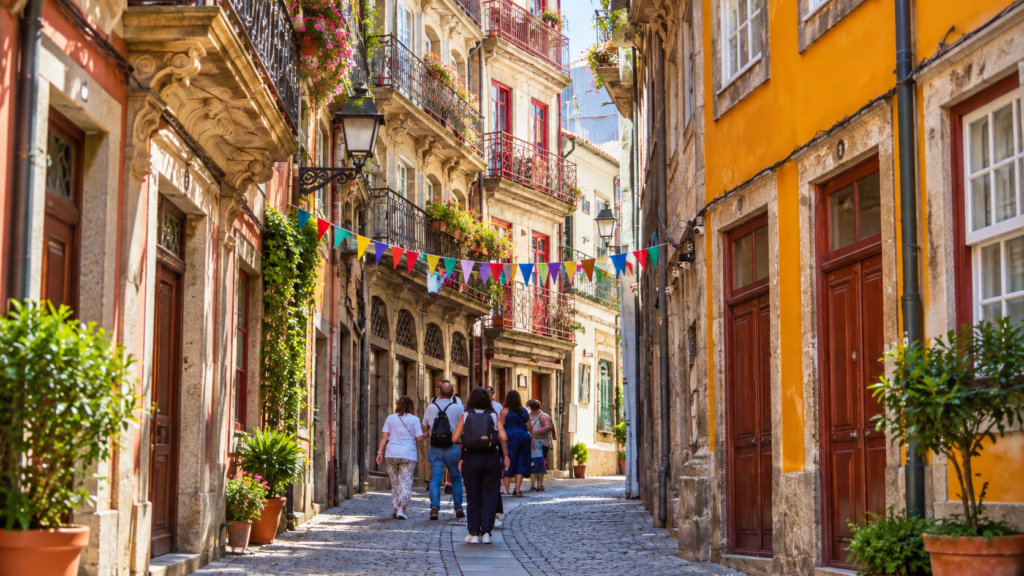
Portugal culture and local customs are shaped by centuries of history, strong regional identities, religious traditions, Atlantic influences and everyday habits that can vary considerably from one part of the country to another.
Travelers do not need to memorize a complicated set of etiquette rules before visiting Portugal. In most situations, simple courtesy, patience and a willingness to observe how people around you behave will take you a long way.
Understanding a few Portuguese customs — from greetings and café culture to religious sites, festivals and neighbourhood life — can make everyday interactions easier and help you experience the country beyond its famous landmarks.
Portugal Culture and Local Customs Vary by Region
Portugal may look compact on a map, but it should not be treated as one completely uniform cultural experience.
Lisbon, Porto, the Minho, the Alentejo, the Algarve, Madeira and the Azores each have their own histories, landscapes, foods, celebrations and local identities.
Even neighbouring towns can have their own festivals, specialties and traditions.
For travelers, this means that moving through Portugal should feel like discovering variations within the same country rather than simply seeing different versions of Lisbon.
Learning about Portugal culture and local customs before your trip can make everyday interactions more comfortable and meaningful.
Lisbon and Porto Feel Different
Portugal’s two largest cities have distinct personalities.
Lisbon’s relationship with the Tagus River, historic neighbourhoods, tiled façades and long maritime history contribute to its character, while Porto has its own northern identity shaped by the Douro, its historic commercial traditions and the surrounding wine region.
There is no need to decide which city is the “real Portugal.” Both are Portuguese, but they represent different parts of the country’s story.
The Islands Have Their Own Traditions
Madeira and the Azores should not be treated simply as extensions of mainland Portugal.
Their island geography, agricultural traditions, festivals, food and historical development have created distinctive local cultures.
If your trip includes the islands, approach them as destinations with identities of their own rather than expecting exactly the same experience you had in Lisbon or Porto.
Greetings and Everyday Courtesy
Small courtesies matter in Portugal, particularly when entering shops, cafés, restaurants or speaking with someone for the first time.
You do not need fluent Portuguese, but learning a handful of expressions is worthwhile.
- Bom dia — good morning or good day
- Boa tarde — good afternoon
- Boa noite — good evening or good night
- Por favor — please
- Obrigado — thank you when spoken by a man
- Obrigada — thank you when spoken by a woman
- Desculpe — excuse me or sorry
Using a greeting before immediately asking a question can make an interaction feel more courteous.
Do Not Worry About Speaking Perfect Portuguese
Travelers frequently encounter English in hotels, major attractions and tourism-related businesses, particularly in heavily visited destinations.
However, visitors should not assume that everyone speaks English or expect conversations to take place in English automatically.
A polite greeting in Portuguese followed by a simple question about whether English is spoken is a better approach than beginning with rapid English.
Translation apps can be useful when communication becomes difficult, particularly in smaller towns or situations involving detailed information.
Be Patient With Communication
Speaking louder rarely solves a language barrier.
Slow down, use simple language and allow the other person time to understand what you are asking.
The goal is communication, not perfect grammar.
Daily Life, Cafés and Social Rhythm
One of the easiest ways to experience Portuguese culture is to stop moving between attractions long enough to observe everyday life.
A neighbourhood café, market, public square or waterfront promenade can reveal a side of Portugal that is difficult to experience from a sightseeing bus or tightly scheduled itinerary.
Cafés Are Part of Everyday Life
Cafés and pastelarias are common gathering places for coffee, pastries, light meals and conversation.
A coffee stop does not need to become a major event. You may see people stopping briefly for an espresso at the counter while others sit longer over a pastry or conversation.
Spending time in an ordinary neighbourhood café can provide a more natural glimpse of daily life than searching only for famous cafés promoted on social media.
Meals Are Often Social
Eating out is a common social activity in Portugal, and meals can be opportunities to spend time with family and friends rather than simply eat as quickly as possible.
Portugal’s official tourism information notes that lunch commonly falls between midday and the middle of the afternoon, while dinner is generally eaten later in the evening.
Travelers should therefore check restaurant hours rather than assuming that every kitchen operates continuously throughout the day.
For a deeper introduction to regional cuisine and dining customs, see our guide to what to eat in Portugal.
Slow Down Occasionally
Portugal can tempt travelers into moving quickly between Lisbon, Sintra, Porto, the Algarve and numerous smaller towns.
A schedule like that can cover significant ground while revealing surprisingly little about everyday life.
Leave some unscheduled time for a market, café, waterfront walk or evening in a neighbourhood square.
Not every memorable part of a trip needs an admission ticket.
Religion, Fado and Cultural Traditions
Portugal’s cultural heritage reflects many historical influences, and visitors will encounter them in architecture, music, festivals, religious sites and decorative arts throughout the country.
Churches Are Cultural Sites and Places of Worship
Portugal contains an extraordinary number of churches, monasteries, chapels and religious shrines.
Many are important architectural and artistic sites, but visitors should remember that active churches remain places of worship.
Keep voices low, follow posted rules, avoid interrupting services and pay attention to any restrictions on photography.
When visiting an active religious site, modest clothing is a sensible choice, particularly when a church or monastery posts specific requirements.
Fado Is More Than Background Music
Fado is one of Portugal’s best-known musical traditions and is particularly associated with Lisbon, although Coimbra also has its own distinctive fado tradition.
Fado was added to UNESCO’s Representative List of the Intangible Cultural Heritage of Humanity in 2011.
If you attend a traditional fado performance, treat the music as the focus rather than as background entertainment for a loud conversation.
Different venues have different atmospheres, but watching how the room responds to the performers will usually tell you how formal or quiet the experience is expected to be.
Notice the Azulejos
Decorative ceramic tiles, known as azulejos, are one of the most recognizable visual features of Portugal.
They appear on churches, palaces, railway stations, homes, fountains and public buildings in designs ranging from geometric patterns to elaborate historical and religious scenes.
They are not simply decoration added for visitors. Tilework has been an important feature of Portuguese architecture for centuries.
Travelers interested in the country’s artistic traditions can explore additional background through Portugal’s official tourism information on art and culture.
Festivals and Local Celebrations
Festivals can completely change the atmosphere of a Portuguese town or city.
Religious celebrations, local fairs, music events and traditional festivals can bring processions, street decorations, food stalls, concerts and large crowds into places that may feel much quieter at other times of year.
The Popular Saints Festivals
June is particularly important for the celebrations known as the Santos Populares.
Lisbon’s celebrations of Santo António reach their peak around June 12 and 13, when neighbourhood festivities, music, parades and grilled sardines fill parts of the city.
Porto celebrates São João on the night of June 23 into June 24, with street celebrations and traditions that are distinct from Lisbon’s festivities.
If your visit coincides with one of these celebrations, expect crowds, altered transportation, road closures and a very different atmosphere from an ordinary sightseeing day.
Religious Festivals Remain Visible
Religious processions, pilgrimages and saint’s days remain important traditions in many communities.
Fátima is Portugal’s most internationally recognized pilgrimage destination, but religious celebrations take place in towns and villages throughout the country.
Travelers are generally welcome to observe public celebrations, but remember that what may look like an interesting cultural event to a visitor can also carry deep religious meaning for participants.
Check the Calendar Before You Travel
A local festival can be one of the highlights of a trip, but it can also affect hotel availability, traffic, restaurant reservations and opening hours.
Check local event calendars before arriving, particularly if you are visiting a smaller town where one major festival can transform the entire destination for several days.
Practical Etiquette for Travelers
Respect Residential Neighbourhoods
Some of Portugal’s most photogenic streets are also home to people who live there year-round.
This is particularly important in historic neighbourhoods where balconies, narrow lanes, tiled façades and traditional houses attract large numbers of visitors.
Avoid blocking entrances, leaning into private windows, entering private stairways or creating unnecessary noise simply to get a photograph.
A beautiful street is not automatically a public stage.
Ask Before Photographing People
Street photography can be part of documenting a trip, but there is a difference between photographing a general public scene and placing a stranger at the centre of a close-up photograph.
When someone is clearly the subject rather than part of the surrounding scene, asking permission is the respectful choice.
Public Transportation Requires Basic Courtesy
On trains, metros, trams and buses, allow passengers to exit before boarding and keep luggage from blocking doors, seats and aisles.
Pay attention to designated priority seating and local ticketing rules.
Portugal has several transportation systems, and validation procedures can differ between cities and operators. Do not assume that a method you used in Lisbon works exactly the same way elsewhere.
Expect Different Business Hours
Traditional shops, cafés and restaurants do not all operate on the schedules travelers may be accustomed to at home.
Some smaller businesses close for part of the afternoon, close one day each week or change their hours by season.
Large shopping centres and businesses in heavily visited areas generally operate longer hours, but always check current opening times before making a special trip.
Tipping Is More Modest Than in North America
Restaurant service is included in the bill in Portugal. Portugal’s official tourism authority says that leaving an additional tip of roughly 5 to 10 percent for good service is customary.
This does not mean travelers need to import North American percentage-based tipping habits into every interaction.
Check the bill, consider the service you received and tip appropriately rather than automatically applying the customs of your home country.
Markets Are Part of Everyday Culture
Markets can provide an excellent introduction to Portuguese produce, fish, cheeses, flowers, crafts and regional products.
Some famous markets have become major visitor attractions, while smaller municipal and neighbourhood markets continue to serve primarily local communities.
Visit both when possible. The heavily photographed market may be entertaining, but the ordinary market can tell you more about what people actually buy and eat.
Travel With Curiosity, Not Stereotypes
Portugal is sometimes reduced in travel advertising to a short list of images: yellow trams, pastel de nata, tiled façades, port wine, beaches and fado.
All of those things have a place in the country’s identity, but none of them explains modern Portugal on its own.
Portugal is a contemporary European country whose cities, communities and lifestyles continue to change.
Avoid trying to perform what you imagine Portuguese culture should look like. Observe, ask respectful questions and allow people and places to be more complicated than the stereotypes you arrived with.
Do Not Treat Every Region as the Same
Someone from Porto, the Algarve, Madeira, the Alentejo or the Azores may have a very different relationship with local food, music, traditions and landscape.
Those differences are not obstacles to understanding Portugal. They are part of what makes the country interesting.
Be a Guest, Not an Audience
Historic neighbourhoods, cafés, markets, churches and waterfronts exist for more than tourism.
People are working, commuting, worshipping, shopping and living their ordinary lives around you.
Recognizing that distinction is one of the simplest ways to become a more respectful traveler.
Experience Portugal Beyond the Landmarks
Portugal’s major attractions deserve their reputation, but understanding the country requires more than visiting palaces, viewpoints and historic monuments.
Culture is also found in the morning coffee at a neighbourhood café, the tiled entrance of an ordinary building, the music heard during a festival, the evening conversation in a public square and the local tradition you knew nothing about before arriving.
Understanding Portugal culture and local customs is less about memorizing rules and more about observing regional differences, everyday courtesy and the rhythms of local life.
Learn a few Portuguese phrases. Notice regional differences. Respect religious and residential spaces. Slow down occasionally and pay attention to how everyday life unfolds around you.
You do not need to imitate local behaviour perfectly. You simply need enough awareness to travel with courtesy and curiosity.
For complete trip-planning information, see our Portugal Travel Guide: What to Know Before You Go.
You can also explore more destination-focused articles in our Culture travel guides.