
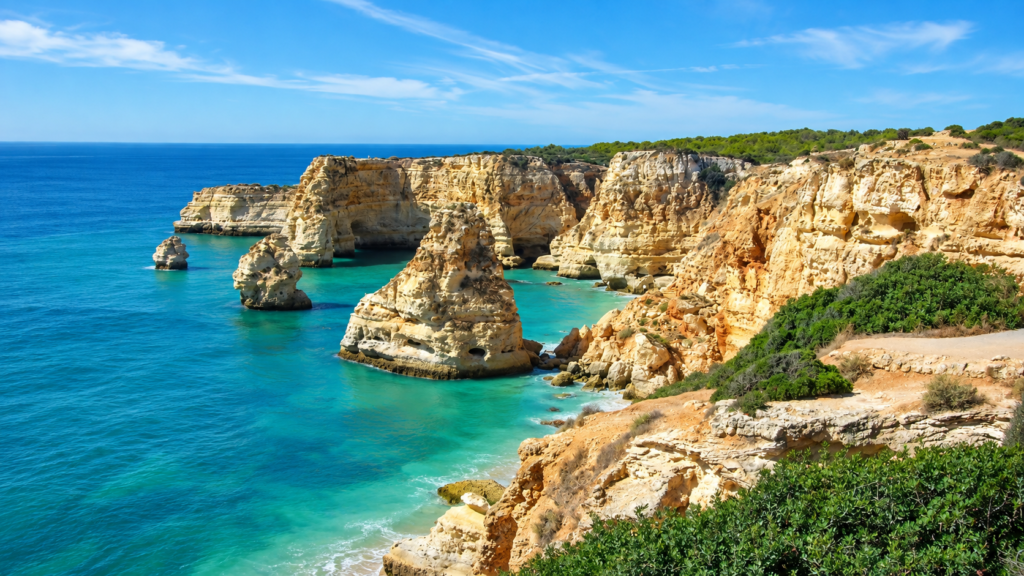
Portugal coastlines and island destinations range from long Atlantic beaches and dramatic surf towns to the golden cliffs of the Algarve and volcanic islands far out in the ocean.
Portugal’s mainland coastline stretches for more than 850 kilometres, and the experience changes considerably as you travel. Near Lisbon you can combine city sightseeing with beaches and seaside towns. The Alentejo and Costa Vicentina offer wilder coastal landscapes, while the Algarve ranges from sheltered coves beneath cliffs to long sandy barrier islands.
Madeira, Porto Santo and the Azores add another dimension entirely, with volcanic scenery, natural swimming areas, Atlantic landscapes and distinctive island communities.
This guide will help you decide which part of Portugal’s coast best fits your trip, whether you are looking for beaches, scenic towns, surfing, island life or a combination of all four.
Portugal Coastlines and Island Destinations: Where to Start
There is no single “best beach area” in Portugal because different parts of the country suit very different types of travelers.
Before choosing a coastal destination, decide what matters most to you.
- Easy access from Lisbon — consider Cascais, Estoril, Costa da Caparica or the Sintra coast
- Surfing and dramatic Atlantic scenery — look toward Ericeira, Peniche, Nazaré and the western coast
- Quieter road-trip scenery — explore the Alentejo coast and Costa Vicentina
- Classic beach holiday — the Algarve provides the widest range of resort towns, beaches and visitor infrastructure
- Golden-sand island escape — Porto Santo is particularly appealing
- Volcanic landscapes and outdoor adventure — consider Madeira or the Azores
Portugal’s official tourism authority describes more than 850 kilometres of mainland coastline, with beaches ranging from the famous Algarve to the wilder Atlantic shore farther north.
Travelers who want to explore individual beaches in more detail can also consult Portugal’s official tourism information on beaches.
Atlantic Coast From Lisbon to the North
You do not need to travel to the Algarve to experience Portugal’s coastline.
The Atlantic coast around Lisbon and farther north offers seaside towns, broad beaches, dramatic cliffs, fishing traditions and some of Europe’s best-known surfing destinations.
Cascais and Estoril
Cascais is one of the easiest coastal destinations to combine with a Lisbon trip.
The town combines a historic centre, marina, restaurants, waterfront walks and several beaches, while regular rail connections make it possible to visit without renting a car.
Nearby Estoril has its own beaches and a more resort-oriented history, and the coastline between Lisbon and Cascais contains several additional places to stop by the sea.
Cascais works particularly well for travelers who want a seaside atmosphere without giving up easy access to Lisbon.
Sintra’s Atlantic Coast
Many visitors know Sintra for its palaces and wooded hills, but the municipality also reaches the Atlantic Ocean.
Coastal areas such as Praia das Maçãs and the landscape around Cabo da Roca provide a dramatic contrast to Sintra’s historic centre.
Beaches here can feel noticeably more exposed to the Atlantic than the protected beaches closer to Cascais.
If you are combining Sintra sightseeing with the coast, avoid trying to fit palaces, old town and multiple beaches into one rushed day. The distances and transportation time add up quickly.
Costa da Caparica
Across the Tagus River from Lisbon, Costa da Caparica provides a long Atlantic shoreline popular with residents as well as visitors.
Its broad sandy beaches make it a practical option when your priority is spending a day beside the ocean rather than exploring another historic town.
Transportation requires more planning than taking the train to Cascais, so check the current route from your accommodation before leaving Lisbon.
Ericeira
Ericeira combines a traditional coastal town with an international surfing reputation.
The whitewashed centre, ocean views and nearby beaches make it appealing even for travelers who have no intention of surfing.
For surfers, the exposed Atlantic coastline offers very different conditions from the calmer beaches found in parts of the southern Algarve.
Ericeira can be visited from Lisbon, but staying overnight provides more time to experience the town after day visitors leave.
Peniche and the Berlenga Islands
Peniche sits on a peninsula surrounded by the Atlantic and has long-standing connections with fishing and the sea.
The surrounding coastline includes beaches popular with surfers, while boat trips can connect travelers with the Berlenga Islands offshore.
If visiting the Berlengas, check current boat schedules and sea conditions rather than building an inflexible itinerary around a crossing. Atlantic weather can affect marine transportation.
Nazaré
Nazaré combines a traditional seaside identity with international fame for exceptionally large Atlantic waves.
The town itself has a broad beach, restaurants, viewpoints and a strong connection with fishing traditions.
The giant-wave conditions associated with Praia do Norte are not an everyday occurrence, so do not plan a trip assuming that enormous waves will automatically be present.
Even without extreme surf, Nazaré remains worthwhile as a coastal destination.
Porto and the Northern Coast
Porto is primarily experienced as a river city, but the Douro reaches the Atlantic at Foz do Douro, where promenades, beaches and waterfront restaurants create a very different atmosphere from the historic centre.
Nearby Matosinhos is also closely connected with the ocean and is particularly well known for seafood and its broad urban beach.
Farther north, the coast continues toward places such as Vila do Conde, Esposende and Viana do Castelo.
The Atlantic generally feels more exposed and the water cooler as you move north, so this part of Portugal is better approached as a combination of coastline, towns, walking and scenery rather than expecting a Mediterranean-style beach holiday.
Alentejo Coast and Costa Vicentina
The Alentejo coast offers one of the strongest alternatives to Portugal’s more developed resort areas.
Portugal’s official tourism authority describes the coastline between the Sado estuary and Zambujeira do Mar as a particularly well-preserved coastal region, with beaches, small communities and access to walking routes.
Comporta and the Troia Peninsula
South of Lisbon, the Troia Peninsula and Comporta area combine long sandy beaches, low-density landscapes and the waters of the Sado estuary.
The area has developed a reputation for stylish accommodation and restaurants, but its greatest attraction remains the relationship between dunes, beaches, rice fields and open landscapes.
A car can make exploring this region considerably easier, particularly if you want to move between beaches and small communities.
Vila Nova de Milfontes
Vila Nova de Milfontes sits where the Mira River meets the Atlantic.
That location gives travelers access to both river and ocean scenery while maintaining the atmosphere of a relatively small coastal town.
It can work well as a base for exploring other parts of the Alentejo coast rather than changing accommodation every night.
Zambujeira do Mar and Odeceixe
Zambujeira do Mar is dramatically positioned above the Atlantic, while Odeceixe lies near the boundary between the Alentejo and Algarve regions.
The beach at Odeceixe sits where the river reaches the sea, creating one of the more distinctive coastal settings along this part of Portugal.
These destinations are particularly appealing to travelers who prefer scenery, walking and smaller towns to large resort developments.
The Costa Vicentina Rewards a Slower Trip
The Costa Vicentina extends through southwestern Alentejo and into the western Algarve.
Cliffs, beaches and protected landscapes dominate much of the route, and coastal walking forms an important part of the experience.
Do not treat the area as a collection of beaches to photograph quickly before driving to the next one.
Choose a base, walk sections of the coast, spend time in the smaller towns and leave enough flexibility for weather conditions.
Algarve Coast and Ria Formosa Islands
The Algarve is Portugal’s most famous beach region, but even here the coastline is far from uniform.
Rougher Atlantic beaches dominate the western coast, dramatic golden cliffs define much of the central Algarve, and long sandy beaches and barrier islands become increasingly important toward the east.
Western Algarve: Aljezur to Sagres
The western Algarve feels noticeably different from the resort coastline farther east.
Beaches around areas such as Arrifana, Amado and Carrapateira sit beneath cliffs and are exposed to Atlantic conditions that attract surfers and travelers looking for a wilder landscape.
Sagres occupies a dramatic position near Portugal’s southwestern edge and works well for travelers who value cliffs, wind, walking and open ocean scenery.
This is not the part of the Algarve I would choose purely for calm-water swimming every day. It is more compelling for landscape and Atlantic character.
Lagos and Ponta da Piedade
Lagos is one of the Algarve’s strongest all-round destinations because it combines an attractive historic centre with nearby beaches and dramatic coastal formations.
Praia Dona Ana and Praia do Camilo are among the area’s best-known beaches, while Ponta da Piedade is famous for its cliffs, arches, sea stacks and grottos.
Boat and kayak excursions are popular ways to see the coastline from the water, but conditions should always determine whether a marine excursion is appropriate on a particular day.
Carvoeiro, Benagil and Praia da Marinha
The central Algarve contains many of the cliff-backed coves that appear in photographs used to represent the region.
Carvoeiro provides a small-town base directly on the coast, while the coastline around Benagil and Praia da Marinha is known for limestone cliffs, caves and small beaches.
Do not assume that every famous cove is easy to reach or appropriate for swimming in every condition.
Follow current safety restrictions around cliffs, caves and marine access rather than relying on photographs or old travel posts.
Albufeira and Vilamoura
Travelers who want extensive tourism infrastructure, restaurants, nightlife and easy access to organized activities often gravitate toward Albufeira and Vilamoura.
These areas provide a very different experience from the quieter Costa Vicentina.
Neither approach is inherently better. The important question is whether you want a developed resort base or a more independent coastal road trip.
Faro, Olhão and the Ria Formosa
Eastern Algarve travel is shaped by the Ria Formosa, a protected lagoon system separated from the Atlantic by sandy islands and peninsulas.
This creates a coastal experience very different from the cliffs around Lagos and Carvoeiro.
From Faro and Olhão, boats and ferries provide access to islands and coastal communities including Culatra, Farol, Armona and other parts of the barrier-island system.
The combination of lagoons, fishing traditions, shellfish, boats and long sandy beaches makes the eastern Algarve particularly appealing to travelers looking for something beyond the classic cliff-cove image of the region.
Tavira and Tavira Island
Tavira combines one of the Algarve’s most attractive historic towns with access to the beaches of the Ria Formosa.
Tavira Island forms part of the sandy barrier separating the lagoon from the Atlantic and is reached by boat services rather than by simply walking from the historic centre.
That separation is part of the appeal. You can spend time exploring the town and then make the journey out to a much more beach-focused landscape.
Madeira, Porto Santo and the Azores
Portugal’s Atlantic islands should not be treated as interchangeable beach destinations.
Madeira is mountainous and volcanic, Porto Santo is defined by its long golden beach, and the Azores combine volcanic coastlines, natural swimming areas and nine islands with distinctive landscapes.
Madeira
Madeira is not primarily a traditional sandy-beach destination.
Much of the island’s coastline is steep and volcanic, and pebble beaches are common. Travelers also encounter natural swimming pools, rocky bathing areas, small coves and a limited number of sandy beaches.
That is not a disadvantage if you understand what you are choosing. Madeira excels at combining ocean views with hiking, mountains, dramatic roads, gardens and towns built into steep terrain.
Places such as Porto Moniz are especially associated with natural volcanic swimming pools, while coastal communities including Câmara de Lobos, Ponta do Sol and Paul do Mar provide different perspectives on the island’s relationship with the sea.
Porto Santo
Porto Santo provides the strongest contrast with Madeira itself.
The smaller inhabited island of the Madeira archipelago is famous for a golden sandy beach stretching for approximately nine kilometres along the south coast.
For travelers whose priority is a relaxed sandy-beach holiday, Porto Santo may actually fit better than Madeira.
It can also be combined with Madeira for a trip that includes both mountain scenery and dedicated beach time.
The Azores
The Azores are best approached as a nature and island-exploration destination rather than a conventional resort beach holiday.
Volcanic geology shapes the coastline, creating dark or grey sand beaches, black-rock headlands, natural pools, steep cliffs and small bays.
São Miguel, the largest island, offers several swimming beaches and natural bathing areas in addition to crater lakes, geothermal landscapes and coastal viewpoints.
Other islands offer their own combinations of harbours, natural pools, volcanic landscapes and small coastal communities.
Trying to see too many Azorean islands during a short trip can create unnecessary transportation pressure. Choose islands according to the landscapes and activities you actually want rather than treating the archipelago as a checklist.
Practical Coastal Travel Tips
The Atlantic Deserves Respect
Portugal faces the Atlantic Ocean, and conditions can change substantially between beaches and from one day to another.
Waves, currents and wind can be considerably stronger than the water appears from shore.
Pay attention to warning flags, lifeguard instructions and local signage, particularly at exposed beaches.
Never assume that because other people are near the water a particular location is safe for swimming.
Not Every Beach Has the Same Facilities
Popular Algarve beaches and urban beaches near Lisbon may have restaurants, showers, lifeguards, parking and equipment rentals.
A remote beach along the Costa Vicentina may offer far fewer facilities.
Check access and services before arriving, especially if you are travelling with children, have mobility considerations or plan to stay for several hours.
Cliff Safety Matters
Some of Portugal’s most spectacular beaches sit beneath eroding cliffs.
Respect barriers, warning signs and marked setback areas rather than moving closer to cliff edges or rock faces simply for a photograph.
Do not assume that a place is safe because an older photograph shows people standing there.
Check Boat and Ferry Schedules
Boats and ferries are part of the experience in destinations such as the Ria Formosa, Berlengas, Madeira, Porto Santo and the Azores.
Schedules can vary by route, season and weather.
Always verify current departures near your travel date and leave additional time when a boat connection must be followed by a flight, train or other fixed reservation.
A Rental Car Can Help — But Not Everywhere
A car is particularly useful for exploring the Alentejo coast, Costa Vicentina, parts of the Algarve, Madeira and many areas of the Azores.
It is less essential when your itinerary is centred on Lisbon, Cascais or another destination with convenient public transportation.
Parking can also become difficult near popular beaches and historic coastal centres during busy periods.
Rent a car because it improves your specific itinerary, not simply because you assume every coastal trip requires one.
Summer Is Not Your Only Option
July and August provide the most obvious beach-holiday conditions, but they also bring greater accommodation demand and busier coastal destinations.
Late spring and early autumn can work extremely well for coastal sightseeing, walking and road trips.
If swimming is central to your trip, research normal conditions for the particular region and month rather than assuming the entire Portuguese coast follows the Algarve’s climate.
Stay Longer in Fewer Places
Portugal’s coastline looks compact on a map, which makes it tempting to build an itinerary around collecting beaches and coastal towns.
That approach can leave you spending more time parking, driving and checking into accommodation than actually enjoying the coast.
Choose a few well-positioned bases and explore the surrounding area properly.
The slower approach we used when planning Italy’s coastline applies equally well here: coastal travel becomes much better when transportation is not the main activity of every day.
Make Regional Food Part of the Coast
Portugal’s coastline is also one of the best places to experience the country’s regional food.
Fresh fish and seafood naturally feature heavily in many coastal communities, but the specialties change between Lisbon, the Alentejo, Algarve, Madeira and the Azores.
For a broader introduction, see our guide to what to eat in Portugal.
Understanding local traditions also makes coastal towns and island communities more meaningful, so you may also want to read our Portugal culture and local customs guide.
Which Portuguese Coast Is Right for You?
There is no single Portugal coastline or island destination that is best for every traveler.
Cascais and the Lisbon coast work well when you want easy coastal access without giving up a city-based itinerary.
Ericeira, Peniche and Nazaré are stronger choices when Atlantic scenery and surfing culture are important.
The Alentejo and Costa Vicentina suit travelers who want smaller towns, walking, road trips and a less developed coastline.
The Algarve offers the broadest choice of classic beaches, resorts, dramatic cliffs and visitor infrastructure, while the Ria Formosa provides a quieter barrier-island experience.
Madeira excels for volcanic scenery, hiking and natural swimming areas rather than conventional beach resorts.
Porto Santo is the standout choice when a long golden sandy beach is the priority.
The Azores are strongest for travelers who want volcanic landscapes, nature, island communities and outdoor exploration.
Understanding Portugal coastlines and island destinations is ultimately about matching the geography to the type of trip you want rather than searching for one universal “best beach.”
You do not need to see every famous stretch of coastline in one trip. Choose the region that fits your interests, leave enough time to explore it properly and allow the Atlantic to be part of the experience rather than simply another photograph.
For broader trip-planning information, see our Portugal Travel Guide: What to Know Before You Go.
You can also explore more seaside destinations in our Coastlines travel guides.