
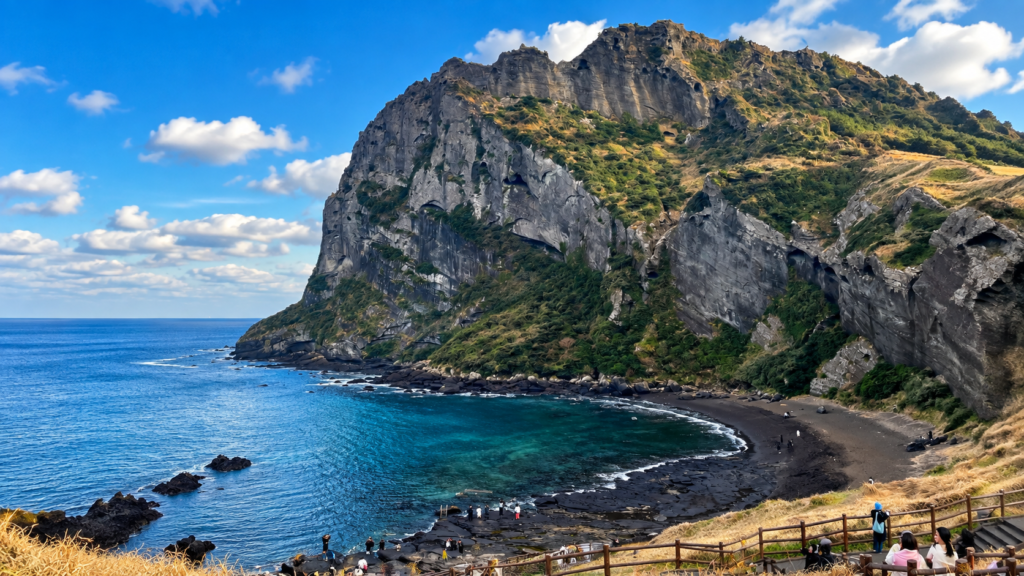
South Korea coastlines and island destinations are far more varied than many first-time visitors expect. The country has long sandy beaches along the east coast, tidal flats and sunsets on the west, island-filled waters along the south and the volcanic landscapes of Jeju far offshore.
Busan provides the easiest combination of major city and beach life, while Gangwon Province offers clear water, surfing and a more open coastline. Farther south, Geoje, Tongyeong, Namhae and Yeosu are surrounded by islands and protected marine landscapes. Jeju is large enough to support an entire trip of its own, while remote Ulleungdo rewards travelers willing to make a longer journey.
The character of the coast also changes dramatically with the season. Summer brings swimming, festivals and the largest crowds, while spring and autumn can be excellent for coastal walking, road trips and island exploration.
This guide will help you compare the major coastal regions and islands so you can choose destinations that fit the type of trip you actually want.
South Korea Coastlines and Island Destinations: Where to Start
There is no single Korean coast that is best for every traveler.
The east, west and south coasts each have distinct landscapes, while Jeju and Ulleungdo feel very different from mainland beach destinations.
- City beaches, cafés and nightlife: Busan
- Clear water, surfing and long sandy beaches: Gangwon Province
- Sunsets, tidal flats and broad beaches: Taean and the west coast
- Island scenery and coastal road trips: Geoje, Tongyeong, Namhae and Yeosu
- Volcanic landscapes, beaches and a complete island trip: Jeju
- Remote cliffs, walking trails and dramatic island scenery: Ulleungdo
Korea Tourism Organization provides additional inspiration in its official guide to Korean beach destinations.
Busan: South Korea’s Major Coastal City
Busan is the easiest place to experience South Korea as both a major city and a beach destination.
Subways connect coastal neighbourhoods with markets, temples, restaurants and urban attractions, making a rental car unnecessary for many visitors.
Haeundae Beach
Haeundae is South Korea’s most internationally recognizable urban beach.
The sandy shoreline sits directly beside high-rise hotels, restaurants and city streets, creating an experience that feels very different from a remote seaside resort.
The surrounding district is lively well beyond swimming season. Dongbaekseom Island, coastal walks, cafés and observation points provide reasons to visit even when the weather is too cool for the beach.
Summer can be extremely busy, so travelers interested primarily in walking and city scenery may prefer spring or autumn.
Gwangalli Beach
Gwangalli offers a more urban evening atmosphere, with cafés, restaurants and bars facing the water.
The illuminated Gwangan Bridge dominates the view after dark and makes this one of Busan’s most attractive areas for an evening walk.
Rather than treating Gwangalli only as a daytime beach, consider visiting around sunset and staying into the evening.
Songjeong and the Eastern Busan Coast
Songjeong Beach, east of Haeundae, has a more relaxed feel and is closely associated with surfing.
The coastline between Haeundae and Songjeong also includes viewpoints, walking routes and the Haeundae Blueline Park area.
This section of Busan works particularly well for travelers who want sea views without spending an entire day lying on the beach.
Gangwon Province and the East Coast
South Korea’s east coast is known for long beaches, relatively clear blue water, mountain backdrops and a more open coastal landscape than the densely developed areas around Busan.
The coast also pairs naturally with nearby mountain destinations such as Seoraksan, allowing travelers to combine hiking and beach scenery within the same trip.
Gangneung
Gangneung is one of the east coast’s most convenient bases.
Gyeongpo Beach is one of the area’s best-known beaches, while Anmok Beach has developed a strong café culture along the waterfront.
Gangneung works particularly well when you want a coastal trip with restaurants, cafés, cultural attractions and easy rail access rather than an isolated beach holiday.
Yangyang
Yangyang has become closely associated with Korean surf culture.
Beaches such as Hajodae, Seorak and Dongho attract surfers as well as ordinary beach visitors, and surf schools operate along parts of the coast.
The atmosphere can feel younger and more casual than traditional Korean resort beaches, particularly around established surf areas.
Swimming seasons at individual beaches are normally concentrated in summer, so check local operating dates if supervised swimming is important to you.
Sokcho
Sokcho is one of the best bases for travelers who want both the coast and Seoraksan National Park.
The city has beaches, fishing harbours and seafood markets, but its location near the mountains gives it a more varied itinerary than a straightforward beach town.
A few nights here can combine mountain hiking, market food and time beside the sea without requiring long daily transfers.
The West Coast: Taean, Boryeong and Incheon Islands
South Korea’s west coast faces the Yellow Sea and provides a very different experience from the east.
Large tidal changes expose mudflats and reshape beaches throughout the day, while sunsets over the sea are one of the region’s major attractions.
Taean Coast
Taean Peninsula contains a long succession of beaches, pine forests, coastal roads and protected landscapes.
Mallipo Beach has a broad sandy shoreline and is popular for swimming and water sports during summer.
Nearby Cheollipo and Baengnipo provide smaller alternatives, while Padori combines sand, pebbles and a sea cave that is accessible only under suitable tidal conditions.
This part of Korea works especially well for road trips because the attraction lies in moving between beaches, viewpoints and smaller coastal communities rather than staying in one major city.
Daecheon Beach and Boryeong
Daecheon is one of the west coast’s largest and best-known beaches.
The long sandy shore supports swimming and summer activities, while the area is internationally associated with the Boryeong Mud Festival.
Outside festival periods, the beach still works as a straightforward seaside stop with restaurants, accommodation and attractive sunsets.
Ganghwa, Seongmodo and Muuido
The islands and coastal areas around Incheon offer a convenient introduction to Korea’s west coast without travelling far from Seoul.
Minmeoru Beach on Seongmodo Island is particularly interesting because low tide exposes a broad mudflat where marine life such as clams and crabs can be seen.
Muuido Island is now connected by bridge and combines beaches with walking trails and views over surrounding islands.
These areas are useful when you want to experience tidal landscapes and coastal scenery as an extension of a Seoul itinerary.
The Southern Coast: Geoje, Tongyeong, Namhae and Yeosu
The southern coastline becomes increasingly intricate, with islands, narrow channels, bays and mountainous land meeting the sea.
Much of the region lies within or around Hallyeohaesang National Marine Park, Korea’s first national marine park. The protected landscape extends through areas including Geoje, Tongyeong, Sacheon, Namhae and Yeosu.
This is less a destination for one famous beach than a region for coastal drives, ferries, walking, island excursions and sea views.
Geoje Island
Geoje is South Korea’s second-largest island and is connected to both Busan and the Tongyeong area by bridges.
The island combines pebble beaches, coastal roads, forested hills and offshore rock formations.
Hakdong and other pebble beaches provide a different shoreline experience from Korea’s long sandy beaches, while boat trips offer views of Haegeumgang and other offshore scenery.
Geoje works well as part of a road trip linking Busan with Korea’s southern coast.
Tongyeong
Tongyeong is surrounded by islands and is one of the strongest bases for exploring Korea’s southern marine landscape.
Ferries and boat routes connect the mainland with islands including Hansando, Bijindo and other destinations within Hallyeohaesang National Marine Park.
Even without taking a ferry, elevated viewpoints around Tongyeong provide expansive views across the island-filled sea.
This is a destination where giving yourself an extra day can make a major difference because weather may affect boat trips and island schedules.
Namhae
Namhae combines beaches, small communities, mountain scenery and one of South Korea’s most attractive coastal driving environments.
Sangju Silver Sand Beach sits beside pine-covered hills, while Boriam Hermitage on Geumsan Mountain provides a dramatic view over the surrounding sea and islands.
The coastal roads around Namhae reward travelers who prefer scenic driving and viewpoints to heavily developed beach resorts.
Yeosu
Yeosu is another excellent base for experiencing Korea’s southern island geography.
The city faces a sea filled with islands and combines coastal viewpoints, bridges, seafood, boat trips and urban attractions.
Odongdo Island is connected to the mainland by a breakwater and can be explored on foot. Camellia forests, coastal cliffs, walking paths and a lighthouse make it one of the city’s easiest nature excursions.
Travelers with more time can use Yeosu as a starting point for additional island exploration.
Jeju Island: South Korea’s Complete Island Destination
Jeju should be treated as a complete destination rather than simply a beach side trip from Seoul.
The volcanic island combines beaches, lava formations, waterfalls, coastal cliffs, villages, museums and Hallasan Mountain.
A full circuit of Jeju reveals how dramatically the coast changes from one side of the island to another.
Jeju’s Beaches
Jeju has beaches for very different travel styles.
Some have broad sand and clear shallow water, while others are framed by volcanic rock and darker coastlines.
Hyeopjae and Geumneung on the western side of the island are particularly well known for pale sand and clear water, while Hamdeok on the north coast combines an attractive beach with restaurants and cafés nearby.
Do not build the entire Jeju itinerary around beaches. The island is strongest when coastal stops are combined with inland scenery, local food and volcanic landscapes.
Seongsan and the Eastern Coast
Jeju’s eastern coast contains some of the island’s most recognizable scenery.
Seongsan Ilchulbong rises dramatically above the coast and is one of Jeju’s most important volcanic landmarks.
The nearby port also provides the main ferry connection to Udo Island.
Udo Island
Udo is a small volcanic island just off Jeju’s eastern coast and one of the easiest island-within-an-island excursions in South Korea.
The ferry from the Seongsan area takes roughly 15 minutes, and visitors can explore the island by shuttle bus, bicycle or other local transportation.
Udo’s coastline includes clear water, beaches, volcanic formations and sea caves.
Sanho Beach is especially distinctive because its bright shoreline is formed from rhodoliths — calcified red algae — rather than ordinary coral sand.
Udo works particularly well as a full-day excursion rather than a hurried photo stop.
Ulleungdo: South Korea’s Remote Island Escape
Ulleungdo offers one of South Korea’s most dramatic island experiences.
The volcanic island lies well off the east coast and is characterized by steep mountains, sea cliffs, small fishing communities and roads that cling to the coastline.
It is significantly more difficult to reach than Jeju, but that isolation is part of its appeal.
Coastal Walking and Scenic Roads
Ulleungdo is better suited to scenery, walking and island exploration than to a conventional beach holiday.
Trails and coastal roads reveal cliffs, volcanic formations and small settlements tucked between mountains and the sea.
The island’s Hakpo Coast is particularly notable for layered volcanic geology and steep sea cliffs.
Ferry schedules can be affected by weather and sea conditions, so an Ulleungdo itinerary should always include flexibility.
Practical Coastal Travel Tips
Beaches Have Seasonal Swimming Periods
Many Korean beaches remain publicly accessible throughout the year, but supervised swimming seasons are generally concentrated in summer.
Operating dates vary by beach and can change annually.
If swimming is important to your trip, check the current local schedule rather than assuming a beach operates the same way year-round.
Understand the West Coast Tides
Tidal differences are especially important along the west coast.
A beach may look completely different at low tide, when large mudflats can be exposed.
Check tide times before visiting sea caves, walking onto mudflats or planning photography around the shoreline.
Island Ferries Depend on Weather
Short ferry trips such as Jeju to Udo are relatively straightforward, but routes to more distant islands can be disrupted by rough seas and high winds.
This is particularly important for Ulleungdo and smaller southern islands.
Avoid scheduling a critical international flight immediately after returning from a remote island.
A Car Helps in Some Regions, but Not Everywhere
Busan and several east-coast cities can be explored effectively with public transportation.
A rental car becomes much more valuable around Taean, Namhae, Geoje and Jeju, where coastal attractions are more spread out.
Choose a car because it improves a particular itinerary rather than assuming every coastal trip requires one.
The East Coast Is Easier by Train Than It Used to Be
Rail connections along Korea’s east coast have improved significantly.
The Donghae Line now links major coastal cities including Busan and Gangneung, making it easier to build a multi-stop coastal itinerary without driving the entire route.
Check current Korail schedules when planning because service patterns and travel times can change.
Summer Is the Busiest Beach Season
July and August bring the greatest beach crowds and hottest weather.
Popular areas such as Haeundae, Jeju and major east-coast beaches can become extremely busy during holiday periods.
Late spring and early autumn are often better for walking, road trips and sightseeing, although water temperatures and formal swimming operations may be less suitable.
Connect the Coast With Regional Food
Korea’s coastal regions make more sense when food becomes part of the itinerary.
Busan is known for seafood and pork-and-rice soup, Gangwon has its own fish and tofu traditions, Yeosu and the south coast are closely connected with seafood, and Jeju has black pork, abalone and other island specialties.
For more ideas, see our guide to what to eat in South Korea.
You may also want to read our South Korea culture and local customs guide for more background on regional identity and everyday travel etiquette.
Which South Korean Coast or Island Fits Your Trip?
Understanding South Korea coastlines and island destinations is ultimately about matching the region to your priorities.
Busan works best when you want beaches, restaurants, nightlife and major-city attractions in one trip.
Gangwon Province is especially appealing for clear water, surfing, long beaches and the ability to combine the coast with mountain scenery.
The west coast suits travelers interested in sunsets, tidal flats, road trips and a less internationally familiar side of Korea.
Geoje, Tongyeong, Namhae and Yeosu are strongest for island scenery, coastal drives, ferries and southern maritime landscapes.
Jeju deserves several days and works best as a complete destination combining beaches, volcanic scenery, food and inland attractions.
Ulleungdo is the choice for travelers willing to invest more time in reaching a remote island defined by cliffs, walking and dramatic scenery rather than conventional resort beaches.
South Korea’s coastline is too varied to reduce to one famous beach. Slow down, choose a region that matches your travel style and allow the sea to become part of the journey rather than simply another stop on the itinerary.
For broader trip-planning information, see our South Korea Travel Guide: What to Know Before You Go.
You can also explore more seaside destinations in our Coastlines travel guides.