
The United States has one of the world’s most varied food landscapes. Rather than one single national cuisine, travelers encounter a patchwork of regional dishes shaped by Indigenous foodways, immigration, local agriculture, coastal access, climate and generations of community traditions.
Exploring United States food is not simply about eating burgers, hot dogs and apple pie. A trip across the country can include New England seafood, New York deli culture, Southern comfort food, Louisiana’s Cajun and Creole traditions, Midwestern specialties, Texas barbecue, Southwestern flavors, West Coast produce and the multicultural food traditions of Hawaii.
The best approach is to eat regionally. Instead of ordering the same familiar meal in every city, look for dishes associated with the place you are visiting. That usually provides a much better introduction to local culture.
United States Food: What Travelers Should Expect
Food in the United States ranges from highly traditional to intensely modern. Travelers can move easily between classic diners, family-run bakeries, seafood shacks, barbecue restaurants, neighborhood delis, food trucks, farmers markets and ambitious contemporary restaurants.
Portions can be larger than international visitors expect, particularly in casual restaurants. Sharing appetizers, splitting desserts or taking leftovers away is completely normal.
The country’s food culture is also deeply multicultural. Italian American, Mexican American, Chinese American, Jewish deli, African American, Caribbean, Vietnamese, Korean and many other culinary traditions have become integral parts of everyday eating in different regions.
That diversity is precisely why searching for one definitive American meal misses the point. The strongest food trips are built around regional differences.
What to Eat in the Northeast
The Northeast combines some of the country’s best-known city food traditions with strong seafood, baking and immigrant food cultures.
New York City
New York is one of the country’s great food cities and an ideal place to experience classic urban food culture.
Bagels are one of the city’s signature foods, particularly when served with cream cheese and smoked salmon. New York-style pizza, pastrami sandwiches, cheesecake and Jewish deli traditions are also part of the city’s culinary identity.
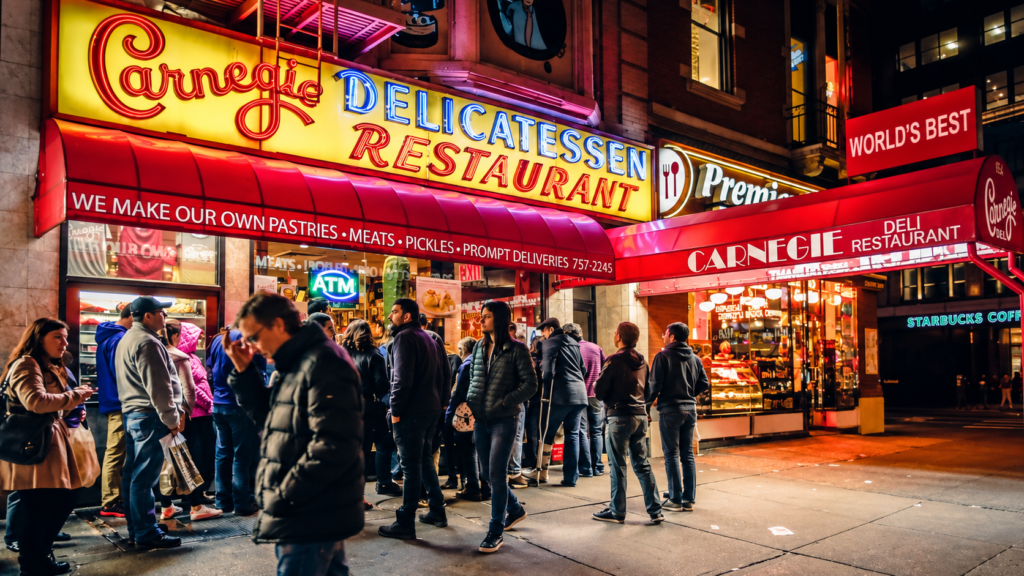
The atmosphere outside Carnegie Deli in the featured image reflects an important part of New York food culture: eating is closely connected to neighborhoods, street life and restaurants that become landmarks in their own right.
Do not limit yourself to famous institutions. Neighborhood bakeries, pizza shops, food carts and small restaurants can be just as memorable.
Philadelphia and the Mid-Atlantic
Philadelphia is strongly associated with the cheesesteak, but its food culture extends well beyond one sandwich.
Soft pretzels, roast pork sandwiches and Italian market traditions are also important. In the wider Mid-Atlantic region, blue crab and crab-based dishes are particularly associated with Maryland and the Chesapeake Bay.
Regional sandwiches and seafood are usually more interesting choices here than falling back on familiar national chains.
New England
New England is one of America’s strongest seafood regions.
Lobster rolls and clam chowder are among the best-known specialties, while oysters, fried clams, scallops and other seafood appear throughout coastal communities.
Lobster rolls vary by location. Some are served chilled with mayonnaise, while others feature warm lobster with butter. Travelers interested in seafood may enjoy trying both styles rather than deciding in advance that one version is more authentic.
The South: Comfort Food, Barbecue and Deep Regional Traditions
Southern cooking is one of the country’s most influential regional food traditions, but it is far from uniform. Food changes significantly between the Carolinas, Georgia, Tennessee, Louisiana and other parts of the South.
Southern Comfort Food
Fried chicken, biscuits, cornbread, collard greens, macaroni and cheese and slow-cooked vegetables frequently appear on Southern menus.
Shrimp and grits is another widely recognized dish, particularly in coastal areas of the Southeast.
Travelers can encounter these foods in everything from casual family restaurants to modern kitchens that reinterpret Southern ingredients and techniques.
American Barbecue
Barbecue provides one of the clearest examples of regional variation in United States food.
The Carolinas are strongly associated with pork and distinctive regional sauces. Memphis is known for pork and ribs. Kansas City barbecue often includes a wide variety of smoked meats and rich sauces, while Texas is particularly famous for smoked beef brisket.
Rather than trying to determine which style is objectively best, treat each regional tradition as its own experience.
Louisiana: Cajun and Creole Cooking
Louisiana has one of America’s most distinctive food cultures.
Travelers should look for gumbo, jambalaya, po’ boys, red beans and rice, étouffée, boudin and beignets. Cajun and Creole traditions overlap in some ways but have different histories and influences.
Explore Louisiana highlights gumbo, jambalaya, beignets, po’ boys, boudin and other regional dishes among the state’s signature foods.
New Orleans is particularly rewarding because neighborhood restaurants, seafood, traditional cooking and contemporary dining all exist side by side.
What to Eat in the Midwest
The Midwest is sometimes overlooked by international travelers, but the region contains some of America’s most recognizable city specialties and strong agricultural traditions.
Chicago
Chicago is particularly important for travelers interested in iconic American city food.
Deep-dish pizza, Chicago-style hot dogs and Italian beef sandwiches are all strongly associated with the city. Choose Chicago includes deep-dish pizza among the city’s defining dishes, while Italian beef remains one of its classic sandwiches.
These famous foods are worth trying, but Chicago also has a sophisticated contemporary restaurant scene, so there is little reason to spend the entire visit eating only traditional specialties.
Wisconsin and the Great Lakes
Wisconsin and nearby Great Lakes states have strong traditions involving dairy, sausages and hearty cold-weather food.
Cheese curds are among Wisconsin’s most recognizable snacks, while Friday fish fries remain an established local tradition in many communities.
Elsewhere around the Great Lakes, travelers may encounter smoked fish, regional baked goods and dishes influenced by generations of European immigration.
Texas and the Southwest
Texas and the American Southwest bring another major set of regional traditions into the country’s food landscape.
Mexican, Indigenous, ranching and borderland influences have shaped the region for generations.
Texas Barbecue
Texas barbecue is particularly associated with beef brisket, although ribs, sausage and other smoked meats are also common.
Many respected barbecue restaurants begin cooking long before opening and may sell out of popular cuts later in the day. Travelers who are serious about barbecue should check opening hours and local practices before arriving.
Tex-Mex
Tex-Mex developed from the food cultures of Texas and northern Mexico and is now closely associated with the state.
Breakfast tacos, queso, enchiladas, fajitas and chili are among the foods travelers are likely to encounter.
Austin, San Antonio and Houston all offer strong food scenes, but some of the most memorable barbecue and Tex-Mex meals can also be found in smaller communities.
New Mexico and the Desert Southwest
Travel farther west and chile becomes increasingly important.
New Mexican cooking is especially associated with red and green chile, while Native American and regional Mexican food traditions contribute additional depth throughout the Southwest.
Do not assume that all food described as Southwestern is interchangeable. Ingredients and traditions change substantially between states and communities.
What to Eat on the West Coast
The West Coast is strongly associated with seafood, excellent produce, multicultural cooking and an emphasis on seasonal ingredients.
California
California is too large and diverse for one dish to define it.
Tacos, burritos, seafood, farm-to-table cooking and produce-driven menus are all important, while generations of immigration have created exceptional Mexican, Chinese, Japanese, Korean, Vietnamese and other food traditions.
San Francisco is associated with sourdough bread and cioppino, while Los Angeles offers one of the country’s most diverse collections of neighborhood restaurants, food trucks and regional Mexican cooking.
Pacific Northwest
Washington and Oregon are particularly strong destinations for seafood, coffee culture, local produce and wine.
Salmon, Dungeness crab and oysters regularly appear on menus, while cities such as Seattle and Portland combine casual neighborhood dining with ambitious contemporary restaurants.
Farmers markets can be particularly rewarding in this region because they bring local producers and prepared-food vendors together in one place.
Hawaii and Island Food Traditions
Hawaii deserves its own section because its food culture is substantially different from that of the continental United States.
Native Hawaiian traditions combine with generations of Japanese, Filipino, Chinese, Korean, Portuguese and other influences to create a distinctive local food culture.
Poke
Poke traditionally features pieces of seasoned raw fish and has become internationally popular, although mainland interpretations may differ considerably from versions found in Hawaii.
Local markets and casual restaurants are often excellent places to try it.
Plate Lunch
The plate lunch is one of Hawaii’s classic everyday meals.
Go Hawaii describes a typical plate lunch as including rice, macaroni salad and a main item that might range from kālua pork to chicken katsu, Korean barbecue or fish.
Other foods worth seeking out include shave ice, malasadas and loco moco.
Travelers should look beyond resort restaurants. Neighborhood cafés, markets and local plate-lunch shops usually provide a broader understanding of how people actually eat in Hawaii.
Foods You Will See Across the Country
Some foods appear almost everywhere in the United States, although their preparation can change dramatically by region.
- Burgers — ranging from simple roadside versions to elaborate restaurant interpretations.
- Hot dogs — particularly common at sporting events, street stands and casual restaurants.
- Pizza — with distinct regional traditions including New York and Chicago styles.
- Barbecue — varying by meat, smoking method, seasoning and sauce.
- Tacos — particularly widespread in the Southwest, California and major cities nationwide.
- Pancakes and breakfast plates — staples of diners and breakfast restaurants.
- Fried chicken — especially associated with Southern cooking but available nationwide.
Trying the same type of food in several places can actually make regional differences more obvious.
Diners, Delis and Food Trucks
Not every memorable American meal needs to take place in a formal restaurant.
Diners
Diners remain one of the easiest ways to experience everyday American food culture.
Breakfast is especially important. Eggs, bacon, pancakes, waffles, hash browns and bottomless or frequently refilled coffee are classic diner choices.
Delis
Delicatessens are particularly important in cities such as New York, where sandwiches, smoked meats, soups, pickles and baked goods form part of a long-established urban food tradition.
The featured Carnegie Deli image reflects this aspect of American city culture particularly well.
Food Trucks
Food trucks have become an important part of food scenes throughout the country.
Depending on the city, travelers may find tacos, barbecue, Korean-inspired food, seafood, sandwiches, desserts and highly specialized regional dishes being served from mobile kitchens.
They are often an inexpensive way to sample local food without giving up substantial sightseeing time.
Farmers Markets and Local Produce
Farmers markets are excellent places to understand contemporary United States food.
Markets frequently combine fruit and vegetables, meat, seafood, bread, cheese, baked goods and prepared foods from small local businesses.
They are particularly valuable for travelers because several regional foods can be sampled in one place without committing to a large meal.
Markets also reveal the importance of seasonality. What appears in California, New England or the Pacific Northwest can differ substantially depending on climate and time of year.
Fine Dining and Contemporary American Food
Traditional regional dishes are only one side of American food culture.
New York, Chicago, New Orleans, San Francisco, Los Angeles and Washington, D.C., all have influential contemporary restaurant scenes, while excellent restaurants can also be found in much smaller cities.
Modern American chefs often work with local seafood, regional produce and traditional ingredients while drawing techniques and influences from cultures around the world.
Travelers do not need to choose between traditional and contemporary food. One of the strongest approaches is to experience both.
You might eat barbecue at lunch and visit a refined restaurant for dinner, or have a classic deli sandwich one day and a modern tasting menu the next.
How to Eat Well While Traveling in the United States
You do not need to chase every famous dish to have a successful food trip.
A better strategy is to combine several types of experience:
- Try at least one food strongly associated with each region you visit.
- Visit a bakery, deli, market or food truck rather than eating only in restaurants.
- Look for seafood when traveling near the coast.
- Try regional barbecue where barbecue traditions are strong.
- Visit locally owned restaurants alongside well-known institutions.
- Balance casual food with one contemporary restaurant if your budget allows.
- Do not rely entirely on national chains simply because they are familiar.
Recent reviews can be useful, but popularity alone is not proof of quality. Famous restaurants sometimes survive largely because of reputation, while excellent neighborhood businesses receive less attention from visitors.
Leave some flexibility in your itinerary so you can follow recommendations from residents, hotel staff or people you meet along the way.
Choosing What to Eat by Region
- In the Northeast: look for bagels, deli sandwiches, pizza, lobster rolls and clam chowder.
- In the South: try fried chicken, biscuits, barbecue, shrimp and grits, gumbo and beignets.
- In the Midwest: look for Chicago deep dish, Italian beef, Chicago-style hot dogs, cheese curds and fish-fry traditions.
- In Texas and the Southwest: try smoked brisket, Tex-Mex, breakfast tacos and regional chile-based cooking.
- On the West Coast: look for seafood, tacos, farmers-market produce, sourdough and multicultural neighborhood restaurants.
- In Hawaii: try poke, plate lunches, shave ice, malasadas and other Pacific-influenced local foods.
Regional variation is what makes exploring United States food worthwhile. Rather than searching for one definitive national meal, use each destination as an opportunity to eat something connected to the place you are visiting.
From New York deli culture and New England seafood to Southern barbecue, Louisiana cooking, Midwestern specialties, Southwestern flavors and Hawaii’s island traditions, American food becomes much more interesting when you stop treating it as one cuisine.
Eat regionally, try both famous dishes and everyday local food, and leave enough flexibility in your trip to discover places you did not plan in advance.
For etiquette, festivals and everyday traditions, see our United States Culture and Local Customs: What Travelers Should Know.
For beaches, islands and coastal road trips, explore our United States Coastlines: Atlantic, Pacific, Gulf and Island Shores.
For broader trip planning, visit our United States Travel Guide.
For more practical trip-planning advice, explore our Travel Tips & Resources.