
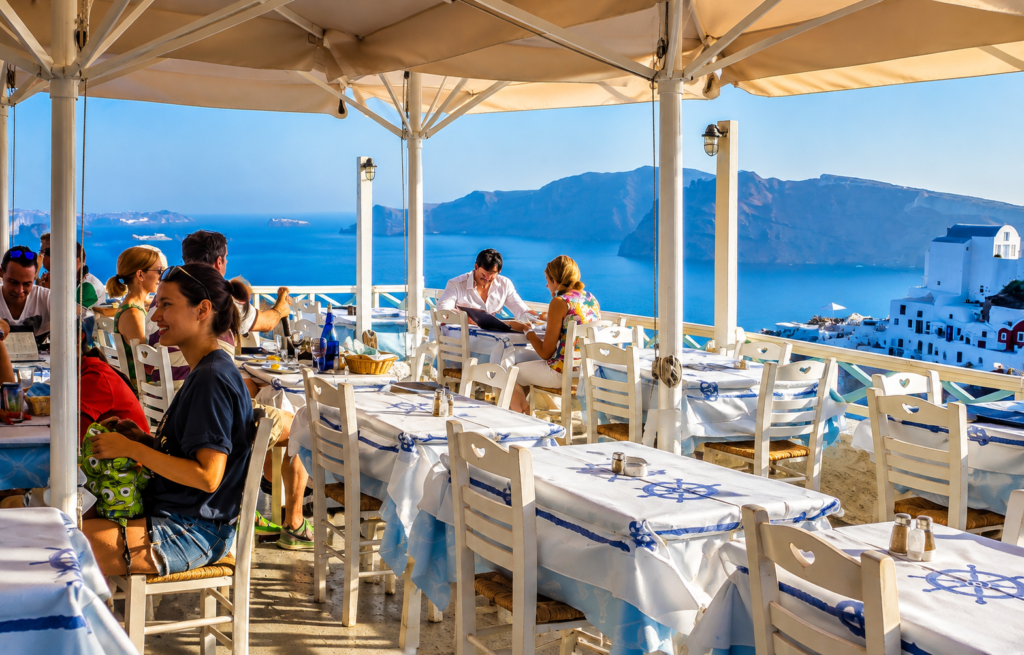
Greece culture and local customs are shaped by thousands of years of history, but everyday Greek life is much more than ancient ruins, mythology and famous archaeological sites. Modern Greece combines strong family and community ties, Orthodox Christian traditions, regional identities, lively social customs and an unmistakably Mediterranean approach to food and conversation.
Travelers will notice that social life often takes place outdoors. Cafés remain busy well into the evening, meals can stretch for hours and town squares become gathering places for families, friends and neighbours.
At the same time, customs can vary considerably between Athens, Thessaloniki, mountain villages, Crete and the hundreds of inhabited Greek islands. A tradition that feels central in one community may be much less noticeable somewhere else.
You do not need to master every cultural rule before visiting Greece. A little awareness, patience and respect will take you a long way. This guide explains the customs travelers are most likely to encounter and the cultural traditions that can make a trip through Greece much more meaningful.
Greece Culture and Local Customs: Understanding the Basics
Greek culture places considerable importance on personal relationships, family, conversation and hospitality.
This can make everyday interactions feel warmer and less formal than travelers may expect. A conversation with a shopkeeper may continue beyond the transaction, a meal may last considerably longer than anticipated and someone offering food or coffee may genuinely expect you to stay for a while.
Hospitality has deep roots in Greek culture, but visitors should avoid turning it into a stereotype. Greece is a modern European country, and people living in Athens or Thessaloniki may have very different routines from residents of a small island or mountain village.
The most useful approach is to observe the people around you and allow local rhythms to guide the interaction.
Greetings and Everyday Courtesy
A simple greeting makes a noticeable difference when entering a small shop, café or family-run business.
Kalimera means good morning or good day and is useful earlier in the day. Kalispera means good evening, while efcharisto means thank you.
You will also hear yassas, a polite or plural form of hello, and the more informal yassou.
English is widely used in major tourism areas, but even a few Greek words are usually appreciated.
Handshakes are common when meeting someone for the first time. Friends and relatives may greet one another more affectionately, but travelers do not need to imitate personal gestures unless the other person initiates them.
Greek Conversation Can Feel Animated
Visitors sometimes interpret an energetic Greek conversation as an argument when everyone involved may simply be having an enthusiastic discussion.
Conversation can involve expressive gestures, overlapping voices and considerable emotion without necessarily signalling conflict.
Do not assume that volume alone tells you whether people are upset.
One gesture worth avoiding is thrusting an open palm directly toward another person’s face. Known as the moutza, it can be insulting. Ordinary waving is not a problem; simply avoid deliberately presenting an outstretched palm toward someone at close range.
Family and Community Life
Family remains a highly visible part of Greek social life.
It is common to see several generations sharing meals, spending evenings in village squares or gathering at cafés and restaurants.
Children are frequently included in evening social activities, particularly during summer when public spaces remain active well after sunset.
Small towns and villages can also have strong community networks. Local festivals, religious celebrations, weddings and seasonal events may involve much of the community rather than being private occasions involving only immediate family.
For travelers, these gatherings provide an opportunity to experience Greek culture as something living rather than something confined to museums.
The Greek Orthodox Tradition
Greek Orthodox Christianity has had a profound influence on the country’s history, art, architecture, calendar and cultural traditions.
Churches and monasteries appear throughout Greece, from tiny whitewashed island chapels to major Byzantine monasteries and pilgrimage sites.
Some visitors enter primarily because of the architecture or artwork, while others are entering an active place of worship. Keeping that distinction in mind is important.
Visiting Churches and Monasteries
Dress expectations vary by site, but modest clothing is the safest choice when visiting an active church or monastery. Some monasteries may provide coverings or have specific requirements posted at the entrance.
Keep voices low, silence your phone and avoid walking directly in front of someone who is praying when it can reasonably be avoided.
Photography rules also vary. Never assume that photographs or video are permitted simply because other visitors are using cameras. Look for signs or ask before photographing interiors, religious services, icons or members of a monastic community.
Places such as Meteora demonstrate how closely religious history, architecture and landscape are connected in Greece. Greece’s official tourism organization describes Meteora as one of the country’s most important Orthodox monastic centres, with six monasteries still operating today.
Religious Festivals and Panigyria
One of the best ways to experience local Greek traditions is at a panigyri, a community celebration often connected with a saint’s feast day or religious occasion.
Depending on the region, a panigyri may combine a church service or procession with music, dancing, food and a large communal gathering.
These are not performances staged primarily for tourists. Many remain important community events, and visitors should approach them as guests.
Greece’s official tourism organization highlights regional festivals where faith, music, dancing and communal meals remain closely connected. You can explore examples through its guide to traditional religious festivals in Greece.
Easter in Greece
Orthodox Easter is one of the most important periods in the Greek religious and cultural calendar.
Traditions differ across the country, but Holy Week may include church services, processions and community gatherings leading to the celebration of Easter.
Individual islands and towns often maintain distinctive local customs, which means Easter in Corfu can look very different from Easter in a small Cycladic village or a community on Crete.
If you visit during this period, expect some businesses and transportation schedules to change around major holidays. Churches can also become extremely busy.
Travelers are welcome to observe many public traditions, but religious services should be treated as worship rather than entertainment.
Music and Dance Are Living Traditions
Greek music extends far beyond the stereotypical sounds sometimes used in tourist restaurants.
Different regions have their own instruments, dances, songs and performance traditions. Cretan music, island music, Epirus polyphonic singing and urban musical traditions can sound dramatically different from one another.
Rebetiko
Rebetiko developed in Greek urban communities during the early twentieth century and became an important musical and cultural expression associated with song and dance.
UNESCO added Rebetiko to the Representative List of the Intangible Cultural Heritage of Humanity in 2017, describing it as a living musical tradition that remains connected with Greek social and cultural identity.
Travelers interested in Greek music can learn more through UNESCO’s Rebetiko cultural heritage profile.
Traditional Dancing
Dance remains an important element of weddings, festivals and community celebrations.
There is no single traditional Greek dance. Different regions maintain distinctive forms, steps and music.
If you are invited to join a dance at a festival or celebration, watch for a moment before entering and follow the people who know the steps rather than trying to lead.
Social Life, Cafés and Dining
Social life in Greece often revolves around cafés, restaurants, tavernas and public gathering places.
Coffee Culture and the Art of Taking Your Time
A Greek café is not simply somewhere to consume caffeine quickly.
Coffee is often part of an extended social ritual. Friends may sit over one drink for a surprisingly long time, talking and watching the world around them.
Traditional Greek coffee remains popular, while frappé, freddo espresso and freddo cappuccino are common choices in contemporary café culture.
For travelers accustomed to taking coffee away, sitting down at a neighbourhood café can provide a much better window into everyday Greek life.
Meals Are Social Events
Dining is another area where visitors encounter the social side of Greek culture.
Meals are often shared, conversation continues between courses and several dishes may be placed in the centre of the table rather than served as strictly separate meals for each person.
Dinner can also take place later than many North American travelers expect, particularly during warm summer months.
There is generally little benefit in rushing a taverna meal. Allow time for the experience itself rather than treating dinner as something to complete before the next activity.
If you’re interested in the regional dishes and dining traditions behind these meals, see our What to Eat in Greece: A Regional Food Guide for Travelers.
Hospitality and Invitations
Travelers may occasionally be offered coffee, sweets, fruit or a small drink by a host, accommodation owner or someone they meet in a smaller community.
You do not have to accept everything offered, but acknowledging the gesture warmly is good practice.
If you are invited into someone’s home, bringing a small gift such as sweets or something appropriate from a bakery is a thoughtful gesture, although expectations vary depending on the situation.
Do not confuse hospitality with unlimited informality. Greek warmth and friendliness still coexist with normal expectations of courtesy and respect for private spaces.
Regional Identity Matters
One of the biggest mistakes travelers can make is thinking of Greece as culturally uniform.
Regional identity remains strong, and geography has helped preserve distinctive music, food, architecture and customs.
Crete
Crete has a particularly strong regional identity shaped by its history, music, food, villages and local traditions.
Cretan music commonly features the lyra, while village celebrations can combine music, dancing, food and long social gatherings.
The Cyclades
The whitewashed architecture familiar from Santorini and Mykonos is only one part of Cycladic identity.
Smaller islands often maintain their own festivals, religious traditions, foods and local rhythms. Life away from the busiest resort centres can feel very different from the international atmosphere of Mykonos.
Epirus
Mountainous Epirus has its own strong traditions in architecture, music and village life.
Polyphonic singing is particularly associated with parts of the region, and stone-built villages provide a cultural landscape quite different from the popular image of blue-and-white Greek islands.
The Dodecanese
Islands such as Rhodes, Karpathos and smaller Dodecanese communities have traditions shaped by their geography and complex histories.
On Karpathos, traditional communal celebrations involving music, improvised song and dance remain part of local cultural life.
Traditional Villages and Cultural Sites
Historic villages are increasingly popular with travelers seeking quieter places beyond Greece’s major destinations.
Remember that picturesque stone lanes, whitewashed houses and flower-filled courtyards are often people’s homes rather than an open-air museum.
Avoid entering private property for a photograph, blocking doorways or windows, flying drones without checking local rules or photographing residents at close range without permission.
This is particularly important in small island and mountain communities where tourism can place considerable pressure on narrow streets and residential areas.
Photography and Cultural Sites
Greece provides extraordinary opportunities for photography, but not every culturally important place should be treated the same way.
Archaeological sites and museums may have rules regarding tripods, flash, professional equipment or photography of particular objects.
Churches, monasteries and religious ceremonies can have additional restrictions.
When people rather than monuments are the subject, asking permission is the safest approach, especially in smaller communities, markets and religious settings.
Ancient Greece and Modern Greece Are Not the Same Thing
Ancient Greek civilization understandably dominates the way Greece is presented internationally.
The Acropolis, Delphi, Olympia, Mycenae and other archaeological sites are fundamental parts of the country’s heritage, but focusing exclusively on antiquity can obscure the many centuries of history that followed.
Byzantine churches, Venetian architecture, Ottoman-era influences, neoclassical cities, twentieth-century history and contemporary Greek culture all contribute to the country travelers encounter today.
The result is not a preserved version of ancient Greece but a modern society with a complex cultural inheritance.
Markets and Everyday Life
Markets provide another opportunity to see everyday Greek culture at close range.
Depending on the destination, you may encounter municipal markets, farmers’ markets, fish markets and small specialist shops selling cheese, olives, herbs or baked goods.
A greeting before asking a question is preferable to immediately pointing at an item or stating what you want.
In busy markets, allow working vendors space and avoid obstructing customers while taking photographs.
Public Spaces and the Evening Walk
Greek towns and villages often become most animated after the heat of the day begins to fade.
Waterfront promenades, pedestrian streets and central squares fill with people walking, meeting friends, having coffee or sitting down for dinner.
Travelers who retreat to their accommodation immediately after sightseeing can miss an important part of local life.
An evening walk through a neighbourhood or village square can reveal more about everyday culture than another scheduled attraction.
Names, Saints and Celebrations
Name days associated with Christian saints remain culturally significant for many Greeks.
Depending on the family and community, a person’s name day can be celebrated alongside or sometimes more prominently than a birthday.
Travelers are most likely to notice this tradition through local festivals, church celebrations or congratulations exchanged among friends and relatives.
You do not need to memorize the Orthodox calendar. Simply understanding why a village or church suddenly seems to be celebrating can make the experience more meaningful.
A Few Useful Greek Words
- Kalimera — Good morning / good day
- Kalispera — Good evening
- Yassas — Hello, polite or plural
- Efcharisto — Thank you
- Parakalo — Please / you’re welcome
- Nai — Yes
- Ochi — No
Pronunciation does not have to be perfect. Making the effort is generally more important than getting every sound exactly right.
Practical Cultural Etiquette for Travelers
- Greet people when entering small shops and family-run businesses.
- Dress respectfully when visiting active churches and monasteries.
- Check before taking photographs inside religious sites.
- Ask before photographing individuals at close range.
- Allow time for long meals and social interaction rather than expecting everything to move quickly.
- Respect homes and private property in picturesque villages.
- Remember that traditions vary considerably between regions and islands.
- Approach local festivals as community celebrations rather than tourist performances.
Experience Greek Culture Beyond the Major Sights
The Acropolis and Greece’s ancient monuments deserve their fame, but some of the country’s most memorable cultural experiences happen in much more ordinary surroundings.
Sit in a village square in the evening. Spend time at a neighbourhood café. Visit a local market. Step quietly into a centuries-old church. Listen to musicians at a community festival. Order several dishes for the table and allow dinner to take as long as it takes.
These experiences reveal how history, religion, food, music and community continue to intersect in everyday Greek life.
Understanding Greece culture and local customs is not about memorizing a rigid set of etiquette rules. It is about recognizing that the country is culturally diverse, observing how local people interact and showing respect for the communities you have come to experience.
For help planning the rest of your trip, visit our Greece Travel Guide: What to Know Before You Go.
You can also explore more destinations through our Culture travel guides.