
The United Kingdom may be relatively compact geographically, but its culture is not uniform. England, Scotland, Wales and Northern Ireland each have their own traditions, identities, accents, history and regional customs.
Understanding United Kingdom culture and local customs does not require memorizing a complicated set of rules. Most travelers will find everyday interactions straightforward. A few habits — respecting queues, using polite language, understanding how pubs work and recognizing regional identities — can simply make the experience smoother.
The most important thing is to avoid treating the entire UK as culturally interchangeable. A trip through London, Edinburgh, Cardiff and Belfast will expose you to four noticeably different parts of the country.
United Kingdom Culture and Local Customs: Regional Differences
The United Kingdom consists of England, Scotland, Wales and Northern Ireland. Great Britain refers specifically to England, Scotland and Wales.
Although “British” is commonly used as a collective term, many people also identify strongly as English, Scottish, Welsh, Northern Irish, Irish or with more than one identity.
For travelers, the simplest approach is to use the regional identity that is appropriate to the place you are visiting. Someone from Scotland is Scottish, someone from Wales is Welsh, and someone from England is English.
In Northern Ireland, identity can be particularly personal. People may identify as British, Irish, Northern Irish or with combinations of those identities, so it is better not to make assumptions about how an individual describes themselves.
Politeness Matters
Everyday interactions throughout the UK tend to involve frequent use of words such as “please,” “thank you,” “sorry” and “excuse me.”
You will hear these in shops, cafés, public transport and casual interactions. Using them naturally helps visitors avoid sounding unnecessarily abrupt.
Visit Wales specifically notes that everyday etiquette includes queuing and saying please and thank you.
You do not need to exaggerate this behaviour. Simple courtesy is enough.
Respect the Queue
Queuing is one of the easiest British customs for travelers to understand.
When people are waiting for a bus, train ticket, attraction, café counter or shop checkout, look for the end of the line and join it.
Moving ahead of people who arrived before you can be interpreted as rude even when there is no obvious barrier or formal queue.
Sometimes the queue is informal. If you are unsure who is next, a simple “Are you waiting?” usually solves the problem.
Conversation Can Be Understated
Communication styles vary enormously between individuals and regions, but visitors may encounter more understatement and indirect language than they expect.
A phrase such as “not bad” may mean something is actually quite good, while “perhaps” or “I’m not sure about that” can sometimes signal disagreement without creating confrontation.
Do not overanalyse every phrase. The useful lesson is simply that disagreement is not always expressed directly.
Humour can also be dry or self-deprecating. If someone makes fun of themselves, it does not necessarily indicate genuine dissatisfaction.
Pub Culture
Pubs remain an important part of social life across much of the United Kingdom, and travelers do not need to drink alcohol to enjoy them.
Many pubs serve lunch and dinner, and rural pubs may function as informal community gathering places as much as drinking establishments.
Traditional pubs often require customers to order drinks and sometimes food at the bar rather than waiting for a server.
VisitBritain notes that buying a “round” means one person buys drinks for the group, with another member of the group typically buying the next round later.
If you are traveling with local friends, you may encounter this tradition. Visitors are not expected to understand it automatically, but repeatedly accepting drinks without eventually participating can feel awkward.
Do You Tip in a Pub?
Tipping at the bar is generally not expected.
If a pub provides table service, a service charge may already be included, particularly in larger cities or gastropubs.
Check the bill before leaving an additional tip.
Tipping in Restaurants
Tipping practices in the UK are different from those in Canada and the United States.
According to VisitBritain, tipping is not compulsory. Restaurants sometimes add an optional service charge, and when no service charge has been added, a tip of around 10 to 15 percent for good service is commonly appreciated.
Always examine the bill first. Adding another 10 or 15 percent when a service charge is already included means you may unintentionally tip twice.
Contactless card payments are extremely common throughout Britain, although carrying a small amount of cash can still be useful in markets and more remote areas.
Restaurant and Café Etiquette
Dining etiquette is generally relaxed.
At cafés and casual restaurants, determine whether you should order at the counter or wait for table service. Both systems are common.
At more formal restaurants, normal international dining etiquette applies.
Do not feel pressured to finish quickly unless the restaurant has clearly stated that your reservation has a fixed seating time.
If you have dietary restrictions, ask. Vegetarian and vegan options are widespread, particularly in larger towns and cities.
For regional dishes and dining traditions, see our United Kingdom Food Guide.
Time and Punctuality
For reservations, guided tours, theatre performances and trains, arriving on time is important.
For restaurant bookings, arriving a few minutes early or at the scheduled time is usually appropriate.
Social gatherings with friends may be more relaxed, but visitors should not assume that a stated meeting time is merely approximate.
Build extra time into journeys involving public transport. Large railway stations and London Underground interchanges can take longer to navigate than expected.
Public Transport Etiquette
On buses and trains, allow passengers to get off before trying to board.
Keep bags out of seats when the vehicle is busy and avoid blocking doors or aisles.
On escalators in the London Underground, the established convention is to stand on the right and leave the left side clear for people walking.
Noise expectations depend on the setting. Busy urban transport can be lively, but playing music or video loudly from a phone without headphones is likely to annoy other passengers.
England: Regional Culture Beyond London
International visitors often experience London first, but English culture varies significantly around the country.
Manchester, Liverpool, Yorkshire, Cornwall, East Anglia and the northeast all have distinct accents, local traditions and strong regional identities.
Historic markets, village fairs, pub culture, football, music and local festivals continue to play visible roles in everyday community life.
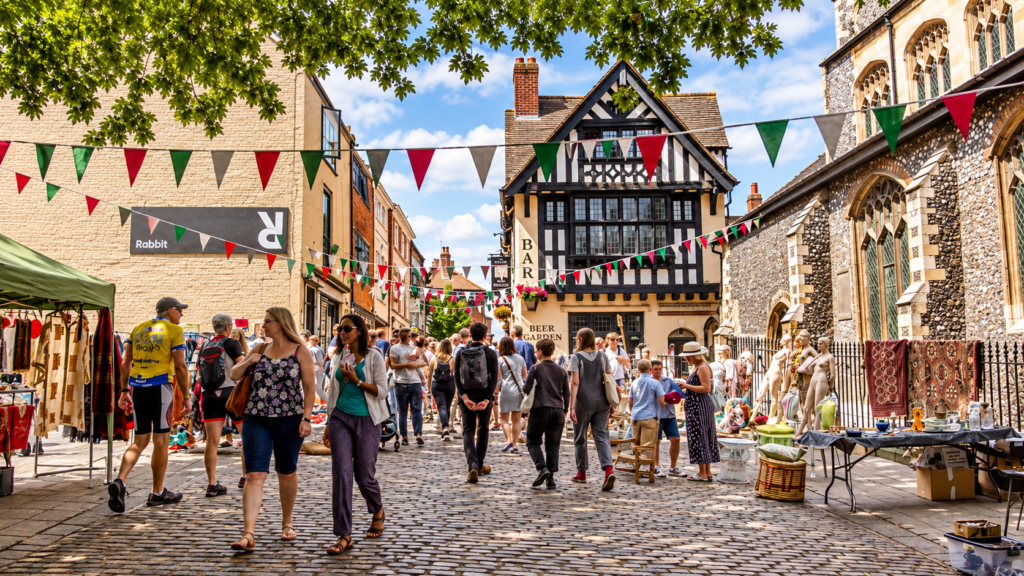
Street fairs and markets are particularly useful places for travelers to experience this side of England because they bring together local businesses, food, music and residents rather than functioning only as tourist attractions.
Scotland: Strong National and Gaelic Traditions
Scotland has a particularly visible cultural identity shaped by history, music, literature, sport and regional traditions.
Many familiar Scottish symbols — including tartan, bagpipes and Highland traditions — have connections to Gaelic culture, but contemporary Scotland is far more diverse than those well-known images suggest.
VisitScotland describes Gaelic as an integral part of Scotland’s heritage, identity and culture, with a living contemporary presence in music, literature, drama, media and sport.
You may encounter Gaelic place names and bilingual signage, particularly in parts of the Highlands and islands.
Festivals and Gatherings
Scottish cultural events range from Highland Games and traditional music gatherings to large international arts festivals.
Edinburgh becomes a major cultural centre during its summer festival season, while events such as Hogmanay, Burns Night celebrations and Highland Games reflect different aspects of Scottish tradition.
Not every cultural experience needs to involve a major event. Smaller music sessions, local museums and community gatherings can often provide more context than highly staged tourist performances.
Wales: Language and Cultural Identity
Welsh culture has a strong relationship with language, music, poetry and community tradition.
Both Welsh and English are part of everyday life, and bilingual signs are common throughout the country.
Visit Wales describes Welsh as a living language and highlights the continuing importance of music, poetry and the Eisteddfod tradition.
Travelers are not expected to speak Welsh, but learning a simple word such as diolch for “thank you” can be appreciated.
Avoid treating the Welsh language as a historical curiosity. It remains an active part of contemporary Welsh life.
The Eisteddfod Tradition
The Eisteddfod is one of Wales’s most distinctive cultural traditions.
Modern Eisteddfod events celebrate Welsh-language music, poetry, performance and visual arts, continuing a tradition with deep historical roots.
Visitors traveling during festival periods may encounter concerts, competitions and community events associated with Welsh culture.
Northern Ireland: Culture and Identity
Northern Ireland has a rich cultural landscape shaped by Irish and British traditions, local history, music, literature and community identity.
Belfast has developed a strong contemporary arts and music scene, while traditional music remains important in many communities.
Travelers should be thoughtful when discussing identity and political history. People may describe themselves in different ways, and there is no need for visitors to assign an identity to someone else.
Listen to the terminology local people use for themselves and follow their lead.
Traditional Music
Traditional Irish music is an important part of cultural life in Northern Ireland as well as across the island of Ireland.
Music sessions in pubs and cultural venues can be excellent experiences, but remember that these are not always performances staged specifically for tourists.
Give musicians space, avoid talking loudly over performances and ask before taking close-up photographs of individual performers.
Discover Northern Ireland highlights the region’s music, literary heritage, mythology and traditional pub culture as important parts of the visitor experience.
Football and Rugby
Sport is an important part of social culture throughout the United Kingdom, although loyalties vary considerably by region.
Football has enormous followings across England and Scotland as well as significant support in Wales and Northern Ireland.
Rugby has particularly strong cultural importance in Wales, while rugby is also widely followed elsewhere in the UK.
Watching a match in a pub can be an entertaining experience, but remember that club and national rivalries can be intense. Visitors do not need to adopt a side simply to participate in the atmosphere.
Markets, Fairs and Community Events
Local markets and fairs provide an accessible way to experience everyday culture away from major landmarks.
Historic market towns frequently host food markets, antique fairs, craft events and seasonal celebrations.
Events such as the Norwich Lanes Summer Fayre combine independent businesses, market stalls, street food, music and performances, illustrating how historic urban spaces continue to function as active community centres rather than simply preserved attractions. :chatgpt-content-reference{index=”1″}
Look at local event calendars when planning your trip. A small festival or weekend market may become one of the more memorable parts of the visit.
Driving and Road Etiquette
Vehicles drive on the left throughout the United Kingdom.
If you are accustomed to driving on the right, take extra care when leaving car parks, entering roundabouts and turning onto quiet roads, where habit can take over.
Rural roads in Scotland, Wales, Cornwall and Northern Ireland can be much narrower than visitors expect.
Do not assume a road is suitable for fast travel simply because the speed limit appears high. Narrow lanes, livestock, cyclists and limited visibility often require much slower speeds.
Northern Ireland’s official road-safety guidance specifically reminds visitors to keep left whenever entering or pulling onto a road. :chatgpt-content-reference{index=”2″}
Photography and Personal Space
Photographing public buildings, landscapes and street scenes is generally straightforward, but use normal consideration around individuals.
Ask before taking close portraits of strangers, performers, market traders or children.
At religious buildings, museums, historic properties and performances, check local photography rules rather than assuming cameras are permitted everywhere.
Common Mistakes Travelers Can Avoid
- Do not call the entire UK “England.” England is one of the four constituent countries.
- Do not ignore queues. Look for the end of the line before approaching a counter or boarding point.
- Do not automatically add a large restaurant tip. Check whether a service charge is already included.
- Do not assume everyone identifies simply as British. Regional and national identities matter.
- Do not treat Welsh or Scottish Gaelic as novelty languages. Both remain part of living contemporary cultures.
- Do not assume every pub uses table service. In many traditional pubs you order at the bar.
- Do not underestimate travel times. Rural roads and city transport networks can make relatively short distances take longer than expected.
Experiencing UK Culture Without Overplanning
The best cultural experiences are not always major attractions.
Spend time in local markets. Eat in a neighborhood pub. Walk through residential districts outside the main tourist streets. Attend a football or rugby match if it interests you. Visit smaller museums and look for local festivals.
Most importantly, allow the four countries of the United Kingdom to feel different from one another.
Understanding United Kingdom culture and local customs is less about learning rigid etiquette and more about recognizing those regional differences while approaching everyday interactions with courtesy and curiosity.
For regional dishes, pub food, seafood and traditional specialties, read our What to Eat in the United Kingdom: A Regional Food Guide for Travelers.
For cliffs, beaches, islands and coastal road trips, see our United Kingdom Coastlines: Cliffs, Beaches and Island Shores.
For broader trip planning, visit our United Kingdom Travel Guide: What to Know Before You Go.
From local markets and pub culture to Welsh-language traditions, Scottish festivals and Northern Ireland’s music scene, the variety of United Kingdom culture and local customs is one of the strongest reasons to travel beyond a single city and experience the country region by region.