
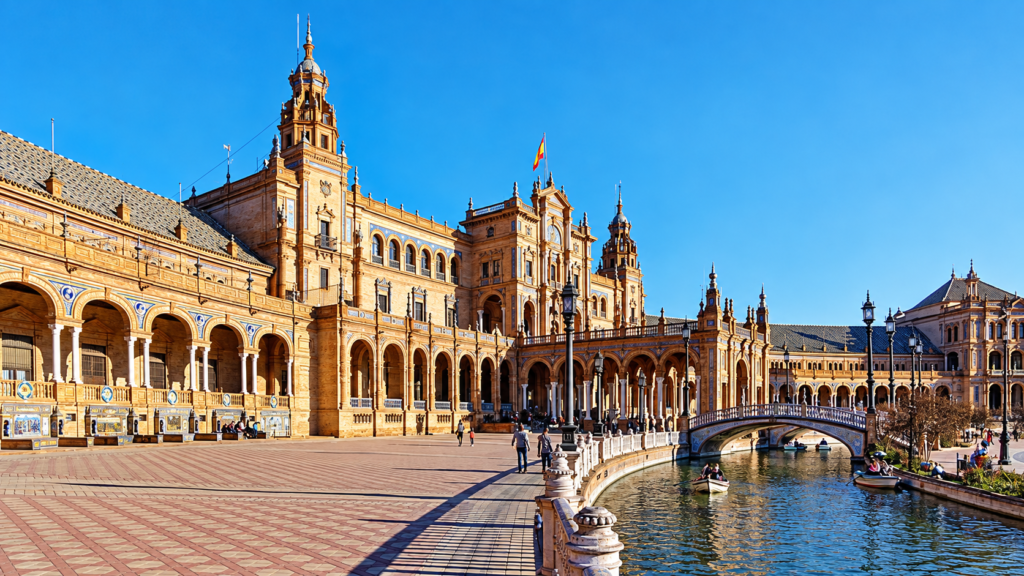
Spain culture and local customs are shaped by strong regional identities, centuries of history, different languages, local festivals and everyday traditions that can change considerably as you travel around the country.
Travelers do not need to memorize an elaborate set of social rules before visiting Spain. Basic courtesy, patience and a willingness to observe how people around you behave will usually take you much further than trying to follow a rigid etiquette checklist.
Understanding a few habits — from greetings and meal times to festivals, public spaces and regional identity — can make everyday interactions easier and help you experience Spain beyond its most famous monuments.
Spain Culture and Local Customs Vary by Region
One of the most important things to understand about Spain is that the country is culturally diverse.
Madrid, Catalonia, Andalusia, Galicia, the Basque Country, Valencia, Asturias, the Balearic Islands and the Canary Islands all have distinct histories, traditions, foods and cultural identities.
That diversity appears in architecture, music, cuisine, festivals, languages and even the rhythm of everyday life.
A trip through several regions should therefore feel like discovering different versions of Spain rather than repeatedly experiencing the same culture in different cities.
Learning about Spain culture and local customs before your trip can help you appreciate those regional differences instead of treating them as minor variations.
Madrid Is Not the Whole of Spain
Madrid is the national capital and an excellent introduction to Spanish art, food and urban life, but it should not be used as the standard against which every other region is measured.
Barcelona has a strong Catalan identity. Seville reflects Andalusian traditions. Bilbao and San Sebastián sit within the Basque Country, while Santiago de Compostela has a distinctly Galician history and culture.
Rather than asking which city feels “most Spanish,” look for the characteristics that make each destination different.
Regional Languages Matter
Spanish is spoken throughout the country, but travelers will also encounter regional languages including Catalan, Galician and Basque.
Signs, menus, announcements and place names may therefore appear in more than one language depending on where you travel.
You do not need to learn several languages for a short trip, but recognizing that linguistic diversity is part of modern Spain helps avoid the assumption that every region has exactly the same cultural identity.
Greetings, Language and Everyday Courtesy
Simple greetings are appreciated in shops, hotels, cafés and restaurants.
A few useful Spanish expressions include:
- Buenos días — good morning
- Buenas tardes — good afternoon
- Buenas noches — good evening or good night
- Por favor — please
- Gracias — thank you
- Perdón or Disculpe — excuse me or sorry
Beginning an interaction with a greeting before immediately asking a question generally feels more courteous than treating someone only as a source of information.
Do Not Assume Everyone Speaks English
English is common in many hotels, attractions and tourism-related businesses, especially in major destinations.
That does not mean every person you meet will speak English comfortably.
Use simple language, speak at a normal volume and give people time to understand what you are asking.
A translation app can be particularly useful in smaller towns, markets, pharmacies or situations where the information is more complicated than a basic travel question.
Observe Before Assuming
Visitors sometimes arrive with fixed ideas about Spanish behaviour based on films, television or previous vacations.
Actual social customs vary by age, region, setting and individual personality.
If you are unsure how formal a situation is, observing how other people greet one another, order food or use a public space is usually more useful than relying on stereotypes.
Daily Life and Social Rhythm
Travelers often notice that daily schedules in Spain can feel different from those in North America.
Meal times are generally later, evenings can remain active well after sunset and public spaces often play an important role in social life.
Do Not Build Your Trip Around the Siesta Stereotype
Spain is frequently associated with the idea that the entire country stops every afternoon for a siesta.
Modern life is much more complicated than that stereotype suggests.
Some independent businesses may close for part of the afternoon, particularly outside major tourist centres, while large stores, museums and businesses in busy urban areas often operate continuously.
Check the opening hours of the specific place you intend to visit rather than assuming that one national rule applies everywhere.
Evenings Can Start Later
Spanish cities and towns can remain socially active later into the evening than some visitors expect.
Restaurants may fill late, families may still be out in public squares and outdoor terraces can remain lively well after the time some travelers would normally end their day.
You do not need to copy the local schedule completely, but adjusting slightly can help you experience destinations when they are at their most animated.
Plazas Are Social Spaces
Public squares are not simply places to photograph.
Plazas frequently function as social spaces surrounded by cafés, restaurants, shops, churches and civic buildings.
Some are monumental tourist attractions, while others are neighbourhood gathering places used primarily by local residents.
Spending time in an ordinary plaza can reveal more about daily life than rushing immediately to the next landmark.
Meals Are Part of Social Life
Meals often provide time for conversation and socializing rather than being treated purely as a quick break between activities.
A relaxed lunch, several shared tapas or an evening moving between pintxos bars can all be part of experiencing Spain’s social culture.
For a deeper introduction to regional cuisine and dining customs, see our guide to what to eat in Spain.
Music, Art and Cultural Traditions
Spain has an unusually rich cultural heritage, but travelers should avoid reducing it to a few internationally familiar images.
Flamenco, historic architecture and famous painters are important parts of the story, but so are local crafts, regional music, religious traditions and forms of popular culture that may be unfamiliar before you arrive.
Flamenco Has Strong Regional Roots
Flamenco combines singing, dance and musicianship and is most strongly associated with Andalusia, although its historical roots also extend into other parts of southern and southeastern Spain.
UNESCO added flamenco to the Representative List of the Intangible Cultural Heritage of Humanity in 2010.
If you attend a flamenco performance, treat it as a musical and artistic event rather than simply a colourful tourist spectacle.
The quality and atmosphere vary enormously between venues, from intimate performances to large productions aimed heavily at visitors.
Spain’s Art Is Not Confined to Museums
Museums in Madrid, Barcelona and other cities contain works by some of Spain’s most influential artists, but artistic traditions are also visible in architecture, churches, ceramics, public monuments and everyday streetscapes.
Pay attention to regional building styles and decorative traditions rather than seeing culture only through major museum collections.
Local Traditions Can Be Highly Specific
Some traditions are closely connected with one particular region or community.
Catalonia is known for castells, the human towers built during festivals. La Gomera in the Canary Islands is associated with Silbo Gomero, a traditional whistled language. Córdoba celebrates its famous courtyard tradition, while numerous towns maintain their own religious, craft and musical customs.
Spain has multiple traditions included on UNESCO’s lists of intangible cultural heritage, reflecting how diverse these regional practices are.
Travelers interested in exploring these traditions further can consult Spain’s official tourism information on culture and traditions.
Festivals and Local Celebrations
Festivals can completely change the experience of a Spanish destination.
Religious observances, local patron-saint celebrations, music events and large civic festivals can bring processions, fireworks, street closures, performances and enormous crowds.
Semana Santa
Holy Week, or Semana Santa, is observed in many parts of Spain, although traditions differ significantly between destinations.
Processions can be especially elaborate in parts of Andalusia and Castilla y León, where religious brotherhoods and communities maintain long-established traditions.
Visitors should remember that these events are not simply performances. They have religious and community significance for many participants.
Las Fallas in Valencia
Valencia’s Las Fallas festival transforms the city in March with enormous satirical sculptures, street activity, fireworks and celebrations.
The festival culminates with the burning of most of the large Fallas monuments.
If your trip overlaps with the festival, expect noise, crowds, road closures and accommodation demand far beyond what you would experience during an ordinary week in Valencia.
San Fermín in Pamplona
Pamplona’s San Fermín festival takes place in July and is internationally associated with the running of the bulls.
The festival includes much more than that one event, with music, gatherings and celebrations throughout the city.
Travelers should research the festival carefully before attending because crowds, accommodation prices and transportation patterns change dramatically during the celebrations.
Local Festivals Can Be Just as Memorable
You do not need to attend one of Spain’s internationally famous festivals to experience local traditions.
Towns throughout the country hold annual celebrations involving music, food, processions, dancing, fireworks and regional customs.
Checking the local calendar before your trip can reveal events you would never discover by looking only at lists of major tourist attractions.
Practical Etiquette for Travelers
Respect Religious Sites
Spain has thousands of churches, cathedrals, monasteries and religious monuments that attract visitors for their architecture and art.
Many remain active places of worship.
Follow posted rules, keep voices low, avoid disrupting services and observe any photography restrictions.
Where dress requirements are posted, follow them rather than assuming that tourist popularity overrides the expectations of an active religious site.
Respect Residential Neighbourhoods
Some of Spain’s most photogenic historic districts are also places where people live and work every day.
Avoid blocking doorways, entering private courtyards, leaning into windows or creating unnecessary noise for photographs.
This is particularly important in heavily visited areas where residents regularly deal with large numbers of tourists.
Ask Before Taking Close-Up Photographs of People
There is a difference between photographing a busy public square and making one stranger the obvious subject of a close-up image.
When a person is clearly the focus of the photograph, asking permission is the more respectful approach.
Use Public Transportation Considerately
Allow passengers to exit trains, metros and buses before boarding.
Keep bags and luggage from blocking aisles, doors and seats, and pay attention to designated priority seating.
Ticketing and validation procedures differ between cities and transportation systems, so follow the instructions for the service you are actually using.
Check Business Hours Rather Than Guessing
Opening hours vary by region, season and type of business.
Some small businesses may close in the afternoon or on particular days of the week, while major stores and businesses in tourism centres often maintain longer schedules.
Always check current hours before making a special journey somewhere.
Remember That Popular Places Are Still Communities
Barcelona, Madrid, Seville, San Sebastián and Spain’s coastal resorts welcome enormous numbers of visitors, but they remain working cities and communities.
Public transport, neighbourhood shops, residential streets and markets exist for local residents as well as travelers.
Travelling respectfully means remembering that distinction even when a destination feels heavily oriented toward tourism.
Travel With Curiosity, Not Stereotypes
Spain is often reduced in travel advertising to flamenco, paella, beaches, bullfighting and late-night parties.
Those images represent only fragments of a much more complicated country.
Modern Spain includes major international cities, rural communities, industrial regions, island cultures, multilingual areas and traditions that differ substantially from one part of the country to another.
Do Not Expect Every Region to Perform the Same Version of Spain
You will not find the same food, music, architecture or traditions everywhere.
Flamenco has particular roots in southern Spain. Pintxos belong strongly to Basque food culture. Castells are associated with Catalonia. Galician traditions reflect another regional history entirely.
Those differences are not exceptions to Spanish culture. They are part of Spanish culture.
Be a Guest Rather Than an Audience
Markets, cafés, plazas, churches and neighbourhood streets do not exist solely to provide travelers with experiences.
People are commuting, working, shopping, worshipping and spending time with friends and family around you.
Approaching those spaces with basic awareness makes travel both more respectful and more interesting.
Experience Spain Beyond the Landmarks
Spain’s museums, cathedrals, palaces and historic cities deserve their reputation, but culture is also found in ordinary moments.
It may be an evening conversation in a neighbourhood plaza, a regional festival you had never heard of, a market filled with unfamiliar ingredients or music performed for a local audience rather than tourists.
Understanding Spain culture and local customs is less about memorizing rules than paying attention to regional differences, everyday courtesy and how people use the places you are visiting.
Learn a few Spanish phrases. Notice regional languages. Respect religious and residential spaces. Leave room for unscheduled time and be willing to discover that the Spain you encounter may differ from the Spain you imagined before arriving.
For complete trip-planning information, see our Spain Travel Guide: What to Know Before You Go.
You can also explore more destination-focused articles in our Culture travel guides.