
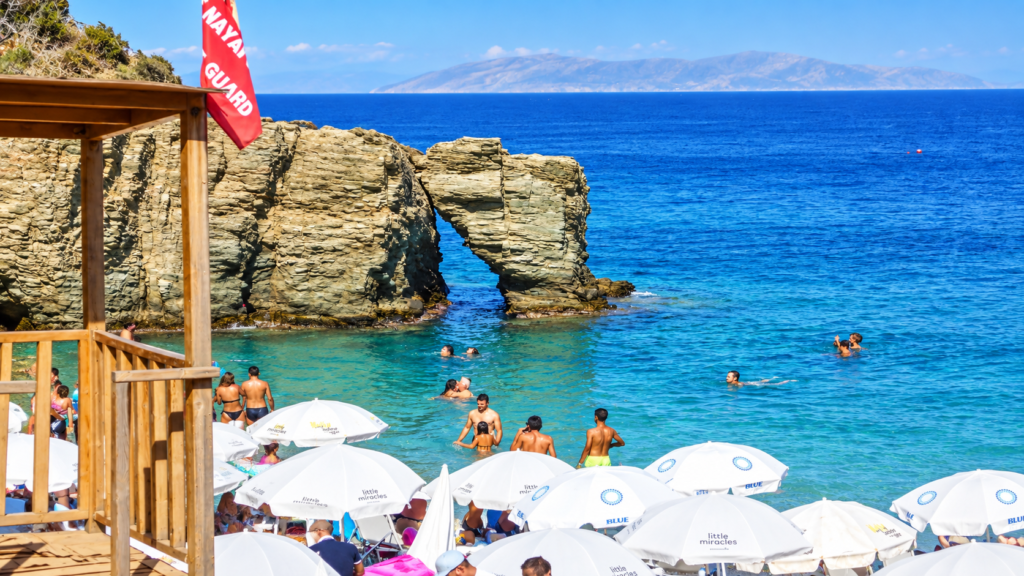
Greece coastlines and island destinations are far more varied than the familiar images of whitewashed villages above a brilliant blue sea. Greece has thousands of islands and islets, hundreds of inhabited islands and an enormous mainland coastline that ranges from sandy resort beaches to rugged cliffs, pine-backed coves, volcanic shores and traditional fishing villages.
The Cyclades offer the classic white-and-blue landscapes associated with Santorini, Paros and Mykonos. The Ionian Islands are greener and more dramatic, with limestone cliffs and remarkably clear water. Crete combines major beaches with mountain scenery and historic coastal cities, while the Dodecanese, Sporades and North Aegean each have their own character.
The mainland should not be overlooked either. The Peloponnese, Halkidiki, the Athens Riviera and countless smaller coastal communities can provide excellent seaside experiences without requiring an island-hopping itinerary.
This guide will help you understand the main coastal regions, choose islands that match the way you like to travel and plan a Greek seaside trip without assuming every destination offers the same experience.
Greece Coastlines and Island Destinations: Where to Start
The first decision is not which Greek island is “best.” It is what kind of coastal experience you want.
- Iconic Cycladic scenery: Santorini, Paros, Naxos, Milos and smaller Cycladic islands.
- Green landscapes and dramatic beaches: Corfu, Lefkada, Kefalonia and Zakynthos.
- Large island with beaches, cities and mountains: Crete.
- History combined with beaches: Rhodes and other Dodecanese islands.
- Pine forests and turquoise coves: Skiathos, Skopelos and the Sporades.
- Quieter island atmosphere: Tilos, Astypalea, smaller Cyclades and parts of the North Aegean.
- Coastal road trips: Peloponnese, Halkidiki and mainland Greece.
Greece’s official tourism organization groups the country’s islands into the Cyclades, Dodecanese, Ionian Islands, Sporades, North Aegean, Argosaronic islands, Crete and Evia. Its official Greek islands guide is a useful starting point when comparing regions.
The Cyclades
The Cyclades are the island group many travelers picture when they imagine Greece.
Whitewashed buildings, blue-domed churches, dry hills, stone walls, small chapels and deep-blue Aegean water create an instantly recognizable landscape.
But the islands are not interchangeable. Santorini, Naxos, Paros, Milos, Sifnos and the smaller Cyclades can produce very different trips.
Santorini
Santorini is primarily famous for its volcanic caldera, clifftop settlements and sunsets rather than for conventional long sandy beaches.
The island’s volcanic geology creates unusual coastlines including black and red-toned beaches. Travelers who choose Santorini should think of the coast as part of a dramatic landscape rather than expecting a classic beach-resort island.
Naxos and Paros
Naxos is particularly useful for travelers who want sandy beaches while still having villages, agricultural landscapes and substantial inland areas to explore.
Neighbouring Paros combines beaches with attractive settlements such as Naoussa and Lefkes, along with restaurants, nightlife and water sports.
Milos and the Smaller Cyclades
Milos stands out for unusual rock formations, colourful fishing settlements and a coastline shaped by volcanic geology.
Smaller islands such as Folegandros, Serifos, Sifnos, Amorgos and the Small Cyclades can provide a quieter experience, although transport and accommodation options may be more limited.
Crete
Crete is large enough to function almost like a separate journey rather than a quick island stop.
The coastline includes developed beach areas, isolated coves, lagoons, dramatic cliffs and historic cities, while the interior rises quickly into major mountain ranges.
Chania and Western Crete
Chania combines a historic harbour and old town with access to some of Crete’s best-known western coastal scenery.
Beaches and landscapes around western Crete range from broad sandy areas to remote shorelines backed by rugged mountains.
The region works particularly well for travelers who want to combine beaches with hiking, villages and food rather than spending the entire trip at one resort.
Southern Crete
The south coast often feels more rugged and less densely developed than the busiest northern resort zones.
Mountain roads descend toward small seaside communities, beaches and coves where travel can feel slower and more remote.
Distances on Crete can be deceptive, so it is usually better to explore one or two regions well rather than attempting to cross the island repeatedly.
The Ionian Islands
Travelers who imagine Greek islands as dry and rocky may be surprised by the Ionian Islands.
Located along western Greece, islands such as Corfu, Lefkada, Kefalonia and Zakynthos receive more rainfall and generally appear greener than the Cyclades.
Their coastlines are known for forested hills, limestone formations, caves and beaches beneath steep cliffs.
Corfu
Corfu combines beaches with one of Greece’s most distinctive historic island towns.
Venetian and other European influences are visible in Corfu Town, while the island’s coastline includes resort beaches, quieter coves and green landscapes.
Lefkada and Kefalonia
Lefkada is unusual because it can be reached from the mainland by road, making it convenient for travelers planning a driving itinerary.
Its western coastline is known for dramatic beaches beneath pale cliffs.
Kefalonia offers a similarly dramatic landscape on a larger scale, combining beaches, mountain scenery, caves and attractive coastal villages.
Zakynthos
Zakynthos is famous for dramatic coastal scenery and remarkably clear water, but it is also environmentally important.
Parts of the island and surrounding marine environment provide habitat for loggerhead sea turtles. Travelers should respect protected areas, beach restrictions and wildlife guidance rather than treating sensitive nesting zones as ordinary recreation areas.
The Dodecanese
The Dodecanese lie in the southeastern Aegean and include islands with very different personalities.
Rhodes combines major historical attractions, beaches and tourism infrastructure, while Karpathos, Astypalea and smaller islands can provide more rugged or quieter experiences.
Rhodes
Rhodes is particularly strong for travelers who want beaches without sacrificing history and sightseeing.
The Medieval Town of Rhodes, Lindos, mountain villages and extensive coastline allow visitors to combine swimming days with cultural exploration.
Karpathos and Astypalea
Karpathos has a long, narrow shape with mountainous terrain, traditional villages and beaches scattered along a dramatic coastline.
Astypalea has a different character, combining whitewashed Aegean architecture with sheltered bays, rocky landscapes and a much smaller-scale tourism environment.
These islands can appeal to travelers who want beautiful coastlines without the intensity of Greece’s busiest international destinations.
The Sporades and Evia
The Sporades provide one of Greece’s greenest island landscapes.
Skiathos, Skopelos and Alonnisos combine pine-covered hills with clear water and numerous coves.
Skiathos has the most developed tourism infrastructure of the group and is particularly well known for beaches backed by vegetation.
Skopelos generally feels quieter, while Alonnisos attracts travelers interested in nature, walking and the surrounding marine environment.
Evia, meanwhile, is Greece’s second-largest island and sits so close to the mainland that parts of it feel more like a coastal road-trip destination than an isolated island escape.
The North Aegean
The North Aegean islands generally receive less international attention than Santorini, Mykonos or Rhodes, which can make them appealing to travelers looking for a slower island experience.
Lesbos, Chios, Samos, Lemnos and Ikaria each have strong local identities and landscapes that differ substantially from the Cyclades.
Here, beaches may share the trip with mountain villages, thermal springs, vineyards, traditional settlements, archaeological sites and local food traditions.
Ikaria is particularly associated with a slower pace of life, while Chios combines beaches with medieval villages and the island’s distinctive mastic-growing culture.
The Saronic Gulf and Athens Riviera
Not every Greek island trip requires a long ferry journey or domestic flight.
The Saronic Gulf islands are relatively close to Athens, making them useful for shorter trips or for travelers who want to combine the capital with island time.
Aegina, Poros, Hydra and Spetses each have distinct personalities, waterfront settlements and beaches.
The Athens Riviera also extends the coastal experience south from the city through seaside suburbs and beaches toward Cape Sounion.
This can be a practical choice for travelers who want access to the sea without changing hotels or reorganizing an entire itinerary around ferries.
Mainland Greece and the Peloponnese
Greece’s mainland coastline deserves far more attention than it usually receives.
The Peloponnese
The Peloponnese provides an excellent setting for a coastal road trip.
Travelers can combine historic towns, archaeological sites, mountain villages and long stretches of coastline without relying on ferries.
Nafplio makes a particularly attractive seaside base, while the Mani Peninsula offers a more rugged landscape of stone villages, mountains and small coastal settlements.
Farther south and west, beaches and seaside towns can be combined with destinations such as Monemvasia, Methoni and Pylos.
Halkidiki
In northern Greece, Halkidiki is one of the country’s major beach regions.
Its distinctive three-pronged peninsula reaches into the Aegean southeast of Thessaloniki and offers extensive beaches, pine-backed coves, resorts and smaller seaside communities.
It can be particularly convenient for travelers combining a northern Greece itinerary with time on the coast.
Beaches, Swimming and Sea Conditions
A beautiful photograph does not tell you everything you need to know about a Greek beach.
Some beaches are sandy and shallow, while others are made of pebbles or volcanic rock and become deep quickly.
Wind can also have a significant effect, particularly in the Aegean during summer. A beach that is calm one day may be much rougher on another.
Bring footwear suitable for hot sand, pebbles or rocky access when appropriate, and consider water shoes if you prefer additional protection on stony beaches.
Where lifeguards, warning flags or local safety notices are present, treat them seriously. Remote coves may have no services at all, so carry sufficient water and sun protection.
Shoulder seasons can offer comfortable sightseeing conditions, but sea temperatures, ferry frequency and beach services will differ from peak summer.
Island-Hopping and Transportation
Greek island-hopping works best when geography drives the itinerary.
Choosing islands within the same group is usually more efficient than trying to connect famous destinations simply because their names are familiar.
For example, combining several Cycladic islands generally makes more sense than repeatedly crossing between the Cyclades, Ionian Islands and Dodecanese during a short trip.
Some islands have airports, while others depend entirely on ferries. Routes and frequency can vary considerably by season.
Weather can also affect sea transportation, so avoid creating an itinerary in which every ferry connection must work perfectly for you to catch an international flight.
Leaving some flexibility before your departure from Greece is particularly sensible when traveling between smaller islands.
Choosing the Right Greek Coast or Island
The most famous Greek island is not necessarily the best island for your trip.
If dramatic scenery and iconic architecture matter most, the Cyclades may be the obvious starting point. If you want greener landscapes and cliff-backed beaches, consider the Ionian Islands. Crete works particularly well for travelers who want beaches, food, cities, mountains and archaeology within one large destination.
Rhodes combines history with a strong beach infrastructure, while the Sporades are appealing for pine-covered landscapes and clear coves. Smaller islands can offer tranquillity but may require more careful planning around ferries and accommodation.
Mainland destinations should remain part of the conversation as well. A Peloponnese road trip or several days in Halkidiki can provide a superb coastal experience without the logistics of island-hopping.
Experience Greece Beyond the Famous Beaches
The coastline is one of Greece’s greatest attractions, but the most rewarding seaside trips usually extend beyond lying on a beach.
Walk through a fishing village in the morning. Eat lunch at a small taverna. Explore an inland village when the afternoon beach becomes crowded. Watch fishing boats return to harbour. Take an evening walk along a waterfront promenade and stay long enough to see how the community changes after sunset.
Greece’s islands and coastal regions are also shaped by food and local traditions. For regional dishes and dining ideas, see our What to Eat in Greece: A Regional Food Guide for Travelers.
For etiquette, festivals and everyday life, read our Greece Culture and Local Customs: What Travelers Should Know.
For broader planning information, visit our Greece Travel Guide: What to Know Before You Go.
You can also explore more seaside destinations through our Coastlines travel guides.
The variety of Greece coastlines and island destinations is what makes planning both exciting and challenging. Rather than trying to see as many islands as possible, choose a region that suits your interests and give yourself enough time to experience its beaches, towns, landscapes and everyday coastal life.