
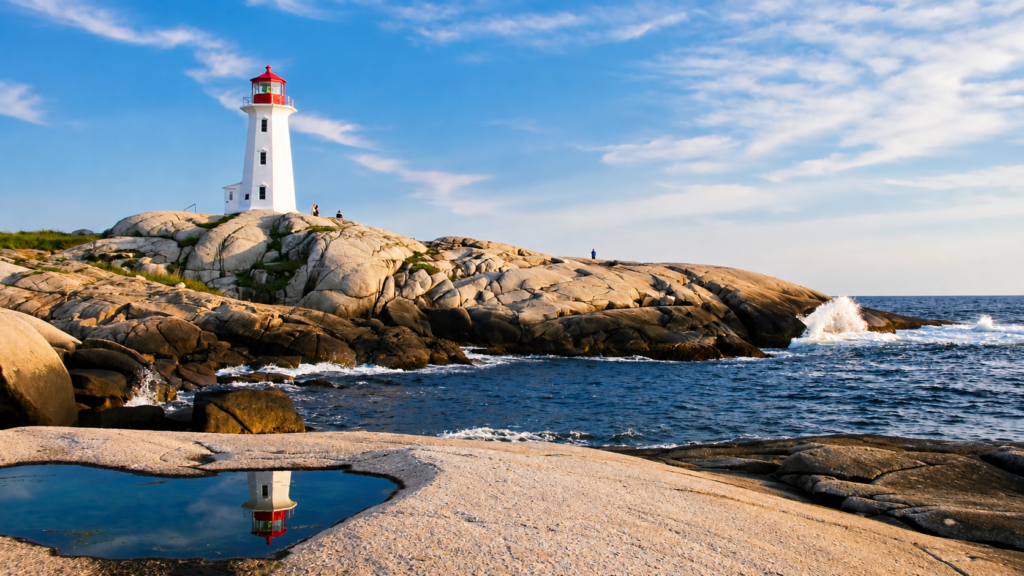
Canada is defined as much by water as it is by land. Its shores meet the Atlantic, Pacific and Arctic oceans, creating an extraordinary range of coastal landscapes — from colourful fishing communities and red sandstone cliffs to temperate rainforests, remote islands and dramatic Arctic fjords.
With more than 243,000 kilometres of shoreline, Canada has the longest coastline in the world. But for travelers, the real attraction is not simply its size. Exploring Canada coastlines can mean watching the enormous tides of the Bay of Fundy, walking beside the Atlantic on Prince Edward Island, standing beneath rainforest beside the Pacific Ocean or travelling through a remote Arctic landscape where mountains, glaciers and sea meet.
If you are planning a broader trip through the country, start with our Canada Travel Guide: What to Know Before You Go before deciding which coastal region best suits your trip.
Canada’s Atlantic Coast
For many travelers, Atlantic Canada delivers the country’s most immediately recognizable coastal scenery. Rocky headlands, lighthouses, fishing harbours, islands, beaches and historic communities stretch through Nova Scotia, Prince Edward Island, New Brunswick and Newfoundland and Labrador.
The Atlantic provinces are particularly well suited to road trips because coastal communities, scenic areas and local food traditions can often be combined within the same itinerary.
Nova Scotia
Nova Scotia is an excellent choice for travelers who want their trip to revolve around the sea. Much of the province is shaped by its relationship with the Atlantic, and the landscape ranges from granite headlands and sheltered coves to working harbours and long stretches of open coastline.
Lighthouses are among the province’s most recognizable landmarks, but Nova Scotia offers much more than postcard views. Small coastal communities, seafood traditions, historic ports and scenic drives allow visitors to experience both the landscape and the culture connected to it.
Halifax provides a convenient urban starting point, while smaller communities offer a quieter introduction to Atlantic Canada.
Prince Edward Island
Prince Edward Island has an entirely different coastal personality.
Prince Edward Island National Park extends across more than 65 kilometres of shoreline and protects sandy beaches, dunes, wetlands and the island’s distinctive red sandstone cliffs.
The combination of red cliffs, green countryside, pale sand and blue water creates some of Atlantic Canada’s most distinctive scenery. The beaches can be inviting during summer, but the coastline is equally rewarding for walking, cycling and photography.
The sandstone cliffs and dune systems are fragile. Travelers should use designated paths, boardwalks and beach-access routes instead of climbing unstable cliffs or walking through protected dunes.
New Brunswick and the Bay of Fundy
New Brunswick provides one of Canada’s most unusual coastal experiences: the Bay of Fundy.
According to Parks Canada, the Bay of Fundy has the highest tides in the world. At Fundy National Park, the difference between high and low tide can reach approximately 12 metres, while the upper reaches of the bay can experience even greater changes.
The result is a coastline that can look completely different within a matter of hours. At low tide, extensive tidal flats and sections of the ocean floor become exposed. When the tide returns, those same areas disappear beneath the water.
If you plan to walk along tidal areas, check official tide schedules first. The incoming tide should never be estimated simply by looking at the water or by relying on the time you arrived.
Newfoundland and Labrador
Newfoundland and Labrador brings a larger, wilder scale to Canada’s Atlantic coast.
Fishing communities, cliffs, offshore islands, bays and exposed ocean views are found throughout the province. In many areas, the coastline feels considerably more remote than in the Maritime provinces farther south.
One of the most striking destinations is Gros Morne National Park in western Newfoundland, where coastal scenery is combined with mountains, glacially shaped valleys and remarkable geology.
Newfoundland is particularly appealing to travelers looking for dramatic landscapes, hiking and smaller communities rather than a traditional beach vacation.
Canada’s Pacific Coast
Cross the country to British Columbia and the character of Canada coastlines changes dramatically.
The Pacific coast is characterized by forest-covered mountains, rocky islands, sheltered waterways, long beaches and areas of temperate rainforest. The climate is generally milder than much of Canada, although rain and rapidly changing coastal weather are part of the experience.
Vancouver Island
The west coast of Vancouver Island offers one of the best introductions to Canada’s Pacific shoreline.
Pacific Rim National Park Reserve lies along Vancouver Island’s west coast in the traditional territories of the Nuu-chah-nulth First Nations. The reserve includes three distinct areas: Long Beach, the Broken Group Islands and the West Coast Trail.
Long Beach is the easiest section for most travelers to experience. Broad sandy beaches face the open Pacific while dense temperate rainforest begins almost immediately behind the shoreline.
The nearby communities of Tofino and Ucluelet make convenient bases for beach walks, hiking, surfing, wildlife excursions and storm watching.
The Pacific Ocean should always be treated with respect. Waves, currents, cold water and rapidly changing conditions can create hazards even when the weather appears calm. Check local warnings and conditions before entering the water or exploring exposed shoreline.
Broken Group Islands
Farther south in Pacific Rim National Park Reserve, the Broken Group Islands offer a very different coastal experience.
Located in Barkley Sound, the islands are accessible only by boat. Sheltered bays, forested islands, rocky reefs and marine passages make the area especially popular with experienced paddlers and travelers looking for a more remote adventure.
Parks Canada requires valid permits for overnight camping, and closures or restrictions can change with conditions. Anyone considering an overnight trip should check the latest information on the official Broken Group Islands page before departure.
Haida Gwaii
For travelers prepared to venture farther from British Columbia’s main tourism routes, Haida Gwaii offers a much more remote coastal environment.
At the southern end of the archipelago, Gwaii Haanas National Park Reserve, National Marine Conservation Area Reserve, and Haida Heritage Site encompasses islands, forest and marine environments.
Gwaii Haanas contains approximately 1,700 kilometres of coastline. There are no roads within the protected area, and access is limited to boats and seaplanes. Most visitors explore with a licensed tour operator, although independent travel is possible with the appropriate reservations and orientation.
Haida Gwaii is also the homeland of the Haida Nation. Travelers should approach the region not simply as a wilderness destination, but as a living cultural landscape with deep Indigenous history and continuing traditions.
Canada’s Arctic Coast
Canada’s Arctic coast is fundamentally different from both the Atlantic and Pacific.
Distances are enormous, road access is extremely limited and many northern communities can only be reached by air. Weather, sea ice and transportation conditions can change quickly, so Arctic coastal trips require considerably more planning.
The reward is access to some of the country’s most extraordinary landscapes.
Baffin Island and Auyuittuq National Park
On southeastern Baffin Island, Auyuittuq National Park contains glaciers, mountains, tundra, river valleys and dramatic fjords.
Parks Canada reports that the park has approximately 800 kilometres of fjord coastline, with some vertical fjord walls rising as much as 900 metres.
Auyuittuq lies within a landscape with longstanding Inuit cultural connections. Visiting this region is very different from taking a road trip through southern Canada. Transportation, permits, local services, guides and seasonal conditions should all be researched before departure.
Travelers should also recognize that northern communities are not simply gateways to wilderness. They are living Inuit communities with their own histories, cultures and relationships with the land and sea.
Canada’s Coastlines Are About More Than Beaches
It is easy to think of coastal travel primarily as a search for beaches, but many of the most memorable experiences along Canada coastlines have little to do with swimming.
You might walk across the exposed ocean floor beside the Bay of Fundy, photograph a Nova Scotia lighthouse, watch fishing boats return to harbour, hike through Pacific rainforest, surf on Vancouver Island or travel between towering Arctic fjords.
That variety is one of the strongest reasons to treat Canada’s coast as a travel theme of its own.
Coastal Road Trips
Atlantic Canada is particularly well suited to travelers who enjoy driving.
Nova Scotia, Prince Edward Island and New Brunswick make it possible to combine coastal communities, scenic viewpoints, beaches, cultural attractions and local restaurants without the extreme distances encountered in other parts of Canada.
Newfoundland can also be explored by road, but distances are greater and itineraries should allow additional time.
Hiking and Walking
Walking is one of the best ways to appreciate Canada’s coastal landscapes.
Options range from easy boardwalks and beach walks on Prince Edward Island to rainforest trails on Vancouver Island and demanding backcountry routes such as the West Coast Trail.
Trail conditions can change quickly in coastal environments. Check official park information before setting out, particularly on remote or backcountry routes.
Wildlife and Marine Experiences
Many coastal regions offer opportunities to see marine wildlife, seabirds and other animals.
The species present and the best viewing seasons vary significantly by region, so travelers should research the specific destination and time of year rather than assuming wildlife sightings are guaranteed.
When booking boat trips or wildlife excursions, use established operators that follow local regulations and responsible wildlife-viewing practices.
When to Visit Canada’s Coasts
For most travelers exploring Atlantic or Pacific Canada, late spring through early autumn provides the easiest conditions for road trips, hiking and general sightseeing.
July and August are typically the busiest months in many popular coastal destinations. Travelers who prefer fewer crowds may find June and September attractive alternatives, although weather can become less predictable outside midsummer.
Atlantic Canada
Summer provides the broadest range of accommodations, attractions and outdoor activities. Early autumn can also be especially attractive for travelers combining coastal scenery with changing foliage.
Pacific Canada
British Columbia’s coast has a comparatively mild maritime climate, but rain should be expected throughout much of the year.
Summer is popular for hiking, camping, paddling and beach activities, while autumn and winter attract visitors interested in storm watching along parts of Vancouver Island.
Arctic Canada
Northern travel is much more seasonal and specialized. Accessibility varies greatly by destination, and transportation can be affected by weather and local conditions.
Rather than choosing a generic “best month for Canada,” plan an Arctic journey around the specific community, park or experience you intend to visit.
Respecting Canada’s Coastal Landscapes
Many of Canada’s most beautiful coastal environments are also fragile.
Dunes, sandstone cliffs, tidal zones, wetlands and wildlife habitat can be damaged surprisingly easily. Follow marked paths, use boardwalks where provided and respect closures designed to protect sensitive areas.
Keep a safe distance from wildlife and never assume that an animal seen near a trail, beach or roadside is comfortable with human presence.
In Indigenous territories, remember that these landscapes are not simply scenic attractions. They are homelands with living cultures and longstanding relationships with the land and sea.
Choosing the Right Canadian Coast
The best Canadian coastline depends on the kind of trip you want.
- Choose Atlantic Canada for lighthouses, historic fishing communities, dramatic tides, seafood traditions, beaches and accessible road trips.
- Choose the Pacific coast for temperate rainforest, surfing, island landscapes, rugged hiking and long ocean beaches.
- Choose the Arctic coast for remote landscapes, Inuit culture, glaciers, mountains and expedition-style travel.
There is no single landscape that represents the Canadian coast. From Nova Scotia’s granite shoreline to Vancouver Island’s rainforest-backed beaches and Baffin Island’s enormous Arctic fjords, the country’s three ocean coastlines offer completely different experiences.
For regional dishes, seafood, local specialties and dining advice, read our What to Eat in Canada: A Regional Food Guide for Travelers.
For etiquette, traditions and everyday customs, see our Canada Culture and Local Customs: What Travelers Should Know.
For broader trip planning, visit our Canada Travel Guide: What to Know Before You Go.
You can also browse additional seaside destinations through our Coastlines travel guides.
The variety of Canada coastlines means there is no single Canadian coastal experience. From Atlantic fishing communities and the enormous tides of the Bay of Fundy to Pacific rainforests and remote Arctic fjords, choose the coast that best matches your travel style and give yourself enough time to experience the landscapes, communities and cultures along the way.