
The United Kingdom is surrounded by an extraordinary variety of coastal landscapes. Across England, Wales, Scotland and Northern Ireland, travelers can find towering chalk cliffs, broad sandy beaches, fishing villages, rugged headlands, remote islands and some of Europe’s most memorable coastal roads.
Exploring United Kingdom coastlines is less about finding one definitive seaside destination and more about choosing the kind of coast that suits your trip. Southern England combines historic seaside towns with dramatic cliffs, Wales is made for coastal walking, Scotland brings mountains and islands directly to the sea, and Northern Ireland combines geological landmarks with one of the UK’s most scenic driving routes.
The distances can also be deceptive. Trying to cover several coastal regions during one short trip usually means spending too much time in transit. Choosing one or two regions and exploring them properly generally produces a much better experience.
England’s Coastline
England’s coast changes dramatically as you travel around the country. Chalk cliffs dominate parts of the southeast, ancient geology defines Dorset and East Devon, and Cornwall’s Atlantic coastline combines cliffs, coves, beaches and traditional harbour towns.
For first-time visitors, southern England offers some of the easiest coastal landscapes to combine with London or a broader road trip.
Dover and the White Cliffs
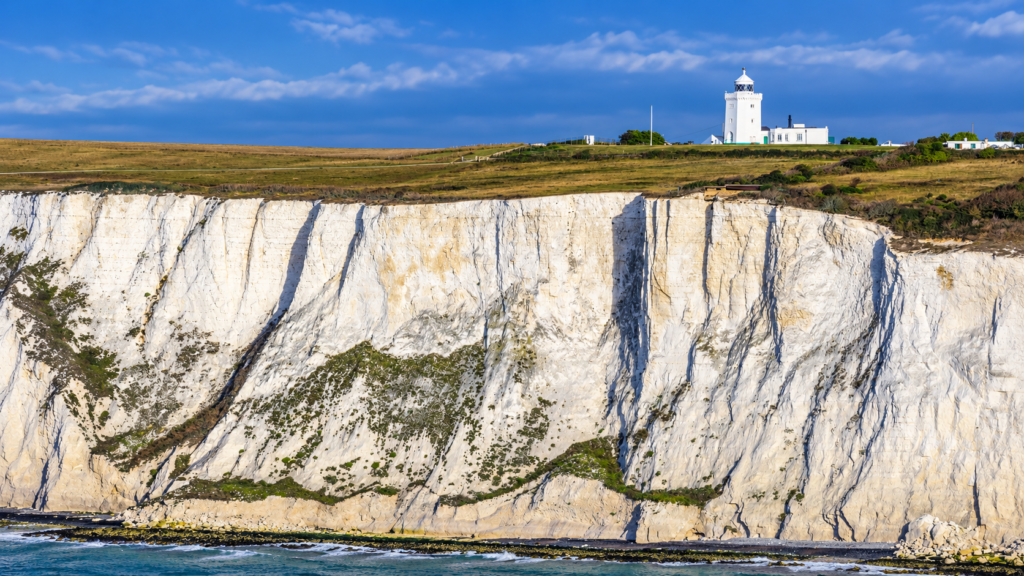
The White Cliffs of Dover are among England’s most recognizable coastal landmarks. Rising above the English Channel in Kent, the bright chalk cliffs have long formed a distinctive approach to Britain’s southeastern coast.
Above the cliffs stands South Foreland Lighthouse, the landmark featured in this article’s image. The Victorian lighthouse was built to help guide ships through the Strait of Dover and warn mariners about hazardous shifting sands.
The combination of open sea, white chalk and historic lighthouse makes this section of coast especially rewarding for walking and photography.
Dover is also relatively straightforward to reach from London, making the coast practical for travelers who want to experience dramatic scenery without committing to a long journey into southwest England.
Seven Sisters and the Sussex Coast
Farther west, the chalk landscape continues along the Sussex coast.
The Seven Sisters form a distinctive sequence of white chalk cliffs within the South Downs National Park. The cliffs are gradually reshaped by coastal erosion, creating the rolling series of peaks and valleys that make this one of southern England’s classic coastal views.
Walks around Seven Sisters, Beachy Head and Cuckmere Haven provide expansive views of the English Channel and surrounding chalk countryside.
The cliffs are also unstable. Coastal erosion causes regular cliff falls, so visitors should remain well back from cliff edges and avoid standing directly beneath unstable chalk faces.
The Jurassic Coast
Continue west and the geology becomes even more remarkable.
The Dorset and East Devon Coast, commonly known as the Jurassic Coast, stretches for approximately 95 miles between East Devon and Dorset. The UNESCO World Heritage landscape exposes roughly 185 million years of Earth’s history through its rocks, fossils and coastal landforms.
Landmarks such as Durdle Door, Lulworth Cove, Chesil Beach and the cliffs around Lyme Regis have made this one of England’s most recognizable stretches of coastline.
The region works particularly well for travelers who enjoy combining short hikes, geological landscapes, beaches and traditional coastal towns.
You do not need to cover the entire coast. Choosing several locations within Dorset or East Devon usually makes more sense than attempting to see every major viewpoint during one visit.
Cornwall and Southwest England
England’s southwest coast has a different personality again.
Cornwall faces both the Atlantic Ocean and the English Channel, creating an extensive coastline of rugged headlands, sandy bays, sheltered coves, fishing harbours and surfing beaches.
Places such as St Ives, Padstow, Falmouth and the villages around the Cornish peninsulas can be combined with coastal walks and beach stops, while more exposed sections of the coast feel dramatically different from the sheltered south coast.
The South West Coast Path links hundreds of miles of coastal scenery through Somerset, Devon, Cornwall and Dorset. Travelers do not need to attempt the entire route; individual sections make excellent half-day or full-day walks.
Wales: A Coast Made for Walking
Wales is one of the strongest destinations in the UK for travelers who want to explore the coast on foot.
The Wales Coast Path extends approximately 870 miles, or 1,400 kilometres, around the Welsh coast. Rather than being one uniform trail, it connects beaches, cliff tops, estuaries, coastal towns, islands and more remote rural landscapes.
You do not need to walk enormous distances to enjoy it. Many sections can be experienced through short day walks, making the path useful even for travelers whose trip is primarily by car or train.
Pembrokeshire
Pembrokeshire in southwest Wales is one of the country’s strongest coastal destinations.
The Pembrokeshire section of the Wales Coast Path runs for approximately 186 miles along a landscape of cliffs, secluded coves, beaches, harbours and small communities.
For most travelers, the attraction is not completing the entire trail. Instead, base yourself in one area and combine shorter walks with beaches and villages.
Places such as Tenby and St Davids make useful bases, while the surrounding coastline provides everything from accessible viewpoints to much more demanding cliff-top hikes.
Gower, Anglesey and the Llŷn Peninsula
Wales has several other coastal regions worth considering.
The Gower Peninsula combines sandy beaches, cliffs and relatively easy access from Swansea. Farther north, Anglesey offers an island landscape of beaches, rocky shorelines and small coastal communities.
The Llŷn Peninsula feels more rural and exposed, with mountains rising behind stretches of coastline and numerous opportunities for walking.
The advantage of Wales is variety. You can build a trip around serious hiking or simply use individual stretches of the coast path to connect beaches, villages and scenic viewpoints.
Scotland’s Wild Coast
Scotland brings a greater sense of scale and remoteness to United Kingdom coastlines.
Mountains, sea lochs, islands and Atlantic beaches often appear within the same landscape. Travel distances can be substantial, however, and narrow roads mean that journeys frequently take longer than they appear on a map.
The North Coast 500
One of Scotland’s best-known coastal road trips is the North Coast 500.
The official route is approximately 516 miles and begins and ends in Inverness, travelling through the northern Highlands including Caithness, Sutherland, Wester Ross and the Black Isle.
Its appeal comes from the combination of beaches, rugged mountains, sea views, fishing communities and remote roads.
This is not a route to rush. The official North Coast 500 organization recommends allowing at least five to seven days, and more time makes it much easier to stop for walks, beaches and smaller communities rather than simply driving the circuit.
Isle of Skye
The Isle of Skye provides another distinctly Scottish coastal experience.
Cliffs, sea lochs, rocky peninsulas and mountain scenery dominate the island, while beaches such as Staffin and Coral Beach provide a softer contrast to the surrounding landscape.
Skye is extremely popular, so travelers visiting during the busiest months should book accommodation well in advance and allow additional time for narrow roads and busy parking areas.
The island rewards slow travel. Rather than trying to race between every famous viewpoint, choose one part of Skye each day and leave time for unplanned coastal stops.
Outer Hebrides
Travel farther west and the Outer Hebrides offer a completely different side of Scotland.
Islands such as Lewis and Harris combine open Atlantic landscapes with long white-sand beaches, turquoise water, exposed headlands and communities where Gaelic culture remains important.
Ferries and changing weather make planning more important here than in mainland destinations, but the islands offer some of the most memorable coastal scenery in Britain.
Northern Ireland’s Causeway Coast
Northern Ireland’s north coast packs a remarkable amount of scenery into a relatively manageable distance.
The Causeway Coastal Route connects Belfast with Derry~Londonderry through a landscape of cliffs, beaches, historic sites, glens and coastal communities.
This makes it particularly appealing to travelers who want the freedom of a coastal road trip without the distances involved in northern Scotland.
Giant’s Causeway
The most famous stop is the Giant’s Causeway, Northern Ireland’s first UNESCO World Heritage Site.
More than 40,000 basalt columns form a remarkable landscape along the Atlantic shore. The formations were created by volcanic activity roughly 60 million years ago.
The surrounding clifftop paths are as important to the experience as the stone formations themselves, offering broader views of the Causeway Coast.
The region also includes beaches, castles and smaller communities, so the Giant’s Causeway works best as one stop within a wider coastal trip rather than an isolated attraction.
United Kingdom Coastlines Are About More Than Beaches
The diversity of United Kingdom coastlines is one of their greatest strengths.
A coastal trip might involve walking above the White Cliffs of Dover, searching for fossils along the Jurassic Coast, hiking in Pembrokeshire, driving through the Scottish Highlands or following the basalt shoreline of Northern Ireland.
Beaches are part of that experience, but the strongest trips usually combine scenery with walking, villages, historic sites and local food.
Coastal Walking
Walking is one of the easiest ways to experience the UK coastline.
You do not need to commit to a long-distance trail. The Wales Coast Path, South West Coast Path and coastal routes throughout Scotland and Northern Ireland can all be experienced in shorter sections.
Choose walks according to your fitness, available daylight and weather conditions rather than simply choosing the most famous route.
Road Trips
Coastal driving works especially well in Cornwall, Wales, northern Scotland and Northern Ireland.
But distances should not be judged by kilometres or miles alone. Narrow roads, ferry crossings, photo stops and walking excursions can turn a short distance on a map into most of a day’s travel.
Build spare time into the itinerary instead of planning every day around the maximum amount of ground you can cover.
Islands
Britain’s islands add another dimension to coastal travel.
Skye, Anglesey, the Outer Hebrides and numerous smaller islands provide landscapes and communities that feel different from mainland coastal resorts.
Ferry schedules should always be checked in advance, particularly when accommodation or onward transportation depends on making a specific sailing.
When to Visit the UK Coast
Late spring through early autumn generally provides the easiest conditions for exploring United Kingdom coastlines, with longer daylight hours and the widest selection of visitor services.
July and August are the busiest months in many coastal destinations. Cornwall, Skye and other popular areas can become particularly crowded during school holidays.
May, June and September can be excellent alternatives when you want reasonable daylight without peak-season visitor numbers.
Weather remains unpredictable at any time of year. Sunshine, wind and rain can all occur within the same day, particularly along exposed Atlantic coasts.
Pack for changing conditions rather than relying too heavily on a long-range forecast.
Respecting the Coast
Many coastal environments in the United Kingdom are dynamic and fragile.
Cliffs erode, tides can cut off beaches and exposed coastal weather can change quickly. Stay behind barriers, keep away from unstable cliff edges and check tides before walking beneath cliffs or around headlands.
Use marked paths where requested and avoid damaging dunes, vegetation and wildlife habitat.
In remote areas of Scotland and Wales, services can also be limited. Carry appropriate clothing, water and navigation information when walking away from towns and established visitor areas.
Choosing the Right UK Coast
The best region depends on the kind of coastal trip you want.
- Choose England for chalk cliffs, historic seaside towns, the Jurassic Coast, Cornwall and easy combinations with major cities.
- Choose Wales for coastal walking, Pembrokeshire, beaches and a coastline that can be explored in manageable sections.
- Choose Scotland for islands, mountains, wild beaches, remote landscapes and longer scenic road trips.
- Choose Northern Ireland for the Causeway Coast, dramatic geology, castles and a relatively compact coastal driving route.
There is no single landscape that defines the British coast. That variety is precisely what makes exploring United Kingdom coastlines worthwhile.
For regional dishes, seafood, traditional specialties and dining advice, read our What to Eat in the United Kingdom: A Regional Food Guide for Travelers.
For etiquette, traditions and everyday customs, see our United Kingdom Culture and Local Customs: What Travelers Should Know.
For broader trip planning, visit our United Kingdom Travel Guide: What to Know Before You Go.
You can also browse additional seaside destinations through our Coastlines travel guides.
From the White Cliffs of Dover and the beaches of Wales to Scotland’s remote islands and Northern Ireland’s basalt shore, the variety of United Kingdom coastlines makes it worth slowing down. Choose the region that best matches your interests and allow enough time to experience its landscapes, communities and coastal character rather than simply collecting famous viewpoints.