
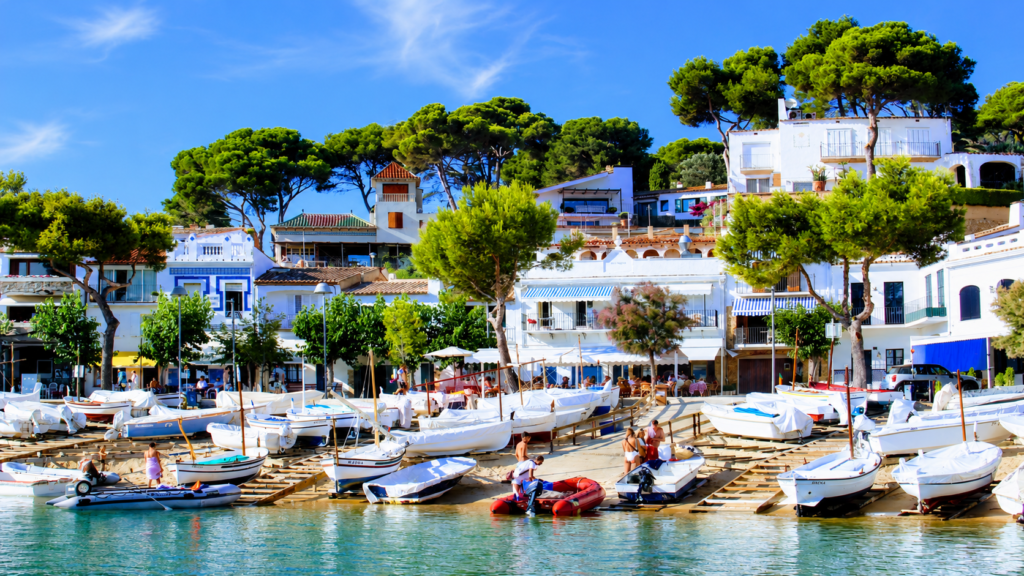
Spain coastlines and island destinations range from sheltered Mediterranean coves and long sandy beaches to rugged Atlantic cliffs, historic seaside towns and volcanic islands far off the mainland.
Spain has almost 8,000 kilometres of coastline, but the experience changes dramatically depending on where you travel. The Mediterranean coast offers beach towns, coves and generally calmer water, while northern Spain faces the Atlantic and Cantabrian seas with greener landscapes, stronger surf and dramatic cliffs.
The islands add even more variety. Mallorca, Menorca, Ibiza and Formentera offer a distinctly Mediterranean environment, while the Canary Islands combine volcanic scenery, beaches, outdoor adventure and a mild subtropical climate.
This guide will help you compare Spain’s major coastal regions and islands so you can choose destinations that fit the kind of trip you actually want rather than simply following a list of famous beaches.
Spain Coastlines and Island Destinations: Where to Start
There is no single Spanish coastline that works best for every traveler.
Before choosing where to stay, decide what matters most to you.
- Mediterranean coves and coastal villages — consider the Costa Brava or Balearic Islands
- Traditional beach resorts and extensive visitor infrastructure — look toward the Costa del Sol or Costa Blanca
- Atlantic beaches and water sports — consider the Costa de la Luz
- Green scenery, fishing towns and dramatic cliffs — explore Galicia, Asturias, Cantabria or the Basque coast
- Turquoise Mediterranean island coves — the Balearic Islands are particularly strong
- Volcanic landscapes and winter sun — look toward the Canary Islands
Spain’s official tourism authority divides the coast into numerous named regions, including the Costa Brava, Costa Blanca, Costa Cálida, Costa del Sol, Costa de la Luz, Costa Verde and the coastlines of Galicia and the Basque Country.
Travelers comparing specific areas can also use Spain’s official guide to coasts and beaches.
Mediterranean Coast: Catalonia, Valencia and Murcia
Spain’s eastern Mediterranean coast includes some of the country’s most established beach destinations, but it would be a mistake to think of the entire shoreline as one continuous resort strip.
Rocky coves, historic towns, modern resorts, long urban beaches and protected natural areas all appear along the route from Catalonia through Valencia and Murcia.
Costa Brava
The Costa Brava stretches along the Girona coast in northeastern Catalonia, from the area around Blanes toward the French border.
It is known for rocky headlands, small coves, Mediterranean vegetation, fishing villages and larger resort communities.
Places such as Cadaqués, Begur, Calella de Palafrugell and Tossa de Mar appeal to travelers who want attractive towns as well as access to the sea.
The coast also works particularly well for travelers who enjoy walking. Coastal paths provide opportunities to combine beaches and coves with views that cannot be appreciated from a car.
If you are planning to explore several smaller coves, research access in advance. Some require walking, have limited parking or become extremely busy during peak summer periods.
Costa Daurada and Tarragona
South of Barcelona, the Costa Daurada in Tarragona province offers a different Mediterranean landscape.
Longer sandy beaches are common, and the area includes family-oriented resorts as well as historic Tarragona, where Roman remains provide a strong cultural counterpoint to the coast.
This can be a practical region for travelers who want conventional beach time without abandoning sightseeing completely.
Costa Blanca
The Costa Blanca runs along the province of Alicante and includes some of Spain’s best-known Mediterranean resort destinations.
Benidorm represents the highly developed end of the spectrum, with high-rise accommodation, extensive beaches and a large tourism industry.
Other destinations such as Altea, Jávea and parts of the Alicante coast can provide a smaller-scale atmosphere, coastal scenery and historic centres alongside beach access.
Do not dismiss the entire Costa Blanca because of one resort image. Different towns can provide substantially different experiences.
Valencia Coast
Valencia allows travelers to combine a major Spanish city with direct access to Mediterranean beaches.
Urban beaches such as Malvarrosa are easy to reach from the city, while additional coastal communities and natural areas lie farther from the centre.
This is a useful choice when you want architecture, food, museums and city life without sacrificing a few days beside the sea.
For food-focused travelers, the region also provides an opportunity to connect the coastline with Valencia’s rice traditions rather than treating beach time and regional cuisine as separate parts of the trip.
Costa Cálida and Murcia
Murcia’s Costa Cálida includes Mediterranean coastline as well as the Mar Menor, a large saltwater coastal lagoon separated from the Mediterranean by La Manga.
The contrast between lagoon beaches and open Mediterranean water gives the region a character that differs from neighbouring Costa Blanca.
Farther south, the coastline around Cabo de Palos becomes rockier and is particularly attractive to travelers interested in diving and marine landscapes.
Andalusia: Costa del Sol, Costa de la Luz and Almería
Andalusia meets both the Mediterranean and Atlantic, producing several coastal regions with very different personalities.
Costa del Sol
The Costa del Sol stretches through Málaga province and is one of Spain’s most internationally recognized beach regions.
Málaga itself has become an increasingly attractive city destination, combining beaches with museums, historic sites, restaurants and an active urban centre.
Marbella is associated with more upscale resorts, restaurants and nightlife, while towns such as Nerja provide access to smaller coves, cliffs and a more compact centre.
The region works particularly well for travelers who prioritize reliable tourism infrastructure and want a large choice of accommodation, restaurants and organized activities.
The trade-off is popularity. During busy periods, the most famous towns and beaches can feel very different from the quieter Andalusian coast visitors may imagine.
Costa de la Luz
Move west toward Cádiz and Huelva and the coastline changes noticeably.
The Costa de la Luz faces the Atlantic and is known for long stretches of golden sand, dunes, wind and open horizons.
Tarifa sits close to the meeting point of the Atlantic and Mediterranean and is internationally associated with windsurfing and kitesurfing.
Bolonia offers an impressive combination of beach, dunes and nearby Roman ruins, while towns such as Zahara de los Atunes combine beach life with strong fishing and food traditions.
If you prefer broad Atlantic beaches to dense resort development, the Costa de la Luz deserves serious consideration.
Cabo de Gata and the Almería Coast
Eastern Andalusia provides another major contrast.
The Cabo de Gata-Níjar area in Almería is known for arid landscapes, volcanic formations, cliffs and relatively undeveloped coastal scenery.
Small communities and coves such as those around San José provide a very different experience from the larger resorts farther west.
This coast works particularly well for travelers who value landscape, photography, walking and road-trip flexibility.
Northern Spain: Basque Country, Cantabria, Asturias and Galicia
Northern Spain challenges the stereotype that a Spanish coastal holiday must involve dry landscapes, resort promenades and Mediterranean heat.
This coast is greener, often more rugged and heavily influenced by the Cantabrian Sea and Atlantic Ocean.
Basque Coast
The Basque coast combines dramatic geology, surf beaches, fishing communities and sophisticated cities.
San Sebastián is one of Spain’s strongest city-and-beach combinations. La Concha curves directly beside the urban centre, allowing travelers to move easily between sightseeing, swimming and one of the country’s best-known food scenes.
Farther along the coast, towns such as Getaria and Zumaia provide smaller-scale alternatives and access to rugged coastal landscapes.
This region works particularly well for travelers who value food, scenery and towns at least as much as traditional beach-resort facilities.
Cantabria
Cantabria offers sandy beaches, cliffs, green landscapes and coastal towns along the Cantabrian Sea.
Santander provides a city base with beaches and promenades, while smaller communities offer a more intimate coastal experience.
Weather can be less predictable than on Spain’s Mediterranean coast, but that greener climate is also part of what gives the region its distinctive appearance.
Asturias and the Costa Verde
Asturias combines mountains and coastline in a way that can feel completely different from southern Spain.
The Costa Verde includes cliffs, sandy beaches, river mouths and small fishing towns surrounded by intensely green countryside.
Ribadesella, Llanes and other coastal communities can work well as bases for travelers who want to combine beaches with hiking, villages and regional food.
This is not necessarily the region to choose if your only priority is guaranteed hot beach weather. It is much stronger as a varied landscape-and-culture trip.
Galicia
Galicia occupies Spain’s northwestern corner and has one of the country’s most distinctive coastlines.
Rías — long coastal inlets — shape much of the shoreline, particularly in the Rías Baixas, where fishing and shellfish traditions are deeply connected with local life.
The Cíes Islands are among Galicia’s best-known coastal destinations, while farther north the Costa da Morte offers lighthouses, cliffs and an exposed Atlantic landscape.
Galicia is especially rewarding when coastline and food are equally important. Seafood, fishing ports and coastal landscapes form part of the same experience rather than separate attractions.
Balearic and Canary Islands
Spain’s two major island groups provide completely different kinds of coastal travel.
The Balearic Islands sit in the Mediterranean and are particularly associated with clear turquoise water, coves and Mediterranean landscapes. The Canary Islands lie in the Atlantic off northwestern Africa and are shaped by volcanic geology and a mild climate.
Mallorca
Mallorca is the largest of the Balearic Islands and provides considerably more variety than its beach-resort reputation suggests.
Palma offers a historic city, cathedral, restaurants and urban life, while the Serra de Tramuntana brings mountains directly into the island experience.
Elsewhere you will find large sandy beaches, small coves, fishing ports and resort towns.
Mallorca works well for travelers who want beaches but do not want the entire trip to revolve around lying beside the sea.
Menorca
Menorca is generally quieter and smaller in scale than Mallorca or Ibiza.
Its coastline is surprisingly varied, with reddish and more rugged landscapes in the north and sheltered sandy coves in the south.
It appeals particularly to travelers interested in walking, swimming, smaller communities and a slower island trip.
Do not underestimate driving and walking time when planning visits to multiple coves. The most attractive beach on a map is not necessarily the easiest one to reach.
Ibiza
Ibiza’s international nightlife reputation is real, but reducing the island to clubs misses much of what makes it interesting.
The island also contains quiet coves, pine-covered landscapes, villages and the historic fortified area of Dalt Vila in Ibiza Town.
Travelers who are not interested in nightlife can still build an excellent trip around beaches, coastal drives, restaurants and historic areas.
Formentera
Formentera is smaller, flatter and more relaxed than neighbouring Ibiza.
It has no airport and is reached by sea, which helps give the island a different rhythm.
Fine sand, transparent turquoise water and relatively short distances make it appealing to travelers looking for a more beach-focused Mediterranean escape.
Cycling and walking can also be useful ways to explore parts of the island rather than relying exclusively on a car.
Canary Islands
The Canary Islands offer a very different landscape from the Balearics.
Volcanic geology, black and golden beaches, dunes, cliffs and mountainous interiors shape the archipelago.
The islands also have a mild climate that makes them especially attractive when mainland European beach destinations are outside their main season.
Tenerife
Tenerife combines major resort areas with volcanic landscapes, traditional towns and the dramatic interior around Mount Teide.
The south is more strongly associated with developed beach tourism, while other parts of the island provide greener landscapes and smaller communities.
Tenerife works particularly well when you want a mix of beaches, hiking, scenery and extensive tourism infrastructure.
Gran Canaria
Gran Canaria also offers substantial variety within a relatively compact island.
Beach resorts are concentrated heavily in parts of the south, while Las Palmas provides an urban experience and the island’s interior contains mountains and villages.
The dunes at Maspalomas provide one of the island’s most distinctive coastal landscapes.
Lanzarote
Lanzarote’s volcanic landscape gives the island an appearance unlike almost anywhere on mainland Spain.
Dark lava fields, low-rise whitewashed communities and beaches create an unusually stark landscape.
Travelers who enjoy geology, photography and distinctive scenery may find Lanzarote more compelling than choosing an island purely according to beach size.
Fuerteventura
Fuerteventura is particularly strong for travelers whose priorities are long beaches, open landscapes and water sports.
Wind plays an important role in the island’s character and contributes to its popularity for activities such as windsurfing and kitesurfing.
If beach time is your main objective in the Canaries, Fuerteventura deserves serious consideration.
Smaller Canary Islands
La Palma, La Gomera and El Hierro generally appeal more strongly to travelers interested in hiking, nature and smaller-scale island life than conventional resort holidays.
La Graciosa, north of Lanzarote, offers an even smaller and quieter experience with unpaved roads, volcanic scenery and beaches.
Trying to visit too many Canary Islands in one short trip can turn island travel into a sequence of airports and ferry terminals. Choose the landscapes and activities that interest you most and give those islands enough time.
Practical Coastal Travel Tips
Mediterranean and Atlantic Beaches Are Different
Do not assume that all Spanish beaches have similar water conditions.
Mediterranean waters are generally calmer and warmer than the exposed Atlantic and Cantabrian coasts, although local conditions can vary considerably.
Always pay attention to flags, lifeguard instructions, currents and weather rather than relying only on how calm the sea appears from shore.
Research Beach Access
Some Spanish beaches sit directly beside cities and promenades. Others require stairs, trails, boats or drives on smaller roads.
A beautiful cove seen online may have limited parking or require more walking than expected.
Check access before leaving, particularly if you have mobility considerations, are travelling with young children or are carrying substantial beach equipment.
Book Island Transportation Carefully
Flights connect the major Balearic and Canary islands, while ferry services provide additional inter-island and mainland connections.
Schedules vary by route and season.
Do not build a tight international-flight connection around an island ferry arriving exactly on schedule. Allow enough margin for weather, transfers and transportation delays.
A Rental Car Can Transform Some Trips
A car can be extremely useful on Mallorca, Menorca, many of the Canary Islands, the Costa Brava, Galicia, Asturias and more rural sections of Andalusia.
It is much less important when your trip is based primarily in Barcelona, Valencia, Málaga, San Sebastián or another city with good transportation and walkable coastal access.
Parking near famous beaches can also become difficult during summer.
Rent a car because it solves a transportation problem in your itinerary, not simply because the trip involves the coast.
Summer Brings the Largest Crowds
July and August are peak periods for many Spanish beach destinations.
Popular islands, coastal towns and smaller coves can become substantially busier, while accommodation prices and parking demand may rise.
Late spring and early autumn can be excellent for sightseeing, walking and coastal road trips, although swimming conditions and seasonal services vary by region.
The Canary Islands are particularly useful for travelers seeking coastal weather outside the traditional mainland summer season.
Stay Longer in Fewer Places
Spain’s coastline is far too extensive to experience properly through a checklist of famous beaches.
Moving accommodation every night can leave you spending more time packing, parking and driving than actually experiencing the coast.
Choose a few strategic bases and explore the surrounding area from them.
This is especially important on larger islands such as Mallorca, Tenerife and Gran Canaria, where distances that look short on a map can involve mountain roads or substantial travel time.
Connect the Coast With Regional Food
Spain’s coastal regions make much more sense when food becomes part of the trip.
Seafood in Galicia, pintxos on the Basque coast, rice dishes around Valencia, fried fish in Andalusia and island cuisine in the Balearics and Canaries all reflect local geography and traditions.
For a broader introduction, see our guide to what to eat in Spain.
You may also want to read our Spain culture and local customs guide to better understand the regional identities behind many coastal communities.
Which Spanish Coast or Island Is Right for You?
There is no single Spanish coastline that is best for every traveler.
The Costa Brava is particularly strong for Mediterranean coves, coastal villages, walking and scenery.
The Costa Blanca and Costa del Sol work well when beaches, extensive accommodation choices and established tourism infrastructure are priorities.
The Costa de la Luz provides long Atlantic beaches, wind, surfing and a less Mediterranean-style coastal experience.
Northern Spain is a strong choice for travelers who want green landscapes, seafood, dramatic coastlines and historic towns rather than a conventional resort holiday.
Mallorca offers perhaps the broadest combination of Balearic beaches, mountains, towns and city life.
Menorca and Formentera suit travelers looking for a quieter Mediterranean island experience.
Ibiza combines beaches and coves with nightlife, history and a cultural side that extends well beyond its clubs.
The Canary Islands are especially compelling for volcanic landscapes, outdoor activities and coastal travel outside the main mainland beach season.
Understanding Spain coastlines and island destinations is ultimately about matching the geography to your priorities rather than looking for one universal “best beach.”
Choose fewer places, stay long enough to understand them and let the coast become part of the trip rather than simply a sequence of photographs.
For broader trip-planning information, see our Spain Travel Guide: What to Know Before You Go.
You can also explore more seaside destinations in our Coastlines travel guides.