
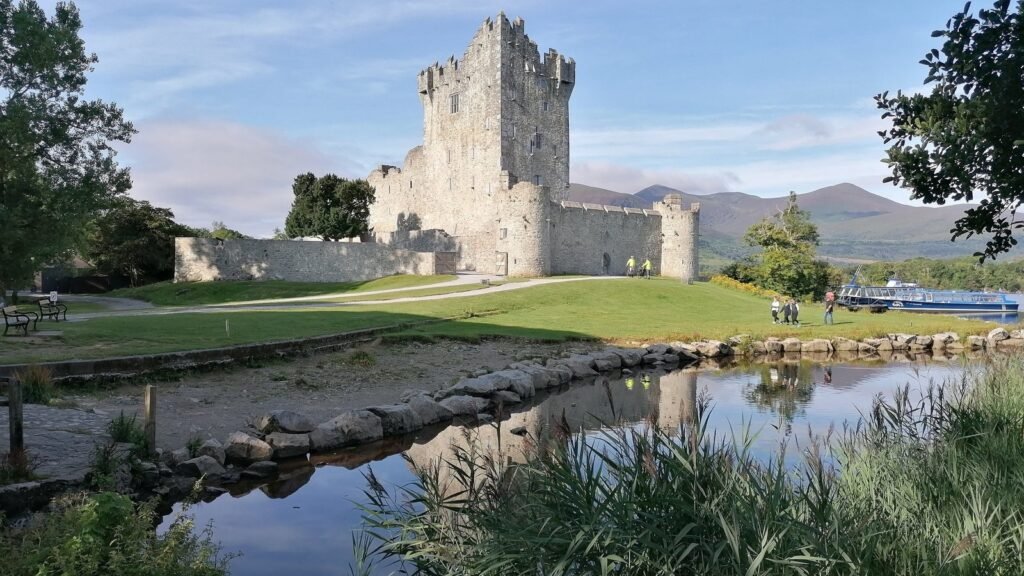
Ireland rewards travelers who build a trip around a few well-chosen bases. The island is small, but rural roads are slow and the weather is changeable, so the best first trip links a few contrasting regions rather than trying to cover everything. This 10 day Ireland itinerary spends two nights in Dublin, two in Galway, three in Killarney and one in Kinsale, with a final night in Dublin before your flight.
You’ll find a day-by-day plan, realistic transfer notes, booking advice and notes on where to stay. It follows the first-time route suggested in our Ireland travel guide, with the detail you need to plan it. Opening times, ticket rules and government travel advice change, so confirm anything important with the official sources linked below.
10 Day Ireland Itinerary at a Glance
- Day 1: Dublin. Arrive and settle in.
- Day 2: Dublin. The Book of Kells and the Guinness Storehouse.
- Day 3: Kilmainham Gaol and Galway. A morning in Dublin, then west.
- Day 4: Cliffs of Moher and the Burren. A day on the Clare coast.
- Day 5: Galway to Killarney. A long transfer day.
- Day 6: Killarney National Park. Lakes, a historic house and a waterfall.
- Day 7: Dingle or the Ring of Kerry. One peninsula, not both.
- Day 8: Cork and Kinsale. A food market and a harbour town.
- Day 9: Rock of Cashel and Dublin. Return east.
- Day 10: Departure.
Each stop in this 10 day Ireland itinerary has a different pace. Dublin is museums and pubs, Galway and Clare are cliffs and music, Kerry is scenery and driving, and Kinsale is food. You change bases four times, and two of the transfers are long, so treat them as part of the day’s plan. If you want to add Donegal or Northern Ireland, you would need extra days.
Before You Go: Entry Rules and Safety
Before you follow this 10 day Ireland itinerary, check your entry requirements. Canadian travel advice says a tourist visa is not required for stays of up to 90 days, that your passport must be valid for the expected duration of your stay, and that customs officials may ask for a return or onward ticket and proof of sufficient funds. Other nationalities have different rules. The route stays in the Republic of Ireland. If you add Northern Ireland, Canadians need a UK Electronic Travel Authorisation (ETA), even when arriving from the Republic, so read our Ireland travel guide first.
Read the full Government of Canada travel advice for Ireland before booking. It currently says to take normal security precautions. Petty crime such as pickpocketing occurs, tourists are frequently targeted, and car theft and break-ins occur, particularly in tourist areas in Dublin and surrounding areas. Keep your passport secure and never leave belongings in a parked vehicle, even in the trunk.
The itinerary assumes a rental car for the western and southern legs, with trains for Dublin to Galway if you prefer. Cars drive on the left. Canadian advice says you can drive on a valid Canadian licence for up to 12 months and recommends carrying an International Driving Permit.
Book the Key Sights First
To keep this 10 day Ireland itinerary on schedule, book these first, because several sights use timed or limited tickets:
- Cliffs of Moher. The visitor experience says you need to book in advance online, and that the busiest period is 11 am to 4 pm.
- Kilmainham Gaol. Access is by guided tour only, and the museum says pre-booking online is the only way to guarantee entry. Use the official site only, because the OPW says tickets bought on resale sites are not valid.
- Guinness Storehouse. Buy tickets only from the official site, and book a timeslot ahead in busy periods.
- Book of Kells. Book through the Trinity College visitor site and choose a morning slot.
- Rock of Cashel. Cormac’s Chapel is visited by guided tour only, and limited interior tickets are sold only at the site, so check tour times when you arrive.
- Rental car. Most rental cars in Ireland are manual, so reserve an automatic early, and most companies will not rent to drivers under 25.
- Hotels. Book Dublin, Galway and Killarney early for June to September.
Day 1: Arrival in Dublin
Fly into Dublin, collect your bags and go to your hotel. Rest, then take a short walk in the evening to get your bearings. Canadian advice says taxis are generally safe but to negotiate the fare in advance or insist on the meter. Pay attention to your surroundings in crowded areas and keep your passport in your hotel safe.
Day 2: Dublin Highlights
Start with the Old Library and the Book of Kells at Trinity College. Trinity says the Old Library and Long Room remain open until the end of 2027, when restoration works are scheduled to begin, and that the Book of Kells will stay on public display during the works. Book a morning slot to avoid the crowds.
In the afternoon, visit the Guinness Storehouse, which ends at the Gravity Bar, and book a timeslot ahead. Have dinner in a pub with live music, and remember that the legal drinking age is 18.
Day 3: Kilmainham Gaol and Travel to Galway
Spend the morning at Kilmainham Gaol, which is part of the story of Ireland’s struggle for independence, including the 1916 Easter Rising. The visit is a guided tour, so arrive on time for your slot.
Then head west. A train from Dublin to Galway takes about 2.5 hours, according to Tourism Ireland, and the main Dublin stations are Heuston and Connolly, so check which one your train uses. If you pick up your rental car in Dublin, allow time for the drive and for the M50, which has a barrier-free toll that must be paid by 8 pm the next day. Spend the evening in Galway, and look for a traditional music session.
If you have a car and prefer prehistory, you could swap the Gaol for Brú na Bóinne in the Boyne Valley. Newgrange and Knowth are reached only by guided tour from the visitor centre, pre-booking is essential, and the detour adds several hours, so it works best if you start early.
Day 4: Cliffs of Moher and the Burren
Drive or take a guided tour from Galway to the Cliffs of Moher, which reach 214 metres at their highest point. Book your ticket online and, if you can, arrive before 11 am or after 4 pm. Bring a rainproof jacket and walking footwear. If the cliffs are lost in fog and you are staying nearby, your ticket can be reused within the following 24 hours. Puffins are present from the end of March to mid-July.
On the way back, stop in the Burren, where the limestone landscape is part of the Burren and Cliffs of Moher UNESCO Global Geopark. Poulnabrone Dolmen is an easy roadside stop. As an alternative, spend the day on Inis Mór in the Aran Islands, where ferries from Rossaveal take about 40 minutes and carry foot passengers only.
Day 5: Galway to Killarney
Day 5 is a long transfer, so allow most of the day. By car, you can break the journey with a stop in a town or at a viewpoint. Public transport between Galway and Kerry is slower and may need a change, so check timetables early or consider a private transfer. Arrive in Killarney with enough daylight to settle in, walk into town and have an early dinner. Killarney is your base for the next two days.
Days 6–7: Killarney and Kerry
Day 6: Killarney National Park
Spend the day in Killarney National Park. Muckross House and Gardens is about 6 km from town, admission to the house is self-guided, and there is no charge to enter the park and Muckross Gardens. Ross Castle is open seasonally, with guided tours, and Torc Waterfall is a popular stop near Muckross House. You can also explore by jaunting car, a horse-drawn cart, from the town. Check the park’s official page for current routes and prices.
Day 7: Dingle Peninsula or the Ring of Kerry
Choose one. The Dingle Peninsula is explored by the Slea Head Drive, and Tourism Ireland’s Dingle guide lists stops such as Dunquin Harbour, Coumeenoole Beach and the Fahan beehive huts. The Conor Pass is narrow, so take it slowly in good weather.
The Ring of Kerry is a 179 km loop of the Iveragh Peninsula that traditionally starts from Killarney. It is easier to fit in a day from Killarney, but allow the whole day and stop often. Skellig Michael is a separate, weather-dependent boat trip, and the OPW’s page currently shows the island closed for 2026, so only plan around it if it is open for your dates.
Day 8: Killarney to Cork and Kinsale
Drive to Cork city and visit the English Market, which Tourism Ireland describes as one of the world’s oldest food markets. If you have time, Blarney Castle is nearby, with gardens, caves and the Blarney Stone.
Continue to Kinsale, about 25 km from Cork city and just over 30 minutes by car. Spend the evening in the harbour town, where menus often feature local products such as Gubbeen salami, Oysterhaven oysters and locally caught lobster. Our guide to what to eat in Ireland explains more of the local specialties.
Day 9: Rock of Cashel and Dublin
Drive north-east to the Rock of Cashel, a limestone outcrop crowned with medieval buildings. Heritage Ireland says Brian Boru was crowned High King there in 978, Cormac’s Chapel holds the only surviving Romanesque frescoes in Ireland and a typical visit takes one to one and a half hours. The site is exposed and can close at short notice in bad weather.
Then continue to Dublin and return your rental car. If you do not have a car, take a train from Cork to Dublin instead, which Tourism Ireland lists at about 2.5 hours, and skip Cashel. Stay near the airport if your flight is early.
Day 10: Departure
Allow plenty of time at Dublin Airport, and return your rental car in advance if you have not already done so.
Ireland Travel Tips
- Driving: Cars drive on the left, and speeds are in kilometres per hour in the Republic.
- Rental cars: Reserve an automatic early, and tell the company if you cross into Northern Ireland.
- Weather: Pack a waterproof jacket and layers for every season.
- Signs: Road signs are bilingual, and in Gaeltacht areas they are in Irish only.
- Power: Ireland uses 230 volt Type G sockets, so bring an adapter.
- Emergency numbers: Dial 112 or 999.
- Tipping: Tipping is voluntary, so check the bill for any service charge first.
Where to Stay on This Itinerary
Dublin
Stay within walking distance of Trinity College and the main pubs for your first two nights. For your last night, a hotel near the airport makes an early flight easier.
Galway
A hotel in or near the city centre makes it easy to walk to restaurants and music venues in the evening.
Killarney
Staying in town gives you restaurants and pubs, while a guesthouse near the park gives you quieter mornings.
Kinsale
Stay near the harbour so that you can walk to dinner.
Best Time for This 10 Day Ireland Itinerary
The best time for this 10 day Ireland itinerary is May to September, when the days are long and the weather is mildest. Met Éireann says spring is the driest season and that late spring is often dry, while October and November bring moderate to heavy Atlantic rain. Puffins are at the Cliffs of Moher from the end of March to mid-July, with May and June the best months.
Summer is the busiest season, so book early. In winter, some attractions and ferries reduce their hours, and daylight is short, so the drives between stops are harder to fit in.
Is 10 Days Enough for Ireland?
For a first visit, 10 days gives a good introduction. You see Dublin, the west coast and the south-west, with time for Galway and Kinsale. You will not see Donegal, Northern Ireland or the midlands, and you will spend several days driving. If you have fewer days, drop Kinsale and Cashel and end in Killarney.
With 14 days, you could add the Causeway Coast in Northern Ireland or a slower pace through Kerry. This 10 day Ireland itinerary works best as a sampler that shows you which region to return to.
Final Thoughts on This 10 Day Ireland Itinerary
The best Ireland itinerary is not the one that covers the most places. It is the one that leaves room for the weather, the drives and a long evening in a pub.
Use this 10 day Ireland itinerary as a starting point, then adjust it to match your time, budget and appetite for driving. For more planning help, read our Ireland travel guide, our guide to Ireland coastlines and our guide to Ireland culture.
If you are comparing trips in Europe, you may also want to read our 12 day UK itinerary.
Explore more trip itineraries on TravelingInformed.