
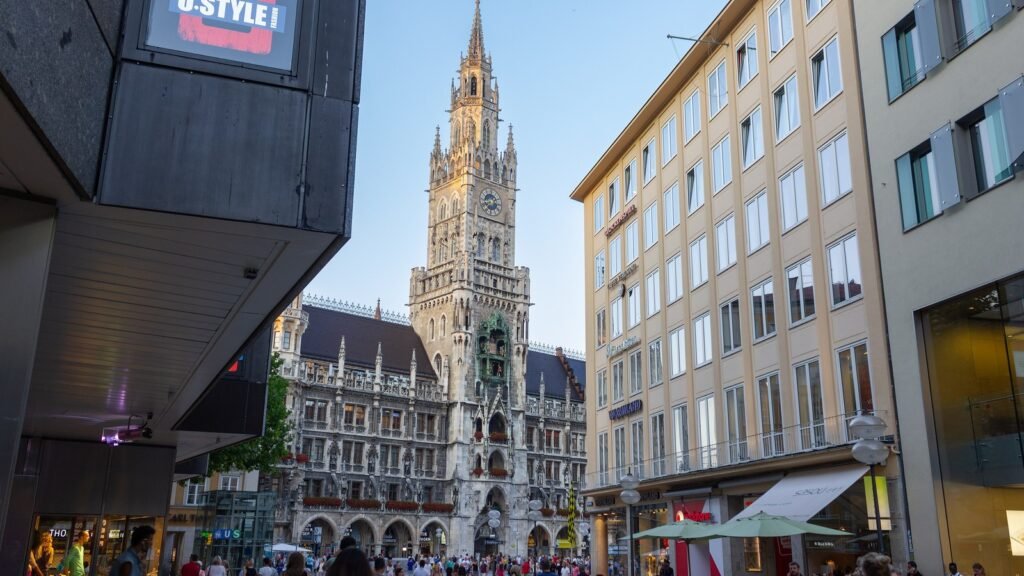
Germany suits travelers who like to move by train between a few strong city bases. This 10 day Germany itinerary spends three nights in Berlin, three in Munich and three in Cologne, with a day trip to Neuschwanstein from Munich and another into the Rhine Valley from Cologne. On the last morning you take a short train to Frankfurt for your flight home.
You’ll find a day-by-day plan, realistic transfer notes, booking advice and notes on where to stay. It follows the first-time route suggested in our Germany travel guide, with the detail you need to plan it. Train timetables, ticket rules, opening hours and government travel advice change, so confirm anything important with the official sources linked below.
10 Day Germany Itinerary at a Glance
- Day 1: Arrive in Berlin. Transfer, rest and a short walk.
- Day 2: Central Berlin. Museum Island, the Brandenburg Gate and the Reichstag dome.
- Day 3: Berlin’s history. The Wall memorial, the Holocaust memorial and Kreuzberg.
- Day 4: Train to Munich. An old-town evening and a beer garden.
- Day 5: Neuschwanstein. A day trip to the castle.
- Day 6: Munich. The English Garden, markets and museums.
- Day 7: Train to Cologne. A long rail day.
- Day 8: Cologne. The cathedral, museums and Kölsch pubs.
- Day 9: The Rhine Valley. A day by train or boat.
- Day 10: Frankfurt and departure.
Each stop in this 10 day Germany itinerary has a different mood. Berlin is history and museums, Munich is Bavarian tradition and mountains on the horizon, and Cologne and the Rhine are cathedral towns and vineyards. You take two long train rides, so treat them as part of the plan. If you want to add Hamburg, Dresden or the coast, you would need extra days.
Before You Go: Entry Rules and Safety
Before you follow this 10 day Germany itinerary, check your entry requirements. Canadian travel advice says Germany is in the Schengen area, that Canadians do not need a visa for stays of up to 90 days in any 180-day period and that your passport must be valid for at least three months beyond the date you expect to leave. Customs may ask for a return ticket and proof of funds, and the Entry/Exit System collects a facial image and fingerprints on entry.
The ETIAS travel authorization is not yet in operation, and the EU says it will announce the start date several months ahead, so check the official site before you fly. Read the full Government of Canada travel advice for Germany before booking. It currently advises a high degree of caution because of the threat of terrorism and notes that pickpockets are active on trains and in crowded places. Buy travel insurance with medical evacuation, since private care is expensive and usually paid upfront.
Book the Key Sights First
To keep this 10 day Germany itinerary on schedule, book these first:
- International flights. An open-jaw ticket, into Berlin and out of Frankfurt, avoids backtracking.
- Reichstag dome. Admission is free but advance online registration is required, according to the Bundestag. Bring photo ID, and check the closure dates, which include a long maintenance closure from 23 August to 19 November 2027.
- Neuschwanstein. The Bavarian Palace Department says the castle can only be visited on a guided tour, tickets are sold online through Hohenschwangau, and leftover tickets are sold only on the day at the ticket center, with no reservations. See the castle’s information page (in German).
- Trains. Check seat and ticket options on bahn.de, especially for the Berlin to Munich and Munich to Cologne legs.
- Hotels. Book Munich early if your dates overlap with Oktoberfest, which runs from 18 September to 3 October in 2027.
Day 1: Arrival in Berlin
Fly into Berlin and go to your hotel. After a long flight, a pre-arranged transfer or a train to the central station is the simplest option. The tourist board says Berlin’s modern central station is only a short walk from the government district and the Brandenburg Gate. Canadian advice says organized pickpockets are active at transport hubs and on public transport, so keep your passport and bag secure. Take a short walk to get your bearings and have an early dinner.
Day 2: Central Berlin
Start on Museum Island, the UNESCO-listed complex of five museums built between 1824 and 1930. Choose one or two museums rather than trying to see them all. Walk to the Brandenburg Gate and the government district in the afternoon.
If you booked the Reichstag dome, go at your registered time. Bring the original of your passport or photo ID, since the Bundestag asks for proof of identity at registration and at the entrance. The dome has a 20-minute audioguide, according to the Bundestag, and the rooftop terrace stays open when the dome is closed.
Day 3: Berlin’s History
Spend the morning on remembrance. The Berlin Wall Memorial on Bernauer Straße has free exhibitions, with the outdoor exhibition open daily. Then visit the Memorial to the Murdered Jews of Europe, where the Field of Stelae is free and open around the clock and the information center is free as well. Check the information center’s current hours before you go.
In the afternoon, explore Kreuzberg, which the tourist board describes as a trendy part of the city. If your trip falls on a Thursday, the organic market at Kollwitzplatz in Prenzlauer Berg is a pleasant stop.
Day 4: Train to Munich
Take the morning train south. The fastest direct Berlin to Munich trains take roughly four hours, so check the timetable on bahn.de and keep your bags with you. The tourist board says Munich’s station is a few minutes’ walk from the old town, with Marienplatz and the cathedral.
Drop your bags, then walk through the old town. In the evening, try a beer garden. The tourist board says guests in traditional Bavarian beer gardens may bring their own food and buy a drink there, and it names the Viktualienmarkt, the English Garden and Wiener Platz among Munich’s best-known gardens. Check each garden’s rules first.
Day 5: Neuschwanstein
Take the train toward Füssen, then a local bus to the castle area, and allow most of the day. Plan on roughly two hours each way and check current timetables, so start early. Visits are by guided tour only, so you need your online ticket for a specific time. UNESCO added the palaces of King Ludwig II to the World Heritage List in 2025, and the Marienbrücke viewpoint can be closed in winter weather.
If you prefer a quieter day, swap in a half-day trip to the Dachau memorial site near Munich, where the town says admission is free. Check the memorial’s page for opening hours.
Day 6: Munich
Spend today at your own pace. Walk in the English Garden, browse the Viktualienmarkt, which has more than 140 permanent stalls, and enjoy a long lunch. Munich’s museums are a good rainy-day plan.
If the weather is clear and you want mountains, check the train and cable car times to Garmisch-Partenkirchen and the Zugspitze, Germany’s highest mountain at 2,963 metres. Canadian advice says to hire a guide for mountain hikes, to never hike alone and to buy insurance that covers helicopter rescue.
Day 7: Train to Cologne
This is a long rail day. Choose a direct ICE if you can, because the tourist board says long-distance trains between major cities usually run every hour, and keep a flexible ticket in case of strikes or delays. Canadian advice says strikes occur regularly in ground transport and aviation, so allow extra time.
When you arrive, you get a view of the cathedral straight from the station, according to the tourist board. Check in, then have an early dinner in a traditional Kölsch pub in the old town.
Day 8: Cologne
Cologne Cathedral is the focus of the day. UNESCO says its construction began in 1248 and finished in 1880, and the front tower is about 157 metres high. Walk through the old town, then choose between the Museum Ludwig, which the tourist board says holds the largest collection of American pop art outside the United States, and the Chocolate Museum.
Outside the busy season, the tourist board suggests exploring the districts, including Ehrenfeld, the Eigelstein quarter and Südstadt, for pubs and local life.
Day 9: The Rhine Valley
Spend the day in the Upper Middle Rhine Valley, which UNESCO describes as a 65-kilometre stretch between Bingen, Rüdesheim and Koblenz with about sixty small towns, terraced vineyards and castle ruins. The Loreley narrows, where the river is no more than 130 metres wide, are the best-known landmark.
The simplest approach is to take a train to Koblenz, which the tourist board says is worth a longer stop on the way to the Middle Rhine, and continue by regional train or river boat. Boat and train timetables change by season, so check them before you go. Return to Cologne in the evening. In Koblenz, a cable car goes up to the Ehrenbreitstein Fortress for views of the German Corner.
Day 10: Frankfurt and Departure
The tourist board says Frankfurt to Cologne takes about an hour by train, so a morning ride gets you to the airport city with time to spare. If your flight is in the evening, store your bags and walk along Frankfurt’s Museumsufer, which has more than 30 museums, or try Äppelwoi in Old Sachsenhausen. Allow plenty of time for the airport, and confirm your passport validity and insurance papers before you leave.
Germany Travel Tips
- Cash. Carry some euros. The tourist board says paying in cash is still very popular, although most shops accept cards.
- Tipping. Tipping is voluntary, and the city of Berlin says 5 to 10 percent is appropriate in restaurants.
- Sundays. Shops are generally closed, according to the Law Library of Congress, so buy supplies on Saturday.
- Layers. The tourist board describes a temperate climate with rain throughout the year, so pack layers and a rain jacket.
- Power. Germany uses 230 volt power, and Type F sockets take Type C plugs, so bring an adapter.
- Emergencies. Dial 112 for ambulance and fire and 110 for police.
Where to Stay on This Itinerary
Berlin
Stay near the central station or in the Mitte area if you want to be close to the sights, or in Kreuzberg for a livelier neighborhood. The tourist board notes that the station is a short walk from the government district, the Brandenburg Gate and Museum Island.
Munich
Stay near the central station or the old town. The tourist board says the old town, with Marienplatz and the cathedral, is a few minutes’ walk from the station.
Cologne
Stay near the cathedral. The tourist board says the cathedral is just around the corner from the central station, next to the Chocolate Museum and the old town.
Best Time for This 10 Day Germany Itinerary
May to September is the easiest window for weather and beer gardens. Spring brings blossom and white asparagus, which the tourist board says peak from April to June, while late summer and early autumn bring wine festivals in the Rhine wine regions. In December you can add Christmas markets, but expect cold weather and crowds, and stay alert for pickpockets in crowds.
Heavy rain in spring and summer can cause flooding, and Canadian advice recommends the Nina warning app. In winter, the Marienbrücke at Neuschwanstein may be closed because of weather.
Is 10 Days Enough for Germany?
Ten days is enough for a first overview of three regions, but not for the whole country. With seven days, drop the Rhine and keep Berlin and Munich, or keep one city and a region. With 14 days, add Hamburg and the coast, Dresden and Nuremberg, or the southwest. Our Germany coastlines guide explains how to add the North Sea or the Baltic.
Final Thoughts on This 10 Day Germany Itinerary
This 10 day Germany itinerary works because it uses Germany’s strength: frequent, comfortable trains between cities that are different from one another. It leaves time for the long museum days, the beer gardens and the river valley, and it keeps the busiest bookings to a few key sights.
Check the entry rules, register for the Reichstag dome, book Neuschwanstein early and leave a buffer for rail delays. Then adapt the route to your interests. For more on food and customs, read our guides to what to eat in Germany and Germany culture and local customs. If you are comparing European itineraries, you may also like our 10 day France itinerary and 10 day Spain itinerary.