This Morocco travel guide is designed to help you decide where and when to go, how to move between the imperial cities, the mountains, the desert and the coast, and what the official safety and entry advice says before you book. Morocco rewards preparation, and the safety picture is different from most countries we cover, so we start with the facts.
Morocco lies in the northwest corner of Africa, with the Mediterranean to the north, the Atlantic to the west, the Rif and Atlas mountains inland and the Sahara to the south, according to the Moroccan National Tourist Office. UNESCO lists nine World Heritage properties in Morocco, including the medinas of Fez and Marrakesh and the Ksar of Ait-Ben-Haddou, and most first trips link a few of them.
Three governments we read, Canada, Australia and the United States, ask visitors to take more care in Morocco than in most countries, mainly because of the threat of terrorism. Most visits pass without trouble, and the everyday problems are petty theft, scams, aggressive touts and traffic. The sections below explain both, with dates.
Is Morocco Right for Your Trip?
This Morocco travel guide suits travelers who want walled medinas, markets, mountain scenery, desert nights and a food culture built around shared dishes and mint tea. It works well for curious first-time visitors to Africa, because the main sights are well established, tourist infrastructure is well developed in the big cities. The tourist board says French is understood by almost all Moroccans, and in our view English is common in tourist businesses.
Morocco may not be the right fit if you want a relaxed trip with little planning, if the safety advice below worries you, or if you would be uncomfortable with the country’s laws and customs, which are stricter than in Europe or the Americas. It is also not an easy destination for travelers who want to drink alcohol freely, dress very casually in town or show affection in public. In our view, a short first trip to the main tourist areas with a licensed guide for the mountains and desert is the most comfortable way to start.
Morocco Safety: What Official Advisories Say
As of 17 November 2026, the advisories we read do not match. Advisories change, so read the current Canadian, British, Australian and American pages before you book.
Canada (updated 26 May 2026). The Government of Canada says to exercise a high degree of caution in Morocco because of the threat of terrorism. It says attacks have targeted foreigners, and cites the December 2018 deaths of two Scandinavian tourists in the mountains of southern Morocco, which the Moroccan authorities described as a terrorist act.
Australia (updated 29 July 2026). Smartraveller advises Australians to exercise a high degree of caution in Morocco overall because of the threat of terrorism, with higher levels in some areas. Its latest update also says political demonstrations and protests may occur at short notice, and advises avoiding them and taking care around Friday prayers.
United States (issued 4 September 2026). The State Department lists Morocco at Level 2, “Exercise increased caution,” because of the risk of terrorism, and advises staying aware of your surroundings and staying alert in tourist spots.
United Kingdom (public update 19 August 2026). The FCDO page we read has no warning against travel to Morocco as a whole. It says terrorists are likely to try to carry out attacks in Morocco, which could be indiscriminate and could include places visited by foreign nationals, such as transport hubs, tourist sites and crowded places. It says authorities regularly disrupt terrorist cells and that hotels and tourist sites may have visible security.
Areas to avoid. Canada says to avoid all travel to the area within 30 km west of the militarized boundary known as the Berm, to the area between the Berm and the neighboring countries, and to the area within 20 km of the border with Algeria, and to avoid non-essential travel to Western Sahara because of terrorism and unexploded landmines. Smartraveller says not to travel within 30 km of the northern or western side of the Berm or in any area south and east of it.
The land and sea border between Morocco and Algeria is closed. This guide covers the main tourist regions only and does not cover Western Sahara.
Crime and scams. All of the governments describe petty theft, bag snatching and pickpocketing in medinas, markets and on beaches. Canada and the FCDO also report armed robberies and street attacks with knives in some cities and on beaches, and advise against resisting robbers. The FCDO warns that people posing as official guides often harass tourists in medinas, so use a guide who has an official badge and permission from the local authority. Card fraud, ATM theft and scams are common.
Other safety points. Canada says women traveling alone may face harassment and verbal abuse. The FCDO reports deaths and serious illness from alcoholic drinks containing methanol, which cannot be detected by taste or smell. Both governments warn about road accidents, and the FCDO says many taxis booked through ride-sharing apps may be unlicensed. Canada says to restrict travel in remote areas to officially designated tourist areas, to hire only official guides recommended by hotels, agencies or tourist authorities, and not to hike alone in remote mountain regions.
Best Time to Visit Morocco
Morocco has several climates in one country. The tourist board says the Atlantic coast around Agadir has mild temperatures, the inland areas have a continental climate with sharper relief, and the south opens onto the Sahara, where it says spring and autumn are the seasons to venture there. We did not find an official page with month-by-month temperatures, so the rest of this section is our view.
In our view, spring (March to May) and autumn (October and November) suit a first trip that combines the cities, the mountains and the desert, because summer heat inland and in the desert can be extreme and winter nights in the desert and mountains are cold. The coast is comfortable in summer. Canadian advice says the rainy season usually runs from November to March, when flash floods can occur frequently and can be especially dangerous in the High Atlas valleys, and the FCDO notes wildfire risk in the summer season.
Ramadan changes the rhythm of the country. Canadian advice says that in 2027 it is expected to begin on or around 7 February, and the FCDO says it starts in February 2027. During the day many people fast, some restaurants close or serve behind screens, and visitors should avoid eating, drinking and smoking in public. Travel is still possible, and many visitors enjoy the evenings, but plan for different opening hours.
Where to Go in Morocco
Most first trips combine two or three of the imperial cities with the Atlas, the desert and perhaps one coastal town.
Marrakech. The tourist board describes the walled medina as the most historic and most visited part of the city, with the Koutoubia mosque near the Jemaa el-Fna square, which it says is transformed into an open-air theater at night. UNESCO inscribed the Medina of Marrakesh in 1985. It is the most common arrival point for visitors and a natural base for the mountains.
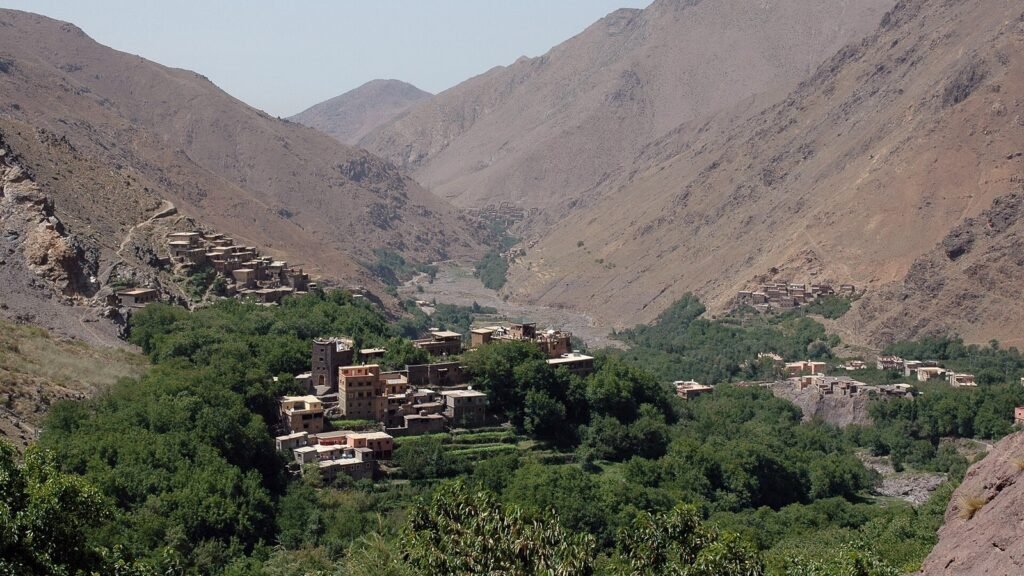
The Atlas and Ait Benhaddou. UNESCO inscribed the Ksar of Ait-Ben-Haddou in 1987. The road from Marrakech over the High Atlas is the usual route toward Ouarzazate and the desert. Canadian advice says to use only a four-wheel-drive vehicle for off-road driving in the mountains or desert, and the FCDO recommends hiring a professional guide for hiking in the Atlas.
The Sahara. The tourist board describes the dunes of Merzouga as the classic desert destination and suggests spending a night in a desert camp. Canadian advice says to seek local official tourist advice before traveling to the desert areas in the south and to hire only official guides. Book a registered operator, not a stranger in the street.
Fez. UNESCO inscribed the Medina of Fez in 1981. The tourist board says Fez El-Bali is home to the Al-Quaraouiyine university, the oldest in the world, and describes a car-free medina of palaces, craftsmanship and narrow streets. It is easy to get lost, so a badged guide is useful on the first day.
Meknes and Volubilis. UNESCO lists the Historic City of Meknes (1996) and the Archaeological Site of Volubilis (1997), which are often visited as a day trip from Fez.
Chefchaouen. The tourist board promotes this small mountain town in the Rif as one of Morocco’s top destinations. It suits one or two nights of slow walking.
Rabat and Casablanca. Rabat, the capital, is listed by UNESCO as “Rabat, Modern Capital and Historic City: a Shared Heritage” (2012), and Casablanca is the country’s largest city and a major transport hub. Canadian advice says demonstrations occur occasionally in Rabat, Casablanca and other major cities, mostly near government buildings.
Essaouira and the coast. UNESCO lists the Medina of Essaouira (2001) and the Portuguese City of Mazagan (El Jadida) (2004). Agadir is the main beach resort, and our guide to Morocco coastlines and beaches covers the options.
How Many Days Do You Need?
A week is enough for Marrakech, one day in the mountains and Essaouira. Ten days lets you add the desert and Fez in a one-way route, and two weeks lets you add Chefchaouen, Meknes, Rabat and slower days. In our view, Morocco is a country where distances are longer than the map suggests, so it is better to see fewer places than to spend every second day on a bus.
Getting Around Morocco
Trains. The tourist board says the high-speed train serves Tangier, Kenitra, Rabat and Casablanca, with a Tangier to Casablanca journey of 2 hours 10 minutes. The conventional ONCF network connects Marrakech to Oujda and serves most main cities, but not Agadir, and tickets can be bought on the ONCF website.
Buses and coaches. Private coach companies serve many towns, including remote ones, and the tourist board says you can buy tickets online.
Taxis. The tourist board says taxis are identified by color: red in Casablanca and Agadir, blue in Rabat, Tangier and Asilah, and orange in Marrakech. Canadian advice and the FCDO say to agree the fare in advance or make sure the meter is running. The FCDO says many taxis booked through ride-sharing apps may be unregulated or unlicensed, and that police may tell you to get out of an unlicensed taxi.
Driving. Canadian advice says road conditions vary greatly, national roads are narrow and heavily congested, accidents causing fatalities are common, and checkpoints are frequent, so carry identification and vehicle documents. It advises avoiding driving at night. The FCDO says British drivers need the 1968 version of the international driving permit as well as their UK licence, and that you must carry your insurance and registration documents. If you rent a car, check what your own government says about licences.
Medinas. Most medinas are closed to cars. In Marrakech and Fez you will walk, and a hotel or riad can arrange a porter or meet you at the gate.
Costs and Money
The currency is the Moroccan dirham (MAD). Canadian advice says it cannot be exchanged outside the country, that it is illegal to take dirhams out of Morocco and that unused dirhams can be converted at the airport on departure with proof of your original currency purchase. The tourist board says ATMs are widespread and that Visa and Mastercard are accepted by most hotels and some restaurants, shops and petrol stations, and Canadian advice says cards are accepted in certain stores and restaurants in urban centers and major hotels.
Carry some cash for markets, taxis and small restaurants. Canada and the FCDO warn about card fraud and ATM theft, so cover the keypad, use ATMs inside banks or businesses and check your statements. The rules on declaring foreign currency differ in the sources we read, so check the current customs rules and your government’s advice before you travel. We did not verify prices, so use our travel budgeting guide to plan a budget and check current costs.
Entry Rules and Documents
Visa. Canada, the United Kingdom, the United States and Australia all say that citizens do not need a visa for tourist stays of up to 90 days. Canadian advice says that to extend your stay you must contact the foreigners’ section of the local police station at least 15 days before the 90-day limit, and that if you overstay you can be held until you see a prosecutor and fined. Other nationalities have different rules, so confirm them with the Moroccan authorities. Our visa requirements guides cover each passport.
Passport. The rules differ between governments. Canada says a regular Canadian passport must be valid for at least 6 months beyond the date you expect to leave Morocco. The United States says your passport must have at least 6 months of validity at entry and one blank page per stamp. The UK says your passport must have an expiry date at least 3 months after you arrive and must not be damaged. We recommend having at least 6 months of validity.
Entry stamp. The FCDO and Smartraveller both say some travelers have had trouble leaving Morocco without an entry stamp, so make sure your passport is stamped when you arrive.
ETIAS and e-visas. Morocco is not in the Schengen area, so ETIAS does not apply. The tourist board says the need for a visa depends on nationality, that some nationalities can apply for an electronic visa through the official Acces Maroc portal, and that for all nationalities the maximum tourist stay is 90 days.
Other rules. The FCDO says drones need permission from the civil aviation authority, and Canadian advice says drones and surveillance equipment are prohibited and will be confiscated. Do not mail your passport in Morocco, because Canada and the FCDO say it is illegal and the authorities may confiscate it. Do not photograph military or security sites.
Health and Natural Hazards
Canadian advice and the CDC recommend that you be up to date on routine vaccines, including measles, and recommend hepatitis A, and typhoid for most travelers. Canada says there is no risk of yellow fever and no proof of vaccination is needed to enter. Rabies is present and carried by stray dogs, so do not feed or approach them, and see a doctor immediately after a bite or scratch. The FCDO notes altitude sickness is a risk in parts of Morocco. The tourist board advises washing hands, peeling fruit and vegetables and making sure meat is well cooked.
Emergency numbers differ by source. Canadian advice lists 190 for police and 150 for medical assistance and firefighters, and the FCDO gives 150 for an ambulance. Buy travel insurance that covers medical care and evacuation, and check that it covers hiking, quad biking and other adventure activities, which the FCDO warns may not meet UK safety standards.
Morocco is in an active seismic zone, and the FCDO says the 2023 earthquake killed almost 3,000 people. Read the safety instructions in your hotel. Flash floods are a risk in the mountains in the rainy season, and the FCDO notes that wildfires can occur in summer.
Practical Details
Laws. Canada and the FCDO say alcohol is available in licensed bars, hotels and restaurants, but drinking in the street or anywhere unlicensed is illegal. Illegal drugs, including cannabis, carry severe penalties. Same-sex sexual relations are illegal, and showing affection in public can lead to prosecution according to the FCDO. Canada also says extramarital sex is illegal, although foreigners are almost always exempt from having to prove they are married to share a hotel room. Attempting to convert a Muslim to another faith and distributing evangelical material are illegal. Respect for the King is expected.
Dress and behavior. Canada says to dress conservatively, behave discreetly and respect religious and social traditions. The FCDO suggests loose-fitting clothing that covers the arms, legs and chest for women. Our guide to Morocco culture and local customs covers this in more detail.
Language. The tourist board says Morocco has two official languages, Arabic and Amazigh, that French is spoken and understood by almost all Moroccans and that Spanish is widely spoken in the north and south.
Guides and shopping. Hire a guide through your hotel or an official office, agree the price before you start, and expect hard bargaining in the souks. Do not follow strangers offering directions to a shop.
Packing. Bring modest, breathable clothing, a scarf or light layer for the evening and for religious sites, and good walking shoes for uneven medina streets. Our packing guide has a full list.
Suggested First-Time Itinerary
For a first trip, we suggest flying into Marrakech and out of Tangier or Casablanca, so you do not backtrack. Spend three nights in Marrakech, one in the Atlas and Ouarzazate area, one in the desert at Merzouga with a registered operator, three in Fez, one in Chefchaouen and the last night near your departure airport. Our 10 day Morocco itinerary sets this out day by day with backup plans.
Morocco Travel FAQ
Do I need a visa to visit Morocco?
Canada, the United Kingdom, the United States and Australia all say their citizens do not need a visa for tourist stays of up to 90 days. Passport rules differ: Canada says your passport must be valid for at least 6 months beyond the date you leave, the United States says at least 6 months at entry plus one blank page, and the UK says an expiry date at least 3 months after you arrive. We suggest having 6 months. The FCDO and Smartraveller both advise getting an entry stamp, since some travelers have had trouble leaving without one. Other nationalities have different rules, so confirm them with the Moroccan authorities.
Is Morocco safe for tourists?
Most visits pass without serious trouble, but the governments ask for more care than in many countries. Canada and Australia advise a high degree of caution because of the threat of terrorism, the United States lists Level 2, and the UK describes a likely terrorist threat while not advising against travel to Morocco as a whole. Petty theft, scams and unofficial guides are the everyday problems in the medinas. Canada also says to avoid the Western Sahara border regions and the area near the Algerian border. Read the current advice before you go.
What is the best time to visit Morocco?
In our view, spring and autumn are the best seasons for a trip that combines the cities, the mountains and the desert. The tourist board says spring and autumn are the times to venture into the Sahara, and Canadian advice says the rainy season usually runs from November to March, with flash floods in the High Atlas valleys. Summer is very hot inland. Ramadan is expected to begin around 7 February 2027, which changes opening hours and public eating and drinking.
How many days do you need in Morocco?
Ten days works well for a first trip that links Marrakech, the High Atlas and the Sahara, Fez and Chefchaouen in one direction. A week suits Marrakech, one day in the mountains and Essaouira, and two weeks lets you add Meknes, Rabat and slower days. Distances are longer than the map suggests, so plan fewer places.
What should I wear in Morocco?
Canada advises dressing conservatively and behaving discreetly, and the FCDO suggests loose-fitting clothing that covers the arms, legs and chest for women. In our view, long trousers or skirts, tops with sleeves and a light scarf work well in medinas and rural areas, with beachwear kept for the beach.
Final Thoughts on This Morocco Travel Guide
This Morocco travel guide comes down to three points. Read the current advisories for your country and take the terrorism warnings seriously without letting them stop you from planning. Use licensed guides for the mountains and desert, keep valuables out of sight in the medinas and agree prices in advance. Respect the laws and customs, especially around alcohol, dress, religion and Ramadan.
For more planning, read our guides to what to eat in Morocco, Morocco culture and local customs and Morocco coastlines, and our travel insurance and safety guide. If you are planning to combine Morocco with Spain or Portugal, see our Spain travel guide and Portugal travel guide.