
This Croatia travel guide is designed to help you decide where and when to go, how to move between the coast and the interior, and what the official entry and safety advice says before you book.
Croatia sits on the eastern shore of the Adriatic Sea, between Slovenia, Hungary, Serbia, Bosnia and Herzegovina, and Montenegro. The Croatian National Tourist Board describes a country of more than a thousand islands, and most first trips follow the long coastline of Istria and Dalmatia. UNESCO lists ten World Heritage properties in Croatia, including the Old City of Dubrovnik, Diocletian’s Palace in Split and Plitvice Lakes National Park.
The main planning issues are crowds, season and logistics, not safety. All four governments we read rate Croatia at their lowest advisory level. The harder questions are when to go to avoid the summer peak, how to link the capital, the lakes and the coast, and which islands are worth the ferry time.
Is Croatia Right for Your Trip?
This Croatia travel guide suits travelers who want walled old towns, clear sea, islands, national parks and food shaped by both the Mediterranean and Central Europe. It works well for couples, families and first-time visitors to Europe, because distances are short and English is widely used in tourism.
Croatia may not be the right fit if you want long sandy beaches, since much of the coast is pebble and rock, or if you can only travel in July and August and dislike crowds and heat. In our view, a trip in May, June or September gives a calmer and cheaper version of the same country.
Croatia Safety: What Official Advisories Say
As of mid-November 2026, the four advisories we read agree. Advisories change, so read the current Canadian, British, Australian and American pages before you book.
Canada (updated 11 August 2026). The Government of Canada says to take normal security precautions in Croatia, its lowest level. It says the violent crime rate is low, while petty crime such as pickpocketing and purse snatching is common in main cities, transport hubs, restaurants and tourist sites.
United Kingdom (updated 11 August 2026). The FCDO has no warnings against travel. It says crime levels are low and violent crime is rare, and that pickpockets operate in tourist areas.
Australia (updated 16 October 2026). Smartraveller advises travelers to exercise normal safety precautions in Croatia.
United States (issued 18 May 2026). The State Department lists Croatia at Level 1, “Exercise normal precautions,” and calls it generally a safe destination for travelers.
Unexploded mines. The FCDO says that if you travel outside the tourist resorts, you should beware of unexploded mines in previously war-affected areas, including Eastern Slavonia, Brod-Posavina County, Karlovac County, areas around Zadar County and more remote areas of Plitvice Lakes National Park. It advises against walking on uncultivated land or stepping off marked paths in those areas. The main tourist routes are not affected, but hikers should stay on marked trails.
Fines for behavior. The FCDO says that in some town centers, including Split and Dubrovnik, you can get on-the-spot fines for drinking alcohol in public spaces, walking through town shirtless or in swimwear, and climbing on monuments. It says fines for public order disturbances can reach 4,000 euros.
Other points. The FCDO reports that tourists have been overcharged at certain “gentlemen’s clubs,” sometimes by thousands of euros, and that there have been reports of sexual assaults in taxis. Canadian advice says to use officially marked taxis or a trusted ridesharing app and to agree on the fare or insist on the meter. Both governments note occasional violence around soccer matches.
Best Time to Visit Croatia
Croatia has a Mediterranean climate on the coast and a continental one inland, so the seasons differ between Dubrovnik and Zagreb. We did not find a single official page with month-by-month guidance, so the advice here is general and marked as our view.
In our view, May, June and September are the best months for a first trip. The sea is warm enough for swimming from about June, ferries run frequent schedules and the old towns are busy but manageable. July and August are the hottest and most crowded months, with the highest prices and cruise-ship days in Dubrovnik and Split.
Spring and autumn suit Zagreb, Plitvice Lakes and Istria. Winter is quiet on the coast, with many island hotels and restaurants closed and reduced ferry timetables, while Zagreb is known for its Advent season. Canadian advice says heavy rain in spring and summer can cause flooding and landslides, and that forest fires may occur, so check local news in a hot, dry summer.
Where to Go in Croatia
Most first trips combine the capital, one national park and two or three stops on the coast.
Zagreb. The capital has an upper town of churches and museums, a lower town of parks and cafes, and the open-air Dolac market. Canadian advice describes public transportation in Zagreb as extensive, safe and reliable, and reminds visitors to validate tickets and watch for tram rails.
Plitvice Lakes National Park. UNESCO inscribed Plitvice Lakes in 1979. The park is known for a chain of lakes linked by waterfalls and wooden walkways. It lies between Zagreb and the coast, which makes it a natural stop on the way south. Stay on the marked paths, as the FCDO advises for remote parts of the park.
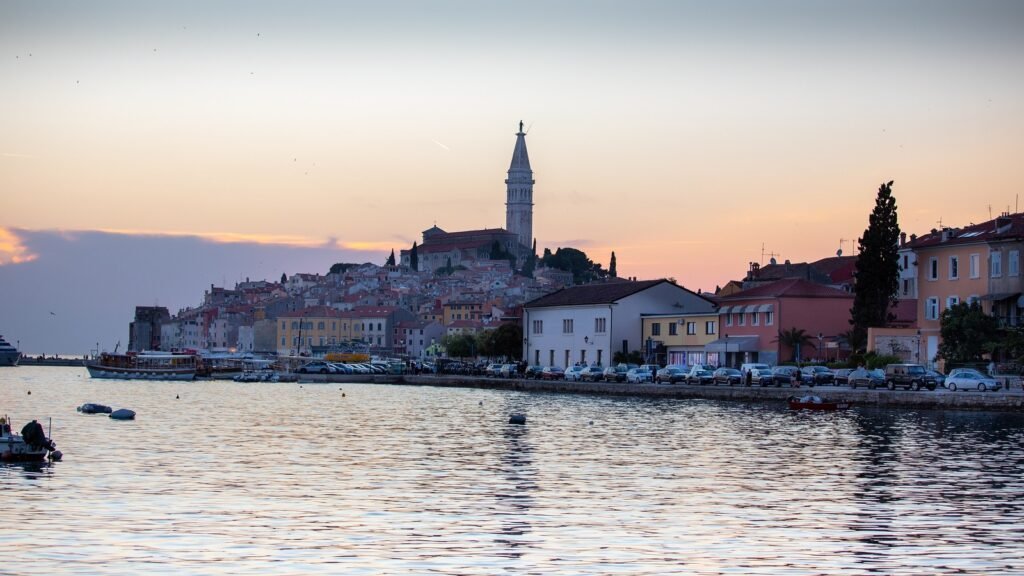
Istria. The northern peninsula is known for Roman remains in Pula, hill towns and the coastal town of Rovinj. UNESCO lists the Euphrasian Basilica in Poreč. Istria suits travelers who want food, wine and shorter drives.
Zadar and Šibenik. These two cities in northern Dalmatia are quieter bases than Split. UNESCO lists the Cathedral of St James in Šibenik, and both cities give access to nearby national parks and islands.
Split and Trogir. Split grew inside the Roman palace of Emperor Diocletian, which UNESCO inscribed in 1979 as the Historical Complex of Split. The small island town of Trogir, also on the UNESCO list, is a short trip away. Split is the main ferry port for the central islands.
The islands. Hvar, Brač, Vis and Korčula are the best-known central Dalmatian islands. UNESCO lists the Stari Grad Plain on Hvar. Our Croatia coastlines guide compares them.
Dubrovnik. The Old City of Dubrovnik, on the UNESCO list since 1979, is enclosed by stone walls that visitors can walk. It is the most crowded place in Croatia in summer, so early mornings and evenings are the best times in the old town.
How Many Days Do You Need?
In our view, a week suits Split, one island and Dubrovnik. Ten days allows Zagreb, Plitvice Lakes, Split and Dubrovnik at a comfortable pace, and two weeks lets you add Istria or more island time.
Our 10 day Croatia itinerary shows one north-to-south route. If you are weighing several countries, you may also want to read our Italy travel guide and Greece travel guide.
Getting Around Croatia
Croatia is long and narrow, so plan your route in one direction and fly into one city and out of another if you can.
Buses and trains. Buses link nearly every town and are the main public transport along the coast. The rail network is limited and does not reach Dubrovnik, so most visitors use buses or cars south of Split.
Ferries. Canadian advice says ferry services operate between the mainland and several islands of the Adriatic coast, particularly during summer. Timetables are thinner outside the season, so check schedules before fixing island nights.
Driving. Canadian advice says road conditions vary greatly, that roads in Istria and along the Adriatic coast can be congested, narrow and slippery when wet, and that many lack guard rails. A car is useful for Istria and Plitvice, and unnecessary in Split, Dubrovnik and on short island stays.
Taxis and ridesharing. Canadian advice says taxis are generally safe and ridesharing services are available. Use officially marked taxis or an app, and agree on the fare if there is no meter.
Costs and Money
Croatia uses the euro. We did not find an official source for typical daily costs, so this guide does not quote budgets. In general, Dubrovnik and Hvar are the most expensive places, the coast costs more than the interior, and prices rise sharply in July and August.
Cards are widely accepted, but carry some cash for small purchases, markets and island buses. Canadian advice says to avoid showing signs of affluence and carrying large sums of cash. Our money and budgeting guide explains how to plan costs.
Entry Rules and Documents
The rules below apply to Canadian, British, American and Australian passport holders visiting as tourists. Other passports differ, and our visa requirements guides cover each passport.
- Visa: Croatia is in the Schengen area. Canadian advice says no visa is needed for stays of up to 90 days in any 180-day period, and that stays in all Schengen countries count together. The FCDO says the same for British citizens.
- Passport: Canadian advice says your passport must be valid for at least three months beyond the date you expect to leave the Schengen area. The FCDO adds that it must have been issued less than 10 years before you arrive.
- Entry/Exit System: The EU’s Entry/Exit System registers your photo and fingerprints at the border. Canadian advice says you do not need to take any action before you travel, and the FCDO says to allow extra time at the border.
- ETIAS: The official EU website says ETIAS, a travel authorization for visa-exempt travelers, is currently not in operation and that no applications are being collected (checked 16 November 2026). Apply only through the official site once it starts.
- At the border: Canadian advice says officials may ask for a return or onward ticket and proof of funds. The FCDO adds proof of accommodation and travel insurance.
- Registration: Canadian advice says you must report your presence to local authorities within 48 hours of arrival. Hotels and other commercial accommodation generally do this for you, but check that it has been done.
Health and Natural Hazards
The emergency number is 112. The FCDO lists biting insects and ticks among the health risks, which matters for hikers in forests and parks. The US State Department says no vaccinations are required for entry.
Canadian advice says Croatia is in an active seismic zone and that even minor earthquakes can cause damage. It also lists wildfires, flooding and landslides. For mountain activities it advises never hiking alone, hiring a guide where needed and buying insurance that covers helicopter rescue.
Buy travel insurance before you go. Our safety and insurance guide explains what to look for.
Practical Details
Croatia is one hour ahead of Greenwich Mean Time in winter and two hours ahead in summer. The language is Croatian, and English is widely spoken in tourist areas. The FCDO says to always carry your passport, and to keep a copy of the photo page in a safe place.
Dress codes matter in old towns: cover up when you leave the beach, since swimwear in town centers can bring a fine in Split and Dubrovnik. Our packing guide covers what to bring, including water shoes for pebble beaches.
Suggested First-Time Itinerary
In our view, the simplest first route runs north to south: two nights in Zagreb, one at Plitvice Lakes, three in Split with a day trip to Trogir or Hvar, and three in Dubrovnik. Fly into Zagreb and out of Dubrovnik to avoid backtracking. The 10 day Croatia itinerary sets out each day.
Croatia Travel FAQ
Do I need a visa to visit Croatia?
Croatia is in the Schengen area. Canadian travel advice says Canadians do not need a visa for stays of up to 90 days in any 180-day period, counted across all Schengen countries, and GOV.UK says the same for British citizens. Canadian advice says your passport must be valid for at least three months beyond the date you expect to leave the Schengen area. Border officers register your photo and fingerprints under the EU’s Entry/Exit System, and you do not need to do anything before you travel. The official EU website says ETIAS, a planned travel authorization, is not yet in operation. Other nationalities have different rules, so confirm them with the Croatian authorities.
What is the best time to visit Croatia?
In our view, May, June and September are the best months for a first trip: the sea is warm enough for swimming from about June, ferries run full schedules and the old towns are less crowded than in July and August. Peak summer is the hottest, busiest and most expensive time on the coast. Spring and autumn suit Zagreb, Plitvice Lakes and Istria, while many island businesses close in winter.
How many days do you need in Croatia?
Ten days works well for a first trip that links Zagreb, Plitvice Lakes, Split and Dubrovnik in one direction. A week suits Split, one island and Dubrovnik, and two weeks lets you add Istria or more island time. Ferries run mainly in summer, so check schedules before fixing island nights.
Is Croatia safe for tourists?
The Government of Canada says to take normal security precautions in Croatia, its lowest level, and the UK, Australia and the United States also rate it at their lowest levels. Violent crime is low, while pickpocketing is common in tourist areas. The UK government warns of unexploded mines in some formerly war-affected areas outside the tourist resorts, so stay on marked paths, and says some town centers issue on-the-spot fines for walking in swimwear or drinking in public. Read the current advice before you go.
Do I need travel insurance for Croatia?
Yes, you should buy it. The UK government says border officers may ask for proof of travel insurance, and Canadian advice recommends insurance that includes helicopter rescue and medical evacuation if you hike in the mountains. Check that your policy covers boat trips and water sports if you plan them.
Final Thoughts on This Croatia Travel Guide
Croatia is one of the easier European countries to plan: low advisory levels, short distances and a clear coastal route. The work is in timing and booking. Avoid the peak weeks if you can, book ferries and Dubrovnik stays early, and keep to marked paths in the national parks and the interior.
For more, read our guides to what to eat in Croatia, Croatia culture and local customs and Croatia coastlines.