This South Africa travel guide is designed to help you decide where and when to go, how to move between Cape Town, the Garden Route, the safari regions and Johannesburg, and what the official safety and entry advice says before you book. South Africa rewards preparation. It offers some of the most varied scenery and wildlife anywhere, and it also asks visitors to take crime seriously, so we start with the facts.
South Africa sits at the southern tip of Africa, with the Atlantic Ocean on its west coast and the Indian Ocean on its east, and the government’s statistics agency estimates a mid-2024 population of about 63 million people, according to the South African government. UNESCO lists 12 World Heritage properties in South Africa, from Robben Island and the Cape Floral Region to the Maloti-Drakensberg Park, and most first trips link a few of them with a safari.
Three of the four governments we read, Canada, Australia and the United States, ask visitors to take more care in South Africa than in most countries, mainly because of violent crime. Most visits pass without trouble when travelers follow a few firm habits, and the sections below explain both the risks and those habits, with dates.
Is South Africa Right for Your Trip?
This South Africa travel guide suits travelers who want dramatic coastlines, mountains, wine regions, big-game safaris and a layered modern history in one trip. It works well for first-time visitors to Africa, because the main routes are well established, English is widely used in tourism, and good private hospitals and well-run lodges exist in the main destinations. In our view, it is one of the easiest African countries for a self-planned first trip, provided you plan around the safety advice.
South Africa may not be the right fit if you want to wander freely on foot at night, rely on public transport, or use rented cars without planning your routes. It is also not the place for a last-minute trip with no research. In our view, a first trip built around Cape Town, the Garden Route and a guided safari, with transport booked ahead and daylight travel, is the most comfortable way to start.
South Africa Safety: What Official Advisories Say
As of 25 November 2026, the advisories we read agree on the main risk, violent crime, but they use different levels. Advisories change, so read the current Canadian, British, Australian and American pages before you book.
Canada (updated 10 November 2026). The Government of Canada says to exercise a high degree of caution in South Africa due to the significant level of serious crime. It says violent crimes occur frequently, including armed robberies, home invasions, carjackings and assaults, and that city centres, townships and isolated areas are particularly affected, especially after dark.
Australia (updated 8 September 2026). Smartraveller advises Australians to exercise a high degree of caution in South Africa due to the threat of violent crime. It adds that protests and large gatherings can occur anywhere and become violent at short notice, and that Australians need to complete an online traveller declaration before travel.
United States (issued 27 May 2025). The State Department lists South Africa at Level 2, “Exercise increased caution,” because of crime, terrorism, unrest and kidnapping. It says violent crime is more common in the downtown areas of big cities, especially after dark.
United Kingdom (public update 5 November 2026). The FCDO page we read has no warning against travel to South Africa as a whole. It describes a high crime rate, says violent crime can take place anywhere, including tourist destinations and transport hubs, and says most violent crimes occur in townships, informal settlements and some city centres.
What the governments ask you to do. The advice is consistent. Do not display valuables, avoid walking in city centres and isolated places after dark, and avoid driving at night. Keep car doors locked and windows closed at junctions, use licensed or app-booked transport, and go to townships only with a reputable tour operator. If you are robbed, Canada says to comply and avoid resisting, and the FCDO warns that resisting can provoke a violent response.
Airports and roads. Canada and the FCDO both warn that travelers have been followed from airports and robbed. For Cape Town International Airport, both advise using the M3 and N2 rather than the R300, and staying on exit 16 of the N2 instead of Borcherds Quarry Road, which leads to the Nyanga township. Both warn about “smash and grab” thefts at traffic lights and about criminals posing as police, and say to continue to a police station or other safe place if you suspect a roadblock is not genuine.
Kidnapping and scams. Canada says kidnappings for ransom occur frequently, that express kidnappings (forced ATM withdrawals) occur regularly, and that victims have been lured through dating apps, with 2SLGBTQI+ people especially targeted. The FCDO and Smartraveller also warn about drink spiking, ATM and card fraud and romance scams. Use ATMs inside banks or malls, and never leave drinks unattended.
Hiking, parks and beaches. The FCDO and Canada report attacks and muggings on hikers in Table Mountain National Park, including Lion’s Head and Signal Hill. The FCDO advises staying on busy, marked trails and hiking in groups of four or more. Canada, the FCDO and Smartraveller advise avoiding the Numbi Gate entrance to Kruger National Park, and Canada and the FCDO advise using the N2 via Colchester, not the R335, to reach Addo Elephant National Park from Gqeberha.
Protests, terrorism and other points. Demonstrations can turn violent at short notice, and the FCDO and Canada describe anti-immigration marches and xenophobic violence, mainly targeting other African nationals. Canada and the FCDO say there is a threat of terrorism, with lone-actor attacks possible in public places. Canada says some countries have imposed measures because of an Ebola outbreak, and Smartraveller says travelers arriving from the Democratic Republic of Congo or Uganda must complete a health questionnaire, so check the current notes if your route touches those countries.
Best Time to Visit South Africa
South Africa’s seasons are the reverse of the Northern Hemisphere, with summer from about December to February and winter from about June to August. Canadian advice describes the pattern by region: Western Cape typically gets its heaviest rain between May and September, Gauteng and the Northwest Province have flash storms from November to April, and KwaZulu-Natal sees heavy rain from October to April, although flash floods are becoming more frequent outside those periods. The FCDO says there is a year-round flood risk. We did not find an official page with month-by-month temperatures, so the rest of this section is our view.
In our view, the shoulder months, roughly March to May and September to November, suit a first trip that combines Cape Town, the Garden Route and a safari, because the weather is mild and the biggest holiday crowds are away. Cape Town is at its driest and warmest in summer, which is also the peak season for the coast. Safari spotting is often easier in the drier winter months, when vegetation is thinner and animals gather at water, but check conditions with your lodge. Winter nights in the interior and at altitude are cold.
Canada also notes that El Niño conditions may raise the likelihood of drought, floods and storms in 2026 and 2027, and that wildfires are common in dry seasons, so check forecasts from the South African Weather Service before you travel.
Where to Go in South Africa
This part of the South Africa travel guide covers the regions most first-time visitors link, and we mention only what the sources we read describe.
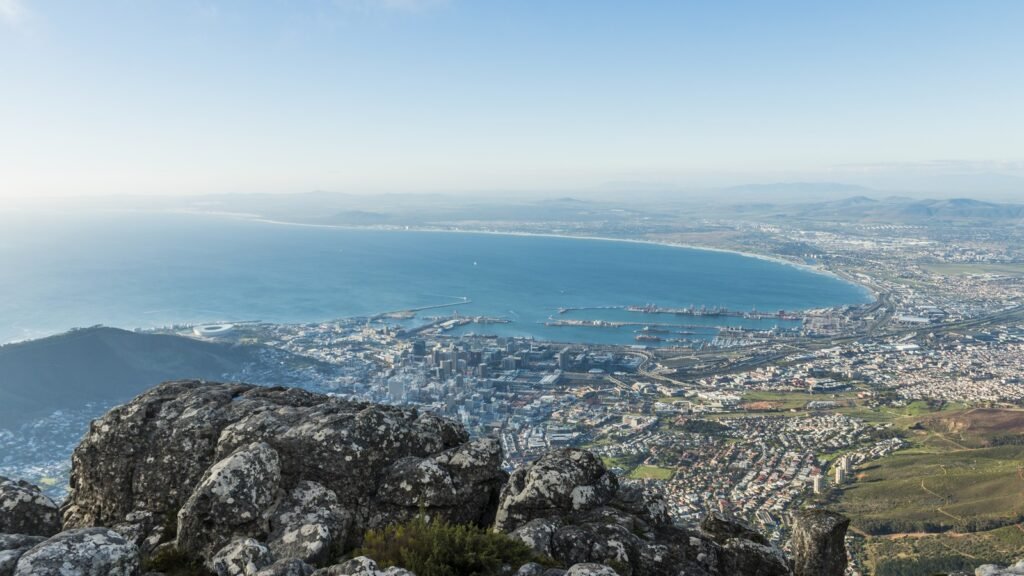
Cape Town and the Cape Peninsula. Most first trips start here. Table Mountain, the Atlantic coast, the V&A Waterfront and the Peninsula drive to Cape Point sit within reach of the city. UNESCO inscribed the Cape Floral Region Protected Areas in 2004 and calls the region one of the world’s great centres of terrestrial biodiversity. Read the hiking advice above before you set out on the mountain.
Robben Island. UNESCO says Robben Island was used between the 17th and 20th centuries as a prison, a hospital and a military base, and that its buildings, particularly the maximum security prison for political prisoners, witness the triumph of democracy and freedom over oppression and racism. The Robben Island Museum runs the visits, which are usually booked in advance, and weather can affect crossings.
The Winelands. Stellenbosch, Franschhoek and Paarl lie inland from Cape Town and make an easy one-night or day-trip addition. Do not drive after tastings, and use a driver or a tour, since Canada notes that drinking and driving is common on South African roads.
The Garden Route. This coastal stretch east of Cape Town takes in lagoons, forests and beaches around Knysna, Plettenberg Bay and Tsitsikamma. In our view, it is best done over two or three nights, with a rental car or private transfers and a daylight-only driving rule.
Kruger and the safari regions. Kruger National Park is the best-known safari area, and private reserves border it. Canada says to always stay in the vehicle unless a professional guide or warden says it is safe, to use only reputable guides and to avoid the Numbi Gate. Malaria occurs in some areas and seasons, so ask a travel clinic about medication about six weeks before you go.
Johannesburg and Pretoria. Most international flights land at OR Tambo International Airport. Canada says Johannesburg’s train station and surrounding area are dangerous, and the FCDO says the Gautrain between Johannesburg, Pretoria and OR Tambo is generally safer and more reliable. Visits to Soweto and other townships are best arranged through a reputable organised tour.
KwaZulu-Natal and the Drakensberg. Durban has the warm Indian Ocean coast. UNESCO describes the Maloti-Drakensberg Park as renowned for its spectacular natural landscape and its rock paintings made by the San people over about 4,000 years.
How Many Days You Need
Ten days is a good length for a first trip that links Cape Town, the Winelands, the Garden Route and a safari. Our 10 day South Africa itinerary sets this out day by day. A week works for Cape Town, the Winelands and a short Garden Route stay, or for Cape Town plus a safari with a domestic flight. Two weeks lets you add the Drakensberg or Durban and slow the pace. Distances are long, so plan fewer bases rather than more.
Getting Around South Africa
Flights. Domestic flights link Cape Town, Johannesburg, Durban, the Garden Route airports and the Kruger area, and are the practical choice for long distances. The FCDO notes delays at airports because of power outages, refuelling disruptions and immigration queues, so allow extra time and check airport updates.
Trains and buses. Canada and the FCDO say the Gautrain, the Blue Train, Rovos Rail and Shosholoza Meyl are safe and reliable options, and advise avoiding other rail services and public minibuses because of attacks, theft and accidents. The FCDO names the MyCiTi bus in central Cape Town and the Atlantic Seaboard as generally safer, and says not to take it to townships.
Taxis and ride-hailing. Canada and the FCDO advise using licensed taxis arranged through a reputable hotel or restaurant, or an established ride-hailing app booked through the app, and checking that the car and driver match what the app shows. Both warn about unlicensed drivers posing as app drivers at airports and about tensions between app and metered taxi drivers.
Driving. Traffic drives on the left, and Canada recommends getting an International Driving Permit before you leave because it cannot be obtained in South Africa. Canada advises avoiding driving after dark and the FCDO advises extra vigilance at night, and both say to keep doors locked and windows closed and to avoid stopping in isolated places. The FCDO says fatal road accidents are common, particularly around weekends and public holidays, and that pedestrian deaths account for many road deaths, so cross at marked crossings.
Costs and Money in South Africa
The currency is the South African rand (ZAR), according to Canada, which says Canadian currency can be exchanged at major banks and foreign exchange counters and that a passport is needed for exchange transactions. Canada and the FCDO say you must declare cash above ZAR 25,000 or the equivalent of USD 10,000 when entering. Cards are widely accepted in cities, but ATM and card fraud occur, so use machines inside banks or malls, cover the keypad and check your statements. Our guide to using money abroad covers cards, cash and fees in more detail.
We did not verify current prices, park fees or exchange rates, so check them close to your trip. In our view, safaris, domestic flights and guided experiences are the largest costs.
Entry Rules and Documents for South Africa
The governments we read agree on the basics for Canadian, British, American and Australian citizens. A tourist visa is not required for stays of up to 90 days, and the South African Department of Home Affairs lists all four countries on its visa-exempt list. Canada notes that officials stamp your passport and may grant fewer than 90 days, so check that the stamp matches your plans, and that overstaying can bring a ban of up to five years.
Canada and the FCDO say your passport must be valid for at least 30 days after the date you plan to leave South Africa and have at least two blank pages. Canada says you must also have a return or onward ticket.
Since 1 July 2026, everyone entering or leaving South Africa must submit an online traveller declaration, according to the FCDO. The South African Revenue Service explains the process in its traveller declaration FAQ. Complete it before you travel. Our passports, visas and entry requirements guide explains how to check rules for your own passport, and our visa requirements guides cover each country.
If you are traveling with children, there are extra requirements, and all four governments point to the Home Affairs website. Canada and the FCDO say a yellow fever certificate is needed only if you arrive from, or have transited through, a country with a risk of yellow fever.
Health and Natural Hazards
Health planning is a bigger part of this South Africa travel guide than for many destinations, mainly because of malaria in some safari areas and the cost of private care.
Canada recommends routine vaccines, hepatitis A and hepatitis B vaccination, and says there is a risk of malaria in certain areas and times of year, rabies, schistosomiasis in untreated freshwater and other insect-borne diseases. Smartraveller says HIV rates are high, that waterborne and foodborne diseases are widespread and that you should drink only boiled or bottled water.
Canada says good medical care is generally available only in major cities, where private hospitals are better equipped, and that air evacuation may be the only option in remote areas. Buy insurance that covers medical evacuation. Our travel insurance and safety guide explains what to look for.
For natural hazards, Canada and the FCDO describe heavy rain and flash floods, drought and water restrictions, and wildfires, including around Cape Town and Table Mountain. The FCDO says planned power cuts, known as load shedding, have fallen significantly, but cuts can still occur and affect shops, banks, ATMs, traffic lights and phone networks. Carry a power bank and ask your accommodation how it manages outages.
Practical Details for South Africa
Emergency numbers. Canada gives 10111 for police, 10177 for medical help and 10111 or 10112 from a mobile for fire. The FCDO gives 112 from a mobile for emergency services and +27 87 094 9774 for the sea rescue service (NSRI).
Sea and wildlife. Coastal waters can be dangerous even for experienced swimmers, and not all beaches are supervised. Swim only between the red and yellow flags and follow lifeguard instructions, as the FCDO advises. Around Cape Town, Shark Spotters runs a flag system, and its page says no flag means no spotter is on duty. Our South Africa coastlines guide covers beaches and sea safety.
Laws. The FCDO says same-sex sexual activity is legal and it is illegal to discriminate based on sexual orientation, that personal consumption of cannabis is considered legal while all other drug possession, use or smuggling is illegal, and that buying, selling or trading protected wildlife products, including ivory and rhino horn, is banned. Canada says to carry certified photocopies of your identification and keep your passport safe. Our guide to South Africa culture and local customs covers these points in more detail.
Eating and drinking. Our guide to what to eat in South Africa covers dishes, markets and wine regions. Smartraveller warns about drink spiking and methanol poisoning from alcoholic drinks, so buy drinks from reputable venues and keep them in sight.
Packing. Bring layers, because mornings and evenings can be cold even in summer, plus a sun hat, sunscreen, comfortable walking shoes and a power bank. Our packing guide has a full list.
Suggested First-Time Itinerary
For a first trip, we suggest flying into Cape Town and out of Johannesburg, so you do not backtrack. Spend three nights in Cape Town, one in the Winelands, two on the Garden Route and three in the Kruger area on a guided safari, then fly to Johannesburg for your flight home on day 10. Our 10 day South Africa itinerary sets this out day by day with backup plans.
South Africa Travel FAQ
Do I need a visa to visit South Africa?
Canada, the United Kingdom, the United States and Australia all say their citizens do not need a tourist visa for stays of up to 90 days, and the South African Department of Home Affairs lists all four countries as visa-exempt. Canada says officials stamp your passport and may grant fewer than 90 days, so check the stamp. Canada and the FCDO say your passport must be valid for at least 30 days after you leave and have at least 2 blank pages. Since 1 July 2026, everyone entering or leaving must also submit an online traveller declaration. Other nationalities have different rules, so confirm them with the South African authorities.
Is South Africa safe for tourists?
Most visits pass without serious trouble, but the governments ask for more care than in many countries. Canada and Australia advise a high degree of caution because of serious crime, the United States lists Level 2 for crime, terrorism, unrest and kidnapping, and the UK describes a high crime rate while not advising against travel to South Africa as a whole. The advice is consistent: avoid walking or driving after dark, use licensed or app-booked transport, keep valuables out of sight, and visit townships and parks only with reputable guides. Read the current advice before you go.
What is the best time to visit South Africa?
In our view, spring and autumn suit a first trip that combines Cape Town, the Garden Route and a safari, with the drier winter months often better for spotting wildlife. Canadian advice says the Western Cape typically gets its heaviest rain between May and September, Gauteng and the Northwest Province have flash storms from November to April, and KwaZulu-Natal has heavy rain from October to April. The seasons are the reverse of the Northern Hemisphere, so December to February is summer.
How many days do you need in South Africa?
Ten days works well for a first trip that links Cape Town, the Winelands, the Garden Route and a safari. A week suits Cape Town and the Winelands with a short Garden Route stay, or Cape Town plus a safari with a domestic flight, and two weeks lets you add the Drakensberg or Durban. Distances are long, so plan fewer bases.
Can I drive in South Africa?
Yes. Traffic drives on the left, and Canada recommends getting an International Driving Permit before you leave because it cannot be obtained in South Africa. Canada advises avoiding driving after dark, and both Canada and the FCDO advise keeping doors locked, windows closed at junctions and valuables out of sight. The FCDO says fatal road accidents are common, so many travelers prefer private transfers or domestic flights for long distances.
Final Thoughts on This South Africa Travel Guide
This South Africa travel guide comes down to three points. Read the current advisories for your country and take the crime warnings seriously without letting them stop you from planning. Move in daylight, use app-booked or licensed transport, and go to townships and parks with reputable guides. Complete the online traveller declaration and check your passport pages and validity before you fly.
For more planning, read our guides to what to eat in South Africa, South Africa culture and local customs and South Africa coastlines, and our travel insurance and safety guide. If you are comparing African trips, see our Morocco travel guide.