
This Ecuador travel guide is designed to help you decide whether, where and when to go, and to put the official safety advice in front of you early, because Ecuador is a country where you should read it before you book anything.
Ecuador sits on the equator, between Colombia and Peru, and packs four very different regions into a small area: the Andes, the Pacific coast, the Amazon and the Galápagos Islands. Ecuador Travel, the official tourism site, describes colonial cities, volcanoes, Indigenous markets, rainforest and an archipelago of wildlife found nowhere else. UNESCO lists five World Heritage properties in Ecuador: the cities of Quito and Cuenca, the Qhapaq Ñan Andean road system, the Galápagos Islands and Sangay National Park.
The main planning issues are safety, altitude, natural hazards and paperwork. Canadian, British and Australian advice all warn about crime and name areas to avoid, and Ecuador has declared a state of “internal armed conflict.” Many travelers still visit, especially the highlands and the Galápagos, which the governments treat differently from the coast and the Colombian border. The sections below set out what each government says, dated, so you can make your own decision.
Is Ecuador Right for Your Trip?
This Ecuador travel guide suits travelers who want a trip built around Andean highlands, colonial cities, Indigenous culture and wildlife, and who are comfortable doing more research and taking more precautions than they would in many other countries. Ecuador Travel describes Cuenca’s historic center, the Otavalo market, volcanoes such as Cotopaxi and Chimborazo, and the Galápagos as the main draws.
Ecuador may not be the right fit if you want a destination where official advisories are not part of your planning, if you cannot take time to acclimatize to high altitude, or if your insurer will not cover the areas you plan to visit. In our view, anyone who is unsure should read the safety section below first and decide before spending money on flights.
Ecuador Safety: What Official Advisories Say
As of early November 2026, the three advisories we could read in full agree on the broad picture, with differences in detail. Advisories change, so read the current versions of the Canadian, British and Australian pages before you book. The US State Department also publishes an advisory for Ecuador, which we could not read in full for this guide, so check its current level yourself.
Canada (updated 9 November 2026). The Government of Canada says to exercise a high degree of caution in Ecuador because of high levels of crime. It advises against all travel within 20 km of the Colombian border in Carchi (except the Pan-American Highway to the Tulcán crossing), Esmeraldas and Sucumbíos, and within 2 km of the Peruvian border in four Zamora-Chinchipe cantons because of landmines.
It advises against non-essential travel to Esmeraldas province, Machala and Huaquillas in El Oro, the cantons of Durán, Milagro, Naranjal and Yaguachi in Guayas, the part of Guayaquil canton east of the Guayas River and named districts of northern and southern Guayaquil, Babahoyo and Quevedo in Los Ríos, Manta and Portoviejo in Manabí, and La Libertad and Santa Elena in Santa Elena province.
For the Galápagos, Canadian advice says to take normal security precautions.
United Kingdom (updated 1 November 2026). The FCDO advises against all but essential travel to the Coastal Region provinces of Esmeraldas, Manabí, Santa Elena, Guayas, El Oro, Los Ríos and Santo Domingo de los Tsáchilas, and to areas within 20 km of the Colombian border, with limited exceptions. Airside transit at Guayaquil airport is excepted. It also says your travel insurance could be invalidated if you travel against FCDO advice, so check your policy.
Australia (updated 23 June 2026). Smartraveller says to exercise a high degree of caution overall, not to travel within 20 km of the Colombian border except at Tulcán, and to reconsider your need to travel to Sucumbíos, Esmeraldas and Guayaquil. It says to exercise normal safety precautions in the Galápagos. It also says tourists are not typically the main targets but that criminal groups have used targeted killings, express kidnappings, armed robberies, extortion and bomb attacks in public places.
State of exception and armed conflict. Canadian advice says a state of exception applies in several provinces, including Pichincha, where Quito is, and Guayas, where Guayaquil is. It lets security forces enter homes, search, read private mail and ban gatherings, so expect an increased police and military presence and carry identification at all times. The same advice says Ecuador is in a state of “internal armed conflict.” The FCDO describes a 60-day state of emergency from 15 September in eight provinces and a car bomb in northern Guayaquil on 14 October 2025.
Crime. Canadian advice says petty crime happens daily in major cities, often by teams who distract victims, and that tourists have been assaulted in downtown areas, on hiking trails, at beaches and in public parks. It reports express kidnappings, sometimes involving taxi or ride-share drivers, and warns about scopolamine, a drug used to incapacitate victims. The FCDO says mugging and pickpocketing are common, so take care in Quito’s old town and at transport hubs.
Practical steps. Both governments recommend official taxis only. Canada says to use taxis with orange plates and not to hail them on the street, and the FCDO says to book through your hotel or a known radio-dispatched service. Canada advises avoiding local and intercity buses, avoiding travel after dark and in isolated areas, withdrawing cash carefully, and handing over valuables without resistance if threatened. Foreigners may not take part in political activities, so avoid demonstrations.
Best Time to Visit Ecuador
Ecuador Travel says the country can be visited year-round, with seasons that depend on the region. For the Andes it gives June to September as the dry season, with clear skies that suit volcano visits and trekking. For the coast it says December to May brings full sun and warm seas, while June to September is cooler with humpback whales. For the Amazon it says December to March is drier, which makes river travel and hikes easier. For the Galápagos it says June to November has cooler water and more marine life, and December to May has warm water that suits snorkeling.
Timing also depends on hazards. Canadian advice says the rainy season runs from December to May, when flooding and landslides can close roads. It says El Niño may bring heavy rainfall, flooding and landslides, typically from October to May, and the FCDO says the Ecuadorian authorities have issued a red alert for the 2026-2027 El Niño. Canadian advice adds that wildfires are common from June to September. In our view, June to September is the simplest window for a first highlands trip.
Where to Go in Ecuador
Most first trips combine two or three of these regions. Always check the safety section above against your route.
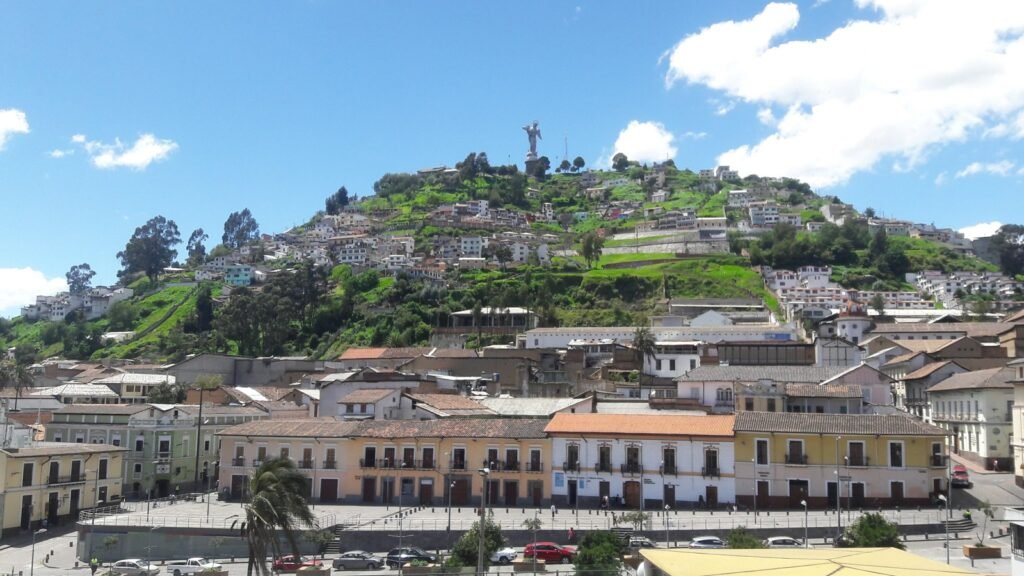
Quito and the highlands. Quito’s historic center was inscribed by UNESCO in 1978. Ecuador Travel’s Andes guide lists the old town’s heritage churches, museums, El Panecillo viewpoint and the TeleferiQo cable car, and says Quito and the highlands sit above 2,800 m. It suggests exploring the old town with local guides. Ecuador Travel also lists Otavalo’s Plaza de los Ponchos market and Cotopaxi’s refuge treks among the highland activities.
Cuenca. Cuenca’s historic center is a UNESCO site, and Ecuador Travel describes a valley city crossed by four rivers, known for toquilla straw (Panama) hat workshops. Cajas National Park nearby has changeable weather, so Ecuador Travel says to bring a rain jacket and warm layers even on sunny days.
Other highland stops. Ecuador Travel also names Baños, with thermal baths and adventure sports, the cloud forest of Mindo for birdwatching, and Riobamba, below Chimborazo, whose summit it gives as 6,263 m. Chimborazo needs prior acclimatization and mountain guides. Canadian advice names volcanoes near Baños and Riobamba among those authorities monitor.
The Amazon. Ecuador Travel describes Yasuní National Park, Tena and Misahuallí, Puyo and the Cuyabeno Reserve, and says to visit Yasuní only with authorized operators and lodges. Canadian advice says some Indigenous groups require permits to enter their territory. Because the advisories name Sucumbíos and the Colombian border area, check them carefully before considering the northern Amazon.
The Galápagos. Ecuador Travel says the national park covers 13 main volcanic islands about 1,000 km from the mainland, with 97 percent of the area protected. It describes Santa Cruz as a base for reaching other islands, San Cristóbal for its airport, and Isabela for volcano hikes and snorkeling. Heavy rain flooded Santa Cruz in late 2026, as the hazards and itinerary sections explain.
The Pacific coast. Ecuador Travel describes Guayaquil as the main gateway, the Spondylus Route, Puerto López and Machalilla National Park for whales, Montañita, Salinas and Esmeraldas. All of these lie in provinces named in the advisories above. This guide does not recommend a mainland coast route, and our Ecuador coastlines guide explains what the governments say.
How Many Days Do You Need?
In our view, a week suits Quito with day trips, or Quito and Cuenca. Ten days allows Quito, Cuenca and a short Galápagos stay if you accept several flights, and two weeks lets you add the Amazon or more islands.
Our 10 day Ecuador itinerary shows one route that stays out of every area named in the advisories. If you are weighing several South American countries, you may also want to read our Peru travel guide and Colombia travel guide.
Getting Around Ecuador
Flights. Galápagos flights leave from Quito or Guayaquil, and Canadian advice says the Transit Control Card counters are at those two airports. The FCDO says there are authorized taxi booths at Quito and Guayaquil international airports. If you connect through Guayaquil, check with your airline before booking that you stay airside, which is the one exception the FCDO makes for Guayas province.
Taxis and ride apps. Canadian advice says taxis are generally safe in the daytime, that ride-sharing apps are popular and usually a safe option, and that assaults and express kidnappings have happened at night. The FCDO says taxi apps provide driver details but are unregulated, so book through your hotel or a known service. Both say not to share taxis with strangers.
Buses. Canadian advice says many buses are poorly maintained and overcrowded, drivers are reckless, and robberies occur regularly, especially around Guayaquil. It advises avoiding local and intercity buses. In our view, that makes flights, hotel-arranged transfers and licensed tour operators the better choices.
Driving. The FCDO says Ecuador has one of the highest road accident rates in Latin America and that heavy rain and mudslides often close roads. Canadian advice lists unmarked speed bumps, potholes, poorly maintained vehicles and drink-driving, and advises not to drive alone or at night. The CDC says to avoid motorbike taxis and night driving and to wear a seat belt.
Costs and Money
Canadian advice says the currency of Ecuador is the US dollar and that credit cards are accepted by many businesses. It advises having small bills ready for taxis. Both Canada and the FCDO warn about ATM robberies and card fraud: Canadian advice recommends ATMs in well-lit public areas or inside a bank, and the FCDO suggests ATMs inside banks or shopping centers and avoiding withdrawals after dark.
Prices change, so this guide does not quote them. Check current prices with operators, airlines and parks, and see our travel budgeting guide. Our flights and transportation guide has general tips for booking.
Food and Dining
Ecuador’s food varies by region. Ecuador Travel’s food page describes encebollado, a coastal fish soup, ceviche, fanesca, a thick soup tied to Holy Week, locro de papa, a potato and cheese soup, and drinks such as colada morada and canelazo. Our guide to what to eat in Ecuador explains the dishes and markets, and our food and dining guide has general tips for eating well while traveling. The health section below covers water and food safety.
Entry Rules and Documents
Visas and passports. Canadian advice says a tourist visa is not required for stays up to 90 days per period of 12 months and that a regular Canadian passport must be valid for at least six months beyond the date you expect to leave. The FCDO says British citizens can visit for up to 90 days in any 12-month period and that the passport’s expiry date must be at least six months after arrival. Other passports have different rules, so see our visa requirements guide.
Entry stamp and onward travel. Canadian advice says to make sure your passport is stamped on arrival, because travelers who skipped the stamp at a land border have had to return to it before leaving. The FCDO says border officers may ask for your reason for travel and proof of a return or onward journey. Canadian advice says you can extend your stay once by 90 days, and that overstaying can bring fines and a one-year entry ban.
Land borders. Canadian advice says most land crossings with Colombia and Peru are closed, with only Rumichaca on the Colombian border and the Pan-American Highway crossing near Huaquillas open on its list. It says that if you enter by land or river from Colombia or Peru, you must show an apostilled criminal record check from your home country covering five years. We do not promote overland routes.
Yellow fever. Canadian advice says proof of vaccination is required if you arrive from, or transit through, the Democratic Republic of the Congo or Uganda, while the CDC lists different entry requirements for travelers who have recently been in several South American countries. Because the two sources differ, check with the Ecuadorian authorities and a travel health clinic.
Galápagos and Indigenous territory. Canadian advice says to enter the Galápagos you need identification, the Galápagos Transit Control Card bought at the Governing Council counter at the Quito or Guayaquil airport, and a return ticket, and that tourists can stay a maximum of 60 days in one year. The Galápagos Governing Council and the national park directorate publish current fees, which change, so read them before you go.
Health, Altitude and Natural Hazards
Altitude. Ecuador Travel says Quito and the highlands sit above 2,800 m and advises drinking plenty of fluids, resting on your first day and easing into the altitude. The FCDO says altitude sickness is a risk in parts of Ecuador and that ultraviolet radiation is a risk.
Health. The CDC (reviewed 3 September 2026) recommends routine vaccines and hepatitis A, and recommends yellow fever vaccination for travelers going to areas below 2,300 m east of the Andes, such as Napo, Orellana and Pastaza. It says yellow fever vaccination is not recommended in Quito, Guayaquil or the Galápagos, and that there is no malaria transmission in those places. Canadian advice added a dengue notice on 2 November, and the CDC says to prevent mosquito bites.
Food and water. The FCDO says to drink boiled, filtered or bottled water and avoid ice in drinks. Canadian advice warns that drinks and snacks from strangers can be drugged, so never leave food or drinks unattended.
Volcanoes and earthquakes. Canadian advice lists eight active volcanoes that authorities watch closely, including Cotopaxi, Guagua Pichincha and Sangay, and says access to Cotopaxi National Park can be restricted at any time without notice. It says ash can disrupt flights and highways. It also says Ecuador is in an active seismic zone, where a tsunami can follow a nearby earthquake within minutes.
Floods and landslides. Canadian advice says seasonal flooding from December to May can make roads impassable, and the FCDO says landslides are common. The FCDO says flooding on Santa Cruz in the Galápagos led the islands’ government to declare an emergency on 31 October, with road closures, power outages and disruption to travel to Baltra airport. The Canadian page, updated on 9 November, no longer lists a flooding notice.
Practical Details
Emergencies and insurance. Canadian advice says to call 911 to report incidents to the National Police, and the FCDO refers to the ECU 911 emergency service. Buy travel insurance that covers altitude and adventure activities and check it against government advice. Our safety and insurance guide explains what to look for.
Power. Ecuador uses 120 volts at 60 Hz with Type A and B plugs, so most North American devices work without an adapter. Travelers from the UK and Europe need an adapter and should check their devices’ voltage.
Suggested First-Time Ecuador Itinerary
If you have 10 days, a workable first-time route is Quito, Cuenca and the Galápagos. It uses three bases and several flights, so it is fast-paced, and it stays out of every area named in the advisories above.
Days 1 to 3: Quito. Rest on the first day, then see the old town with a local guide and make a day trip to Otavalo or Cotopaxi if the park is open.
Days 4 and 5: Cuenca. Fly from Quito, see the historic center and Cajas National Park.
Days 6 to 10: Galápagos and departure. Return to Quito, fly to the islands, and keep a flexible plan because flooding on Santa Cruz has disrupted roads and flights this season.
With a week, choose Quito and Cuenca. With 14 days, add the Amazon or more islands rather than more stops. Our full 10 day Ecuador itinerary has the day-by-day plan.
Ecuador Travel FAQ
Do I need a visa to visit Ecuador?
Canadian travel advice says a tourist visa is not required for stays up to 90 days per period of 12 months and that a regular Canadian passport must be valid for at least six months beyond the date you expect to leave. GOV.UK gives British citizens the same 90 days in any 12-month period and says the passport’s expiry date must be at least six months after arrival. Canadian advice says to make sure your passport is stamped on arrival, because travelers without an entry stamp have had trouble leaving, and that if you enter by land or river from Colombia or Peru you must show an apostilled criminal record check covering five years. Border officers may ask for proof of onward travel. Other nationalities have different rules, so confirm them with the Ecuadorian authorities.
What is the best time to visit Ecuador?
It depends on the region. Ecuador Travel says the Andes are driest from June to September, the coast has full sun and warm seas from December to May, the Amazon is drier from December to March, and the Galápagos have cooler water from June to November and warm water from December to May. Canadian advice says the rainy season runs from December to May, when floods and landslides can close roads, and that El Niño may bring heavy rainfall, flooding and landslides, typically from October to May. Check the forecasts of Ecuador’s national weather service before you commit to dates.
How many days do you need in Ecuador?
Ten days works for a first trip that links Quito, Cuenca and a short Galápagos stay, but it is fast-paced, with four domestic flights. A week suits Quito and Cuenca, and two weeks lets you add the Amazon with an authorized operator or more time in the islands. Because Canadian advice says to avoid intercity buses, flights and hotel-arranged transfers are the practical choices, which also affects how many bases you can fit in.
Is Ecuador safe for tourists?
Ecuador carries more official warnings than many first-time destinations. The Government of Canada says to exercise a high degree of caution because of high levels of crime and names areas to avoid, the UK government advises against all but essential travel to the whole Coastal Region and the Colombian border area, and Smartraveller says to exercise a high degree of caution and to reconsider travel to Guayaquil and two provinces. A state of exception applies in several provinces, including Quito’s, and Ecuador is in a state of internal armed conflict. Canada and Australia say to take normal precautions in the Galápagos. In our view, most visitors reduce risk by staying in the highlands and islands, using official taxis and licensed operators, and buying insurance. Read the current advice before you go.
Do I need travel insurance for Ecuador?
Yes, you should buy it. The UK government says your travel insurance could be invalidated if you travel against its advice, so check your policy against the areas you plan to visit. The CDC recommends travel health and medical evacuation insurance, and Canadian advice warns about altitude, floods and natural hazards. Check that your policy covers high altitude and any adventure activities you plan, and carry your insurer’s emergency number.
Final Thoughts on This Ecuador Travel Guide
Ecuador rewards travelers who plan around safety, altitude and weather, and who accept that some of the country is better left for another trip. A first visit works best as a short, careful introduction rather than an attempt to see everything.
For a first visit, check each government’s current advice, confirm that your insurance covers your route, use official taxis and licensed operators, keep your passport stamped and copied, and give yourself time to adjust to altitude. Respect the land, the parks and the communities you visit.
Use this Ecuador travel guide as a starting point, then adjust the route to match your time and comfort level. For more help, see how to plan a better trip.
If you are thinking of combining Ecuador with a neighboring country, read our Peru travel guide and Colombia travel guide, and note that the Canadian page says most land borders are closed. You may also want our Chile travel guide.
Explore more destination guides on TravelingInformed.